

The most common advice about Pokémon booster boxes is wrong in the way that matters most. People talk as if the box is priced by pull rates alone, but the market doesn’t reward packs in the abstract. It prices sealed inventory, the likelihood of future scarcity, and the convenience premium that buyers pay to avoid hunting singles one card at a time.
That’s why pokemon booster box value is really a sealed-product problem, not just a pull-rate problem. Once a box is opened, the sealed supply is gone forever, and that permanent reduction changes how collectors and vendors think about the asset. The market keeps revaluing sealed product because the box itself becomes scarcer, even when the immediate singles inside are ordinary.
Table of Contents
Why Pull Rates Do Not Determine Booster Box Value
Pull rates matter most to the person opening the box. They do not fully set what a sealed box trades for in the market.
Sealed product is priced differently from singles
Sealed pricing follows scarcity and collector behavior, not just card odds. A market-history discussion showed sealed box values rising sharply from an October 2023 reference point to about $23.44 at the time of the video, a move that reflects tightening supply and stronger demand for the sealed object itself, not a sudden improvement in average pack contents (market-history discussion).
Practical rule: once enough boxes have been opened, the remaining sealed copies can matter more than the cards inside.
That is why booster box value behaves like an asset price. Every box that gets cracked removes one more sealed unit from the pool, and the market never gets that specific copy back. The top singles can beat the box on upside inside an open case, but a sealed box serves a different function. It gives buyers exposure to the set without forcing them to take concentration risk in one card.
The market watches sealed stock, not just hit lists
The same market-history discussion compared box pricing with singles and noted that the top 20 singles were 249% more valuable than the booster box benchmark. That gap matters because it shows how easily chase-card excitement can outrun sealed pricing (same market-history discussion). A sealed box does not need to match the singles chart to hold value. It only needs enough collector demand to keep a premium over its opening value.
For vendors, that creates a clear ranking. Singles answer the question, “What can I pull right now?” Sealed boxes answer a different question, “How much unopened supply is still left?” Over longer holding periods, the second question often carries more weight.
Public price history also shapes valuation. Reliable records for older booster boxes are limited, especially for vintage product, and collectors often have to reconstruct the market from sold listings and archived marketplace data. A Reddit discussion on past booster pricing reflects that problem of thin history and partial records (market-history discussion). When the record is incomplete, surviving sealed copies become the anchor, especially for eras where unopened supply has already contracted hard.
Expected Value and the Math Behind Opening a Box
Opening a box is a math problem before it’s an experience. If the expected singles value inside is below the box price, the buyer is paying a premium for the thrill of opening, not for positive financial return.
The basic EV calculation
The formula is straightforward, EV = Σ(Pull Rate x Card Value). You multiply each outcome by its probability, add them together, and compare that result with the box’s cost. The infographic below lays out that logic visually.
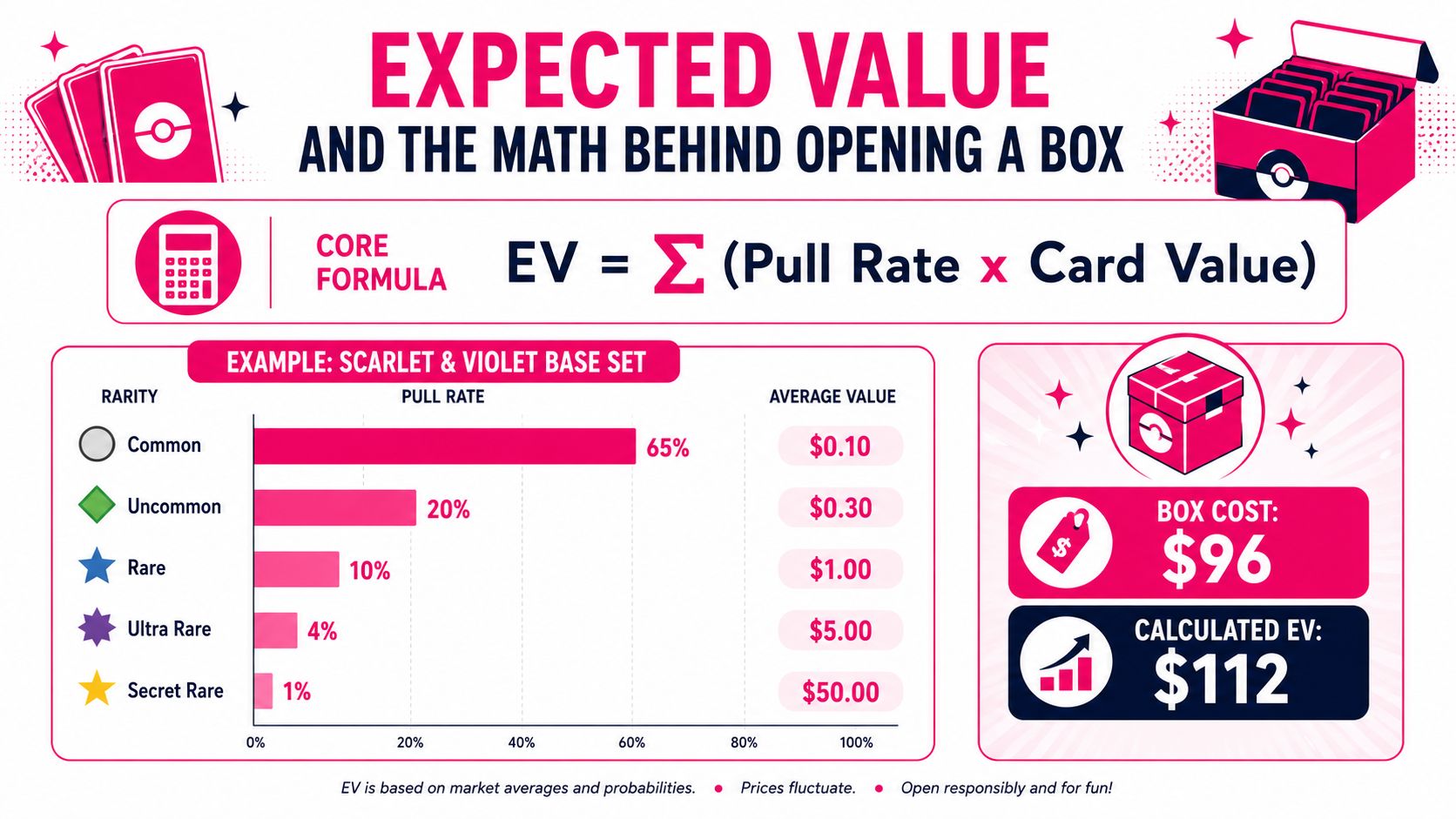
The key point isn’t that every box has the same result. It’s that the distribution is asymmetric. Most boxes deliver ordinary returns, a small number deliver strong hits, and the rare chase box creates the headline. That’s why EV, not anecdotal luck, should drive opening decisions.
Why most modern boxes are negative-EV to open
When a box prices above its raw contents, the premium usually reflects three things. First, buyers are paying for the chance to hit. Second, they’re paying for the convenience of not sourcing each card individually. Third, they’re paying for sealed scarcity, which is a separate market premium from singles value.
Bottom line: if the sealed price is above expected singles value, the box is already carrying the market’s optimism.
That’s also why vendors treat opening as inventory conversion, not profit creation. The singles inside may be liquid, but they rarely add up to a clean edge unless the set has unusual chase concentration or temporary price dislocations. For everyone else, the sealed box is the asset, and opening it is the event.
Set Demand and Chase Card Concentration
Not every set develops the same valuation pattern. Some boxes appreciate because demand is broad, while others hold value because one or two cards dominate the singles market.
Balanced sets versus chase-heavy sets
A balanced set spreads value across many cards, which lowers the odds that one pull will completely distort expected returns. A chase-heavy set concentrates value into a small number of cards, which can push short-term singles pricing much higher even if the average box still isn’t a strong opening bet. That difference matters because the market doesn’t reward “good pulls” equally, it rewards sets where enough buyers want enough cards for long enough.
The source material points to Scarlet & Violet 151 as an outlier with much higher expected singles value than typical releases (box-pricing explanation). That kind of set matters because it changes the discussion from “Is this box worth opening?” to “How concentrated is the upside, and who is competing for it?” A chase set can support both strong sealed demand and strong singles demand at the same time.
What actually supports sealed demand
Set-level demand has three main drivers. Collector nostalgia pulls in buyers who want the set itself. Competitive relevance keeps certain cards in circulation longer. Chase concentration creates attention, and attention supports liquidity.
Here’s the practical lens serious buyers use:
-
Broad nostalgia: sets with strong character or anniversary appeal often attract collectors who don’t care about perfect EV.
-
Playable cards: cards used in decks keep the set visible beyond the first hype window.
-
Concentrated hits: when most of the value sits in a few cards, sealed openings feel more dramatic, which can boost demand for the box even if EV remains poor.
The important nuance is that sealed appreciation doesn’t require a perfect opening profile. It requires enough people wanting sealed copies later, after many other buyers have already opened theirs. That’s why some sets with mediocre opening math still become attractive sealed holds.
Buyers rarely pay sealed premiums because the box is mathematically efficient to open. They pay because enough other people will want the same sealed box later.
Sealed Condition Premiums and Supply Contraction
Sealed box pricing changes for a different reason than opening value does. Once a set leaves active circulation, the market stops treating the box as a container of pack EV and starts pricing the shrinking pool of unopened inventory itself. That shift is supply contraction, and it is the main reason sealed premiums expand over time.
Why age changes the pricing model
Historical sealed-box analysis shows a clear timing effect. After a set has been out of rotation for roughly 5 years, box prices tend to track the set’s total single-card value more closely. By the 8–10 year range, some eras trade at about 2× total set value, and in certain cases such as FlashFire, closer to 3× (historical sealed-box analysis). The math behind that premium is straightforward. The box is no longer valued mainly for what it may contain, it is valued for how few untouched examples are still available.
That creates a different pricing ladder than the one used for fresh product. Every box opened reduces the future sealed pool. Over time, repeated openings thin the supply faster than new collectors can replace it, and the remaining sealed copies start trading on scarcity instead of expected contents. The market then assigns a premium to the unopened box because it is one of the few remaining claims on a finite piece of product history.
Why supply contraction matters more than nostalgia
The cleanest way to see this is by looking at the timeline of contraction rather than a broad vintage story. Early in a set’s life, boxes still move close to ordinary product logic. Later, after years of openings and attrition, the sealed supply becomes fragmented enough that price behavior changes. That is the point where sealed copies start to separate from raw set value and move on their own curve.
The premium is not random. It reflects how many boxes survive long after the set’s release window has passed. As unopened inventory gets thinner, serious buyers are forced to compete for fewer copies, and sellers can ask more for pristine condition. That premium can appear even when opening the box remains a poor proposition.
What the historical multipliers imply for collectors
Those historical multipliers show that sealed appreciation is a waiting game, not a pull-rate story. A modern box can still be negative-EV to open while the sealed version gradually strengthens as an asset. The contradiction is real, and it is exactly why opening math and sealed valuation cannot be treated as the same problem.
The strongest takeaway is timing. As a set ages, the market stops comparing the box only to its contents and starts comparing it to the remaining stock of unopened boxes. That is why later-era sealed product can start cheap relative to singles, then climb as available inventory narrows and replacement supply dries up.
Public pricing records are often incomplete outside recent product cycles, so valuation has to rely on sold listings, archived market references, and collector discussion, including market-history discussion. That imperfect record does not weaken the supply-contraction thesis. It explains why sealed examples with clean condition and proven authenticity keep attracting a premium, even when the opening math no longer justifies cracking the box.
Resale Channels and Fee Structures
Where you sell matters almost as much as what you sell. Fees eat a real chunk of proceeds, and on sealed product that spread can decide whether a sale feels clean or disappointing.
Fee comparison across major channels
| Platform | Standard Seller Fee | Premium Seller Fee | Net on $200 Box Sale |
|---|---|---|---|
| eBay | 12.9% | N/A | $174.20 |
| TCGPlayer | 10.75% | N/A | $178.50 |
| Double Holo | 4.9% + 2.9% and $0.50 processing | 4.7% + 2.9% and $0.50 processing | $183.90 |
The gap is obvious. On a $200 box sale, the listed fees alone leave materially different net outcomes. eBay lists the highest headline rate of the three, TCGPlayer sits in the middle, and Double Holo’s total fee load, including its 2.9% + $0.50 card processing fee, is the lowest in the data provided.
What the numbers mean in practice
Fees are only one part of the decision. eBay gives sellers broad reach and familiar buyer behavior at a higher fee rate. TCGPlayer is embedded in the card market with a mid-range fee rate. Double Holo’s lower fee structure preserves more margin, which matters more as the box value rises and shipping costs stay fixed.
For sealed boxes, the seller should also think about dispute risk and liquidity. Larger marketplaces often move inventory faster; weigh that speed against each platform’s fee load. Lower-fee channels help most when the box is expensive enough that a percentage-based fee becomes painful.
Practical rule: sell through the channel that keeps the most money after fees, not the one with the loudest audience.
That rule sounds obvious, but sellers violate it constantly. They optimize for exposure and ignore retention. In a market where sealed product already carries a premium, preserving more of the gross sale often matters more than chasing the broadest possible listing pool.
When to Hold, Sell, or Open Your Booster Boxes
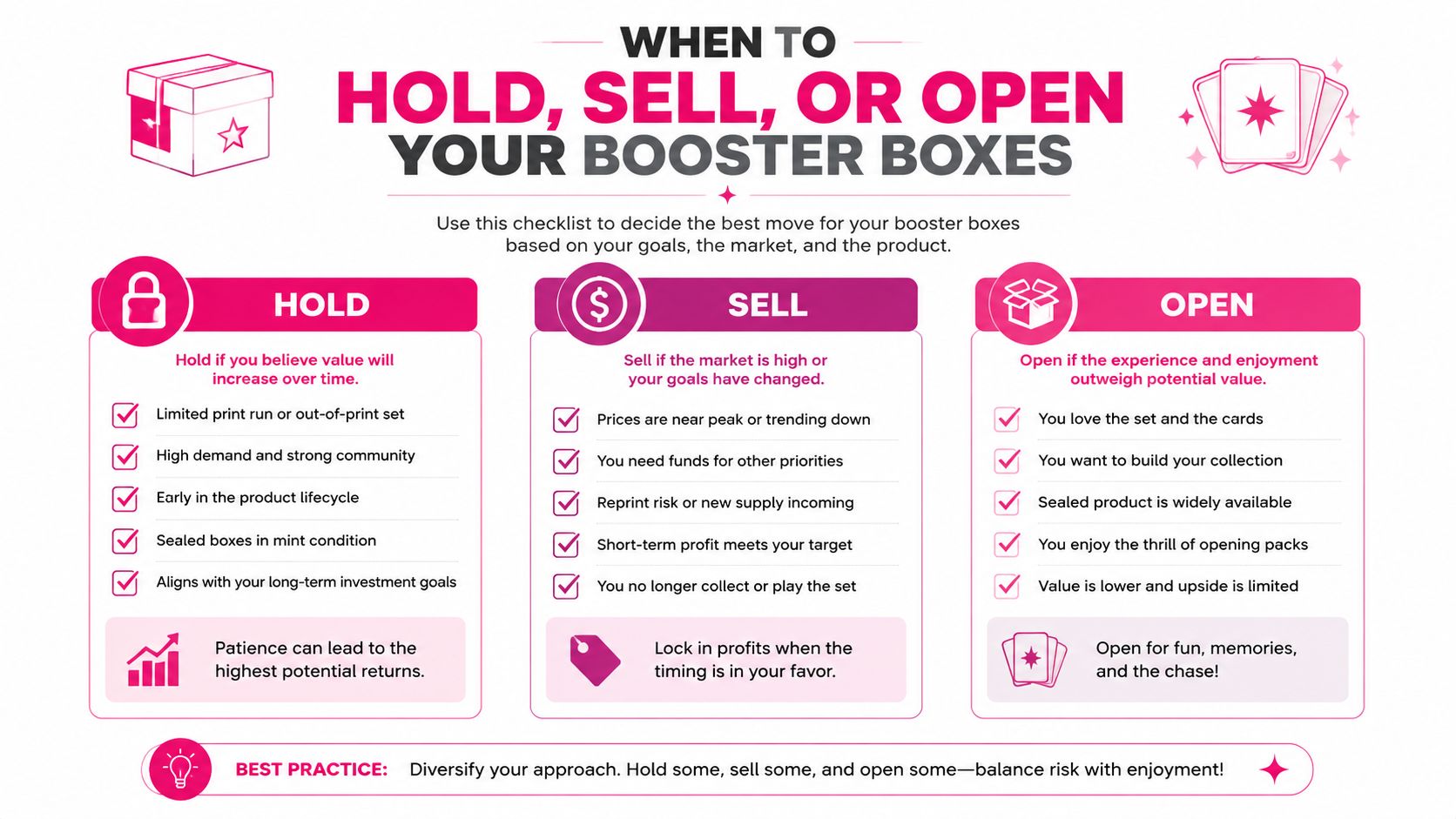
The right move depends on what kind of value you’re trying to capture. Sealed boxes can be held for scarcity, sold into current demand, or opened for entertainment and selective singles exposure.
Hold sealed when scarcity is the thesis
Hold when the box belongs to a scarcer era, especially if the set has already been out of rotation long enough for sealed inventory to contract. That’s where the historical evidence is strongest. Vintage and first-generation boxes benefit from survivorship, and the market pays for the fact that untouched copies are harder to find every year.
Sell when current demand is unusually strong and the market is already pricing in the story. That’s often the best choice for vendors who need cash flow or want to rotate capital into newer opportunities. If a box has already attracted attention from collectors and the premium looks stretched relative to its set profile, taking profits can be the rational move.
Open only when the non-financial upside matters
Opening is hardest to justify financially because the box is usually priced above its expected singles value. The rare exceptions are personal collecting goals, set completion, gifting, or a temporary mismatch between sealed price and singles pricing. If you want a specific chase card, buying the single is usually cleaner. If you want the experience, sealed is the correct format, but you should treat it as paid entertainment.
The infographic below gives a simple decision frame.
Using Market Intelligence to Track Box Values
Manual tracking breaks down fast once you watch more than a few sets. Price discovery moves across sealed boxes, singles, and graded cards at different speeds, and the person who spots the gap first usually has the better trade.
What to monitor daily
The cleanest setup is one that watches sealed price, single-card comps, and recent sale distribution at the same time. That gives you the context to tell whether a box is drifting toward a sealed premium, whether chase cards are inflating EV, or whether the market has overreacted to short-term hype.
For collectors and vendors who want more structure, Double Holo’s market intelligence suite bundles daily AI buy, sell, and hold picks, 24/7 market alerts for underpriced listings and arbitrage, professional charting with RSI, MACD, Bollinger Bands, and volume, plus Pack Value EV analysis for opening decisions. It also includes sales histograms and true market ranges, which matter because sealed product often gets mispriced when people anchor to a single recent sale instead of the broader distribution.
How to apply the framework
Use EV tools when the question is whether to open. Use sales histograms when the question is whether a listed sealed price is fair. Use alerts when you need to catch dislocations before they disappear. Those three habits cover most of the market inefficiency that serious collectors and vendors face.
A good workflow looks like this:
-
Check EV first: confirm whether the set’s opening math supports ripping or argues for holding sealed.
-
Compare sale ranges: avoid pricing off one outlier transaction.
-
Watch alerts daily: sealed opportunities often show up when a listing is misclassified or underpriced.
-
Revisit the thesis: chase-card concentration, supply contraction, and resale fees can change the answer over time.
The person who wins in this market isn’t the one who knows every set by memory. It’s the one who can separate opened value from sealed scarcity, then act before the gap closes.
If you want a cleaner way to evaluate pokemon booster box value, price sealed inventory, and decide when to hold versus sell, visit Double Holo. Its marketplace and market intelligence tools are built for collectors and vendors who want real pricing context, better fee control, and faster decisions on sealed product.