

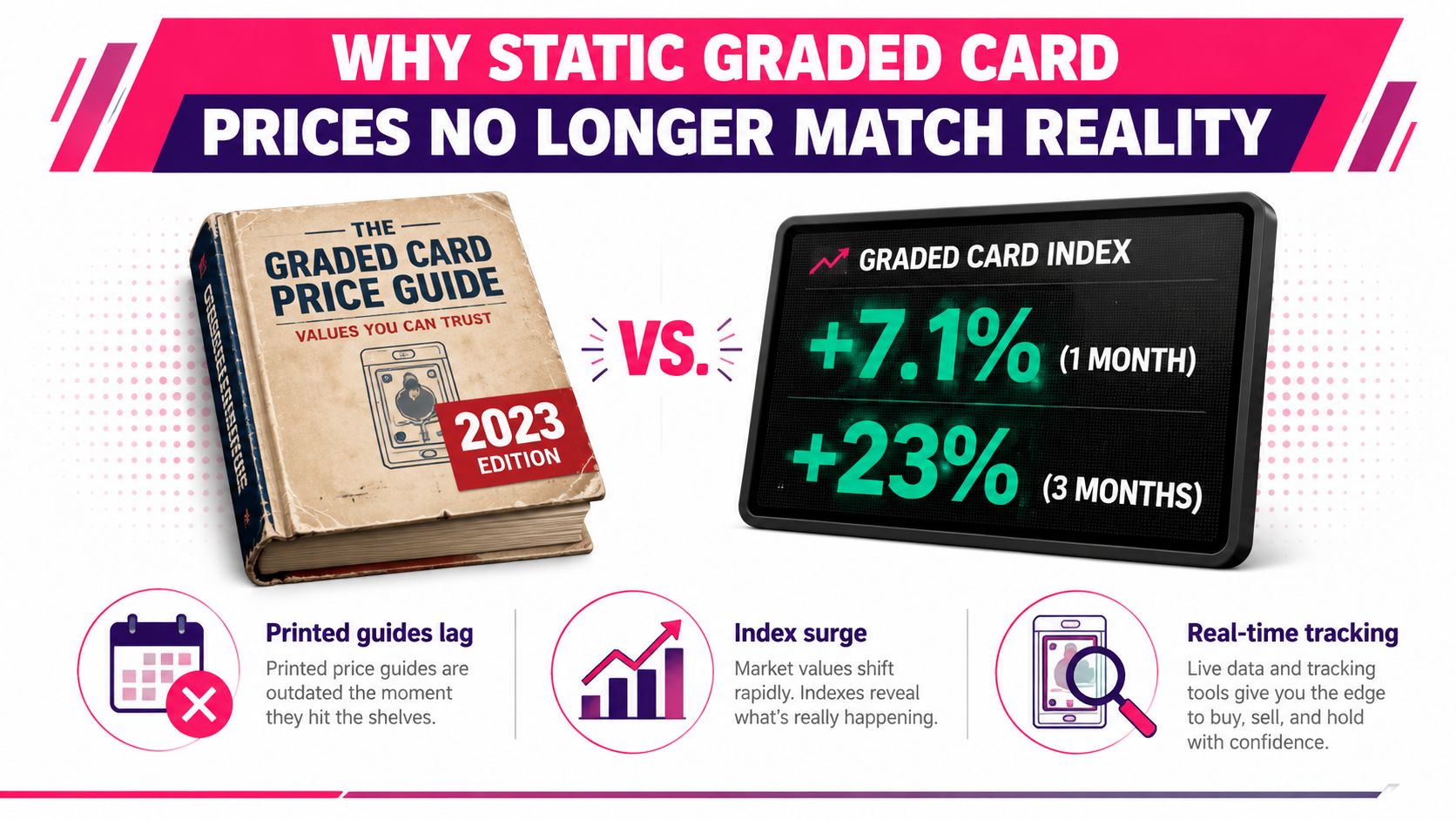
A graded-card benchmark index at $6,098,526, up 7.1% month over month and 23% over six months, is a blunt reminder that slab pricing moves too fast for a once-a-year handbook to stay honest. That gap is the core problem with any graded card price guide that still behaves like a static reference, because the market now reprices in real time, not on a print cycle. PSA’s price guide still matters as a long-running reference point, but the pricing question in 2026 is no longer “what’s the guide number,” it’s “where do recent sold comps cluster, and what’s the true sellable range?”
Table of Contents
Why Static Graded Card Prices No Longer Match Reality
A market that can move 7.1% in one month and 23% in six months does not reward stale reference pricing. A printed or slowly refreshed graded card price guide can still provide a starting point, but it cannot keep pace with slabs that reprice fast in volatile grade tiers or thin population pockets. The live market usually moves before a handbook does, so a single guide number can lag the actual trade range.
The core mistake buyers keep making
The first pricing error is treating one guide value as the market. That only works when a card trades inside a tight band and the grade premium stays stable, which is not how many sought-after slabs behave. As market analysis on graded Pokémon cards shows, grade premiums can move by multiples rather than by small increments, so a listed guide price may sit well outside the range where actual sales clear.
What a modern guide has to replace
A useful graded card price guide cannot stop at one number. It has to account for the recent sold range, the grade tier, and the way the market is repricing the card right now, not last season. The point of a guide is to reduce uncertainty around a slab, not freeze that slab at an older benchmark.
Practical rule: if a slab’s recent sales are moving, the guide number is a reference point, not the answer.
That is why a pricing workflow needs a working definition of the guide, then a grade-by-grade read, then a live-sales range that replaces the old handbook mindset.
What a Graded Card Price Guide Covers
A graded card price guide is a valuation tool for cards that have already been encapsulated and assigned a grade. Beckett’s dedicated Graded Card Price Guide was built as a market-values reference for professionally graded cards, and PSA’s public guide serves a similar role for slabbed cards. Beckett’s graded-card guide provides the historical framework, while live sales data shows whether that framework still matches current trades.
What the guide includes
At minimum, the guide has to be organized around the card, the set, the grade, and the grader. That is the basic language collectors use when they compare slabs, because a raw card list does not tell you what an encapsulated copy should command. In a working pricing process, guide price is the reference value for a specific slabbed card, while comps are the recent completed sales that test whether the reference is still credible.
The most useful guides also separate pricing by grade tier instead of treating all copies as interchangeable. A PSA 8 and a PSA 10 may belong to the same card, but the market does not read them the same way, and the spread between them often reflects more than simple condition. For higher-demand cards, that spread can widen fast when supply is thin or collectors are chasing the cleaner copy.
What the guide leaves out
A static guide usually leaves out the parts that decide whether a trade works. It does not automatically include seller fees, declared-value costs, time to cash, or the spread between the low and high end of recent sales. It also does not tell you whether the market paid extra for a visually stronger copy inside the same grade, which is why one printed number can hide a wide true market range.
That gap matters most when slab prices are moving. A guide may show a single reference point, but recent completed sales often cluster around several price bands, not one clean figure. If the card has uneven demand, the guide can sit in the middle while real buyers are paying at the edges.
The vocabulary that keeps pricing clean
A better pricing conversation uses four terms consistently.
-
Guide price means the reference anchor.
-
Comps means recent completed sales.
-
True market range means the span where most real sales clustered.
-
Sales histogram means the distribution of those sales across price points.
A guide that cannot be checked against live sold results is a catalog entry, not a pricing tool.
That distinction matters because Beckett’s guide and PSA’s guide are valuation references, not substitutes for market discovery. The next step is the grade itself, since the same label can still cover different visual quality and different price behavior.
The Grading Standard as the Pricing Anchor
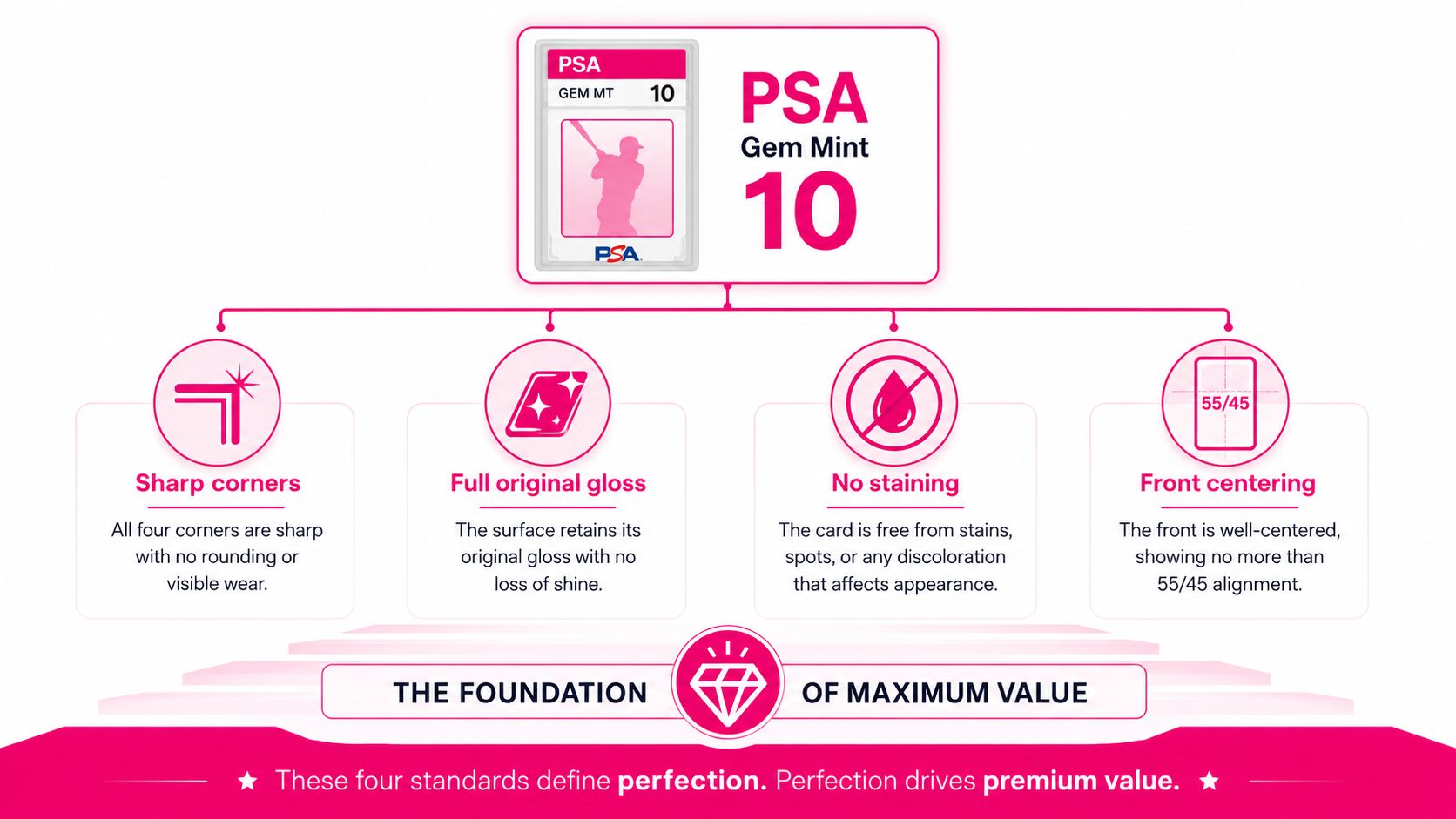
The price guide only works if the underlying grade means something specific. PSA’s Gem Mint 10 standard requires four sharp corners, full original gloss, no staining, and about 55/45 front centering and 75/25 back centering. PSA’s grading standards also note that centering is only one factor among overall eye appeal, with graders allowed small variances at their discretion.
Why one grade can hide multiple price realities
A slab labeled PSA 10 is not a mechanical promise that every copy looks identical. One card may barely clear centering thresholds, while another is visually cleaner across corners, surface, and gloss. That matters because buyers compare the visual strength of the slab against the published standard before deciding whether the premium over raw or lower grades is justified.
What a pricing model should store
A defensible price guide should store more than the headline grade. It should keep the sub-grade drivers the market responds to, especially centering, surface, and corner quality. That’s the only way to apply premium and discount logic consistently across modern cards, where tiny visual differences can affect what a buyer will pay.
Why the standard matters most in high-liquidity modern cards
Modern Pokémon cards are the clearest example of this problem because they trade quickly and collectors compare copies in detail. When a card just barely qualifies for a top label, its slab value can still differ from a stronger-looking example of the same grade. The guide has to reflect that reality or it will overstate uniformity that doesn’t exist.
Pricing anchor: the grade is the label, but the sub-grade drivers are what determine how that label trades in the market.
That’s why the guide can’t stop at “PSA 10 equals premium.” It needs to explain how much premium, and that’s where the multiplier effect becomes obvious.
Grade Tier Multipliers in Real Numbers
A grade label only becomes meaningful once you compare it with a lower tier. The premium spread is the point, because a PSA 10 can trade far above the same card raw, while vintage Pokémon cards often show especially large jumps between lower grades and top slab examples. Static lists that stop at one headline number miss that spread completely.
Grade premium snapshot for iconic Pokémon cards
| Card | Raw / Lower Grade Range | PSA 10 Range | Premium Multiple |
|---|---|---|---|
| 1st Ed Base Charizard | $8,000–$12,000 in PSA 9 | $45,000–$60,000 in PSA 10 | about 5–7.5x |
| Base Set Charizard (Unlimited) | $400–$600 in PSA 9 | $2,500–$3,500 in PSA 10 | roughly 4–8.75x |
What the table really tells you
The gap between PSA 9 and PSA 10 is large enough that a guide built only on raw-card value misses the market jump. On the 1st Ed Base Charizard, the move from PSA 9 to PSA 10 alone lands around 5–7.5x, which is a different pricing regime, not a minor adjustment. On the Unlimited Base Set Charizard, the PSA 10 premium still changes the buy decision because the slab is no longer priced like a normal copy of the card.
Why the grade cliff matters more than the card name
Collectors often give the card name too much weight and the grade tier too little. The better-known the card, the more clearly the market separates acceptable copies from elite copies, so the pricing gap can widen fast once the top label enters the picture. A raw or lower-grade estimate may look close on paper, but the slab market does not price on paper, it prices on tier.
That is why a flat guide price loses accuracy quickly. A card can have the same identity and a very different sell-through zone once grade premium kicks in.
The bigger the grade cliff, the less useful a flat guide price becomes.
For a closer look at how scarcity changes that premium inside the top grade, see how population affects graded Pokémon card pricing.
Population, Comps, and Why Two PSA 10s Can Price Differently
A PSA 10 is not automatically the same as every other PSA 10. Population scarcity changes how hard the market has to bid for a copy, and recent sold comps show whether buyers are paying a rarity premium or just a normal top-grade price. The practical point is simple, two slabs with the same grade can still trade in different zones depending on how many copies exist and how the last sales stacked up.
Scarcity is part of the value, not a footnote
Population scarcity matters because a high-pop PSA 10 behaves differently from a low-pop PSA 10. The first usually trades closer to the underlying card’s broader market, while the second can command a premium because buyers know replacements are harder to find. That is why graded pricing should never reduce the whole market to a single label and a single number.
Comps are the check against the label
Recent sales provide the necessary verification. A guide that ignores comps can only tell you what the market used to think, not what it thinks now. That is why PSA’s long-running guide function and Beckett’s graded-card reference are best treated as anchors, with live sales used to confirm whether the current clearing price is higher or lower.
For a deeper look at how supply shapes pricing, see does population matter to graded Pokémon cards.
Market rule: when population is thin, the top-grade premium often widens before the guide catches up.
That interaction between scarcity and recent sales is what creates the true market range. A one-line guide number can’t show you whether a card is selling near the low end, mid-band, or at a scarcity spike, which is why histograms matter more than headline values.
How Sales Histograms Build a True Market Range
A sales histogram (like Double Holo’s slab insights chart) is the cleanest way to turn recent comps into a usable price range. Instead of asking what one guide number says, you look at where the sales clustered and identify the span where the market cleared most often. That range is more honest than a single midpoint because it shows the spread, the concentration, and the outliers all at once.
Reading the histogram like a seller
The goal is not to admire the chart. The goal is to see where buyers closed. If most sales cluster in a narrow band, that band is your true market range. If the bars are spread out, the card is telling you that the guide price is probably too neat for the level of volatility in the market.
Why the midpoint alone can mislead
A midpoint can hide the fact that a card mostly sells at one level but occasionally spikes higher on strong photos, better eye appeal, or sharper competition between buyers. That’s why the middle of the distribution is more useful than a simple guide price, but only if you can still see the surrounding range. A histogram makes that visible at a glance.
How to use the range before listing or buying
-
Anchor to the dense part of the chart: that’s where most trades clear.
-
Ignore isolated spikes: one outlier sale doesn’t define the market.
-
Price for speed or patience: a tighter list price can sell faster, a high ask can sit.
-
Recheck after the next comp wave: once the distribution shifts, the range may move with it.
For a workflow built around that logic, a graded card price tracker should always be used as a live reference, not a static catalog.
That histogram-first approach is exactly what serious pricing needs, because it tells you where the market is clearing instead of pretending every sale landed at the same number.
The Grading ROI Question Most Guides Skip
The highest-value raw card is not always the best grading candidate. That sounds backwards until you price the submission the way a buyer or vendor lives with it, by expected value, not by headline value alone. The question is whether the card’s likely slab value clears the full cost stack after fee tier, shipping, turnaround, and grade risk.
The expected-value lens
A rational grading decision has four parts. First, estimate the probability of each grade outcome. Second, compare those outcomes against the likely resale spread by grader. Third, subtract the submission cost and shipping. Fourth, include time-to-cash, because a card that sits for weeks ties up capital even if the final sale is decent.
Hard truth: grading only helps when the expected margin after fees is strong enough to survive a weaker-than-hoped result.
Why the most valuable raw card can be the wrong one
A pricey raw card can still be a bad grading play if the card is uncertain, the declared value is high, or the upside over raw is too thin. In contrast, a lower raw-value card with a strong chance of a premium grade can produce a better expected result. That’s the contrarian part many guides skip, because the best candidate is often the card with the best margin profile, not the biggest sticker price.
How the market should think about grading
PSA’s own service structure makes the economics explicit through declared-value tiers and turnaround-driven costs, which means grading is never free and never neutral. A card can look profitable in a raw-vs-slab comparison and still fail once it lands in a more expensive tier or a slower service path. That’s why ROI has to be modeled before the card ships, not after it comes back.
For a deeper pricing lens, opportunity cost in Pokémon grading belongs in the decision process every time.
Normalizing for Service Level, Fees, and Turnaround
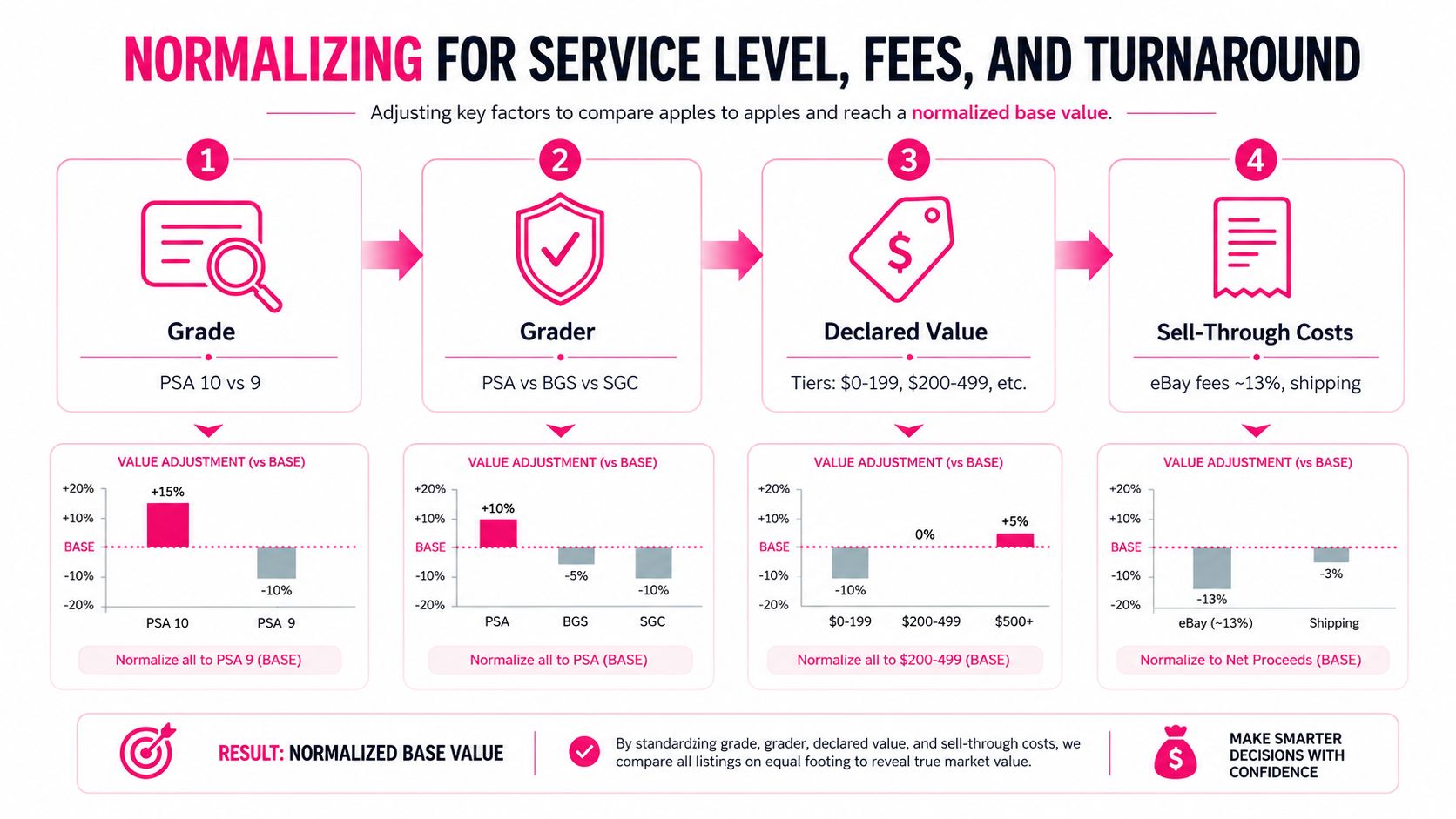
A guide that doesn’t normalize for service level is missing the business side of grading. PSA’s Trading Card Grading service uses declared-value tiers and turnaround-based pricing, and independent grading guidance still shows that service bands can vary sharply across graders and speed levels. The practical result is that gross slab value is not the same thing as net value.
Normalize the card before you price it
A slab should be priced after you account for grade, grader, declared-value band, and sell-through cost. That is the only way to avoid quoting a buy number that looks fine on paper but fails once the card is sold. A net-minded guide should therefore convert the slab into an expected realized value, not just a nominal comp.
Why fees and speed change the outcome
If the card is forced into a higher declared-value bracket, the economics move immediately. If you rush the submission, the tier cost can rise again. Even when the market is strong, the extra friction can erase a thin margin, which is why service level should be part of the price model from the beginning.
A cleaner way to think about the math
-
Grade first: PSA 10 and PSA 9 are not interchangeable.
-
Grader second: the market pays differently depending on the label.
-
Declared value third: higher tiers can change the break-even point.
-
Sell-through costs last: fees and shipping trim the proceeds.
A vendor operating system can help here too, and Double Holo is one option that combines market intelligence with repricing and inventory tools in the same workflow. I mention it because pricing slabs correctly is as much an operations problem as it is a valuation problem.
The point is simple, a guide that ignores service level assumes a free and fast grading process. That assumption breaks the moment real cards hit real submission queues.
Using a Graded Card Price Guide in Real Buying and Selling
The daily use case is more straightforward than many make it. Buyers use the guide to anchor offers, sellers use it to set list prices, and vendors use it to reprice inventory when the distribution shifts. The key is not to chase the single headline number, but to work from the range that recent sales support.
For buyers
Start with the true market range, then bid below the dense part of the histogram. That gives you room for fees, soft spots in eye appeal, and a slower exit if the market cools. If the slab is scarce, the offer should reflect that, but not so much that you’re paying for a peak sale as if it were normal.
For sellers
List against recent comps, not against wishful guide values. If the histogram shows a tight band, price near the upper side only when the slab has the eye appeal to justify it. If the recent sold range is wide, your listing should target the part of the chart where buyers already proved they’ll transact.
For vendors
Inventory repricing only works if the shop is reading live comps, not reusing old shelf tags. That’s where tools that sync inventory, labels, and repricing rules matter, because the slab case needs to move with the market, not behind it. Use comp-driven pricing on everyday singles as well, including cards like Switch - Sword & Shield #183 and Scorbunny - Sword & Shield #30, where static guide numbers usually tell you less than recent sold behavior.
The best price is the one that matches the market you can actually clear, not the market you wish existed.
That operational discipline is what turns a guide from a reference book into a pricing system. Once you work that way, the last step is a fast checklist you can use on any slab in under a minute.
Quick Reference Framework for Pricing Any Slab
Use the same five checks every time and the guesswork drops fast. The goal is to move from label-level thinking to transaction-level thinking, because a graded card price guide only helps when it leads to a price someone will pay.
The five checks
-
Confirm the grade and sub-grade drivers. Look at centering, corners, surface, and gloss, not just the label.
-
Pull the recent sales histogram. Ignore the single high sale and focus on the cluster.
-
Locate the true market range. Price against where most comps closed, not the outlier peak.
-
Normalize for declared value and seller fees. A gross comp isn’t your net number.
-
Run a quick grading ROI test if the card isn’t slabbed yet. If the expected margin after fees is thin, leave it raw.
A quick decision rule
If the histogram is tight, the slab can be priced near the center of the band. If it’s wide, you need to be more conservative and closer to the clearing side of the market. If the raw card is uncertain, grading only makes sense when the upside comfortably clears the cost stack and the time you’ll wait.
The takeaway that keeps you out of trouble
A guide price is a starting point, not a verdict. The market pays for the card, the grade, the population context, and the economics of getting the slab to market. That’s the difference between a handbook number and a pricing system that works.
If you want a slab workflow that pairs live pricing, grading ROI, and inventory control in one place, visit Double Holo and use it to compare market ranges before you buy, sell, or grade. It’s built for collectors and vendors who need current comps, not stale handbook pricing, and it gives you a cleaner way to decide whether a slab is worth listing, holding, or submitting.