

You pull a rare card, check the price, and get three different answers. TCGplayer says one thing, eBay sold listings say another, and your own gut says the market moved again while you were still sleeving the card. That’s the truth of a pokemon card price tracker in 2026, because price is never just a number, it’s a snapshot of condition, venue, and timing.
Serious collectors and vendors need more than a fast lookup. They need a workflow that starts with comping, moves into grading and portfolio decisions, and ends with repricing and sale execution without stale data getting in the way. The best tools don’t just tell you what a card sold for, they help you decide whether to buy, sell, hold, or grade based on the exact market you’re targeting.
Table of Contents
1. Double Holo
Double Holo is built for collectors and vendors who want a pokemon card price tracker to support pricing, listing, and inventory decisions in one place. It combines a live bid and ask marketplace with market intelligence and seller tools, so you can move from comping to execution without jumping between disconnected tabs. A tracker that only shows a number still leaves you to judge condition, venue, and exit timing on your own.
The platform supports raw and graded singles, sealed product, and multilingual releases, including Japanese cards. It also surfaces live market discovery instead of relying on fixed listings alone, which matters if you are pricing for a fast sale or holding out for a better exit. For collectors, the value is in deciding whether a card belongs in a binder, a submission pile, or a lot for sale.
Its intelligence tools go beyond a basic chart. Double Holo includes AI buy, sell, and hold picks, market alerts, technical charting, Slab Insights sales histograms, grading ROI comparison, pack EV analysis, and price forecasting. That mix helps when you need to compare grading risk against expected resale value, or decide whether a sealed product position still justifies the cash tied up in it.
For sellers, fee structure affects margin directly. Double Holo states a standard seller fee of 4.9%, and 4.7% on premium, plus a 2.9% + $0.50 card processing fee, and positions those rates against eBay’s 12.9% and TCGPlayer’s 10.75%. Lower fees matter most on higher-volume sales, where platform costs can take a large share of the spread between buy-in and exit price.
1. Double Holo
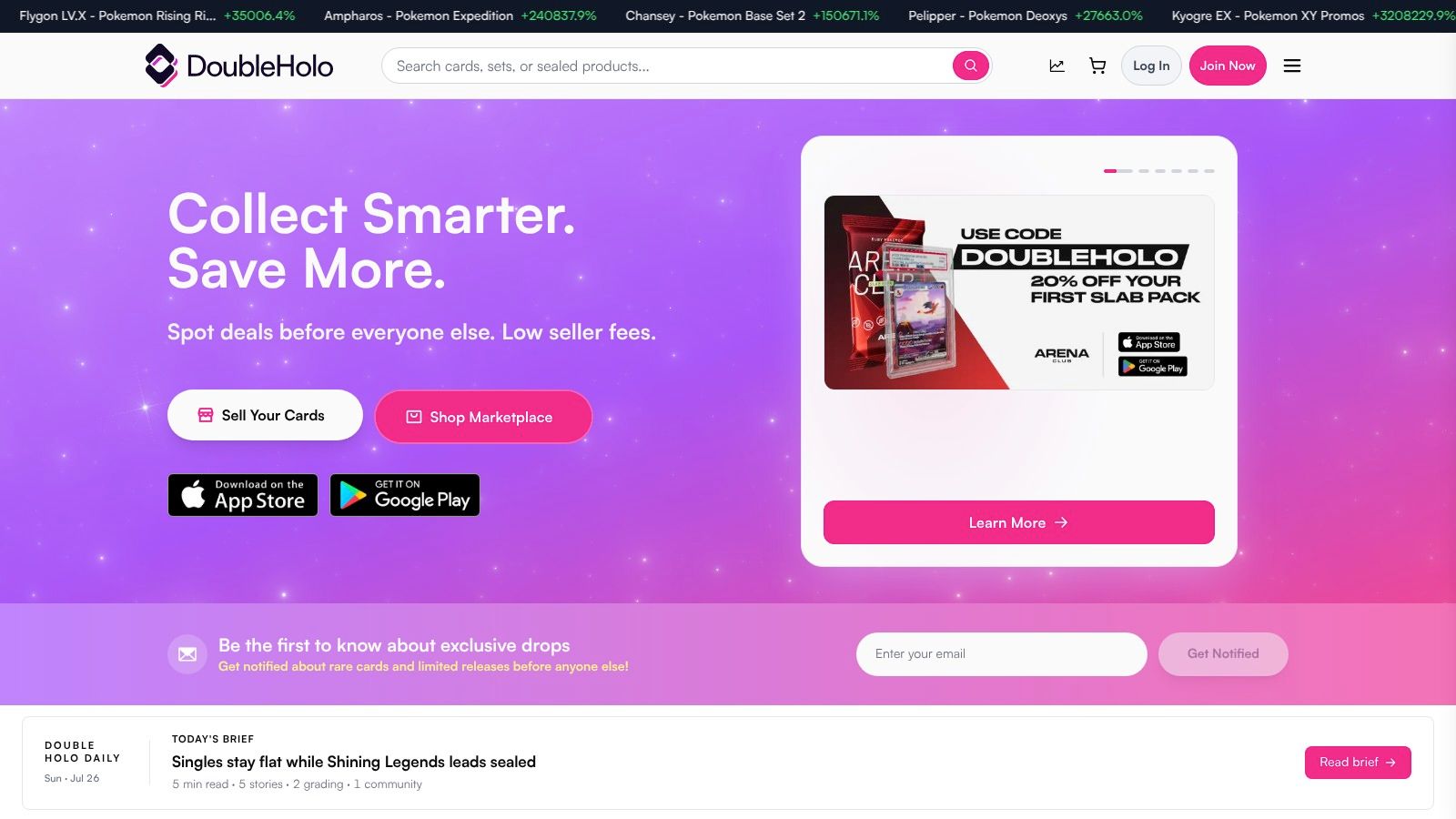
Double Holo is built for people who want a pokemon card price tracker to function like a trading desk, not a static lookup page. It combines a live bid/ask marketplace with market intelligence and vendor operations, so you can price, list, and manage cards in one place at Double Holo. That matters because a tracker that only shows a number still leaves you doing the work of interpreting condition, venue, and exit strategy.
Why it works for serious buyers and sellers
The platform supports raw and graded singles, sealed product, and multilingual releases, including Japanese cards, while surfacing live market discovery instead of fixed listings alone. Its intelligence stack goes beyond basic charts, with daily AI buy/sell/hold picks, 24/7 market alerts across 10 alert types, technical charting, Slab Insights sales histograms, grading ROI comparison, pack EV analysis, and price forecasting. If you’re trying to decide whether a card belongs in a binder, a submission pile, or a sales lot, that combination is hard to beat.
For sellers, the practical edge is margin control. Double Holo states a standard seller fee of 4.9%, and 4.7% on premium, plus a 2.9% + $0.50 card processing fee, which it positions against eBay’s 12.9% and TCGPlayer’s 10.75%. Lower fees matter most when you move a lot of cards, because the spread between gross sale price and net proceeds is where vendor businesses live or die.
Practical rule: If a tool helps you price cards but not actually move inventory, you’re still doing two jobs. Double Holo cuts that down by combining pricing, listing, repricing, and back-office work in one system.
Where it fits in a vendor workflow
Vendor Hub is the piece that pushes this beyond collector software. It centralizes inventory with live market valuation, supports slab scanning straight into inventory, automates repricing, prints labels through NIIMBOT, syncs one inventory across eBay, Shopify, TCGPlayer, and Double Holo, and supports instant deal comping at shows with per-show profit and loss. That’s a real operating system, not a watchlist.
The scale also matters. Double Holo says it’s trusted by 90,000+ collectors, and the marketplace surfaces featured storefronts, trending movers, and recent high-value sales across sets and languages. That kind of activity is useful because the more liquid the venue, the faster you can judge whether a listed price is meaningful or just wishful thinking.
If you run a table, a store, or a multi-channel shop, this is the closest thing on the list to replacing a spreadsheet, a pricing tab, and a label queue at once.
Pros, in plain terms, are lower seller fees, real marketplace liquidity, strong analytics, and automation that keeps you from babysitting the market. The downside is that it’s still Pokémon-first, so it won’t give you the cross-category reach of a giant general marketplace. Some tools also sit behind premium plans, and Vendor Hub is in open beta, so there’s a learning curve if you want the full stack.
2. TCGplayer Price Guide and App
TCGplayer is the baseline many U.S. sellers still use because it reflects a huge amount of marketplace activity in one familiar place. Its pricing view centers on Market Price, plus Listed Median and Most Recent Sale, which gives you a quick read on what buyers and sellers are doing right now. If you need a fast, defensible starting point for raw English singles, this is still one of the first tabs to open.
Best use in the workflow
The mobile app makes it useful in the field. Scan a card, check the market, and decide whether it belongs in your buy pile or your trade binder. That’s especially helpful when you’re doing first-pass pricing on modern cards and don’t want to waste time triangulating every common pull.
TCGplayer also fits the “comp first, list second” routine because it’s easy to use as a listing anchor. Sellers often use it to sanity-check prices before they publish elsewhere, then refine using sold listings and condition adjustments. That workflow is stronger than trusting a single marketplace feed on its own.
Where it falls short
The main weakness is scope. TCGplayer’s Market Price reflects TCGplayer sales, not the whole market, so it can miss broader shifts that show up on eBay, Cardmarket, or graded-specific venues. On thinly traded cards, that can smooth out spikes or delay the signal you need.
If you’re tracking raw English cards, it’s a practical base layer. If you’re selling slabs, Japanese cards, or chase-tier cards with volatile premiums, it’s only one leg of the stool. The best practice is to use it for the first number, then cross-check elsewhere before making money decisions.
3. eBay Price Guide, Sold Listings, and Terapeak
eBay is still the broadest comp source because it captures the marketplace where a lot of hobby money changes hands. The Sold Listings view shows realized prices, the Trading Cards Price Guide surfaces price context on listing pages, and Terapeak adds deeper historical research inside Seller Hub. For raw cards and slabs alike, that combination gives you a strong ground-truth layer.
What makes it useful
The biggest strength is breadth. You can see real transaction prices across variants, conditions, and grades, which matters when you’re trying to understand how much of the spread is card quality versus listing noise. eBay also tends to show the weird stuff that smaller tools miss, including outliers and unusual demand pockets.
For sellers, this matters because the market doesn’t care what a guide says if buyers are paying something else. A sold listing is closer to truth than an asking price, and Terapeak helps you spot patterns instead of staring at one-off sales.
The part that takes discipline
eBay data needs filtering. Best-offer acceptances can blur the final amount, listings can be mislabeled, and condition can vary more than sellers admit. If you don’t check the exact variant, grading company, and card version, you’ll overestimate or underestimate value fast.
Use eBay as the real-world correction layer, not the only source. That’s why many experienced sellers compare it against a platform baseline and then verify against a more structured tool such as the one discussed in Double Holo’s comparison of TCGplayer, eBay, and its own marketplace. The workflow is simple, comp on eBay, normalize with another source, then list with confidence.
4. Cardmarket Price Trends EU
Cardmarket is the tool you open when the card sits in European demand, not just U.S. demand. Its price trend view is useful because it reflects a deep EU marketplace with language and printing variation that U.S.-centric trackers often flatten out. For collectors dealing in German, French, Italian, or Japanese-language variants sold into Europe, that difference is not cosmetic, it’s pricing reality.
Why EU sellers need it
The main value is context. A card can look fairly priced in dollars and still be off in euros once local liquidity, language preference, and regional print differences are factored in. Cardmarket helps you avoid making decisions based only on American comps when your buyer pool is in Europe.
It’s also useful as a cross-check tool. If a card’s EU trend is diverging from U.S. comps, that can point to a region-specific premium or a slower-moving market. That’s exactly the kind of signal serious resellers want before they commit inventory.
What to watch for
The price trend is derived, so you should treat it as guidance rather than gospel. It’s strong for quick market framing, but it still needs human judgment when the card is scarce or when regional demand is choppy. Currency conversion also matters whenever you compare it to U.S. pricing, because a simple spot check can hide the spread.
Practical rule: Use Cardmarket when the card’s strongest buyer pool is in Europe or when language and print differences matter. If you’re only checking it after a U.S. comp, you’re probably missing part of the market.
For vendors, the upside is clear. Cardmarket gives you the European lens that helps prevent underpricing region-specific cards and overestimating U.S. demand. For collectors, it’s a better answer than guessing whether a local-language copy should sell at the same number as an English one.
5. PSA Auction Prices Realized and PSA Price Guide
PSA’s auction data is the cleanest option on this list when the card’s grade is the main story. PSA Auction Prices Realized focuses on verified realized prices for PSA-graded Pokémon cards, which makes it especially useful when you’re trying to price slabs without condition noise from raw copies. If your business revolves around graded inventory, this is a reference point you should check regularly.
Why grade-specific data matters
A raw card and a PSA 10 are not the same product, even if they’re the same card. Grade, population context, and collector preference all change the pricing logic. PSA’s ecosystem is useful because it anchors the conversation around exact grade rather than forcing you to guess based on raw-card comps.
That helps with submission decisions too. If a card’s slab market looks strong but the raw-to-grade spread doesn’t justify grading costs, you can avoid tying up capital in a submission that won’t clear profit. That’s a better decision than sending every promising pull to be graded by default.
Limitations that matter in practice
PSA-centric coverage is the obvious trade-off. It’s strongest for PSA slabs, but it doesn’t fully solve pricing for other grading companies or for raw cards sold in mixed marketplaces. It also won’t always reflect private deals or fixed-price bargains that never hit auction history.
The right use is narrow and disciplined. Check PSA when the card is already graded or when you’re evaluating whether a slabbed copy should be listed, held, or liquidated. If the card is raw, use a broader comp stack first, then move into PSA once grade becomes part of the decision.
6. PriceCharting Pokémon Cards
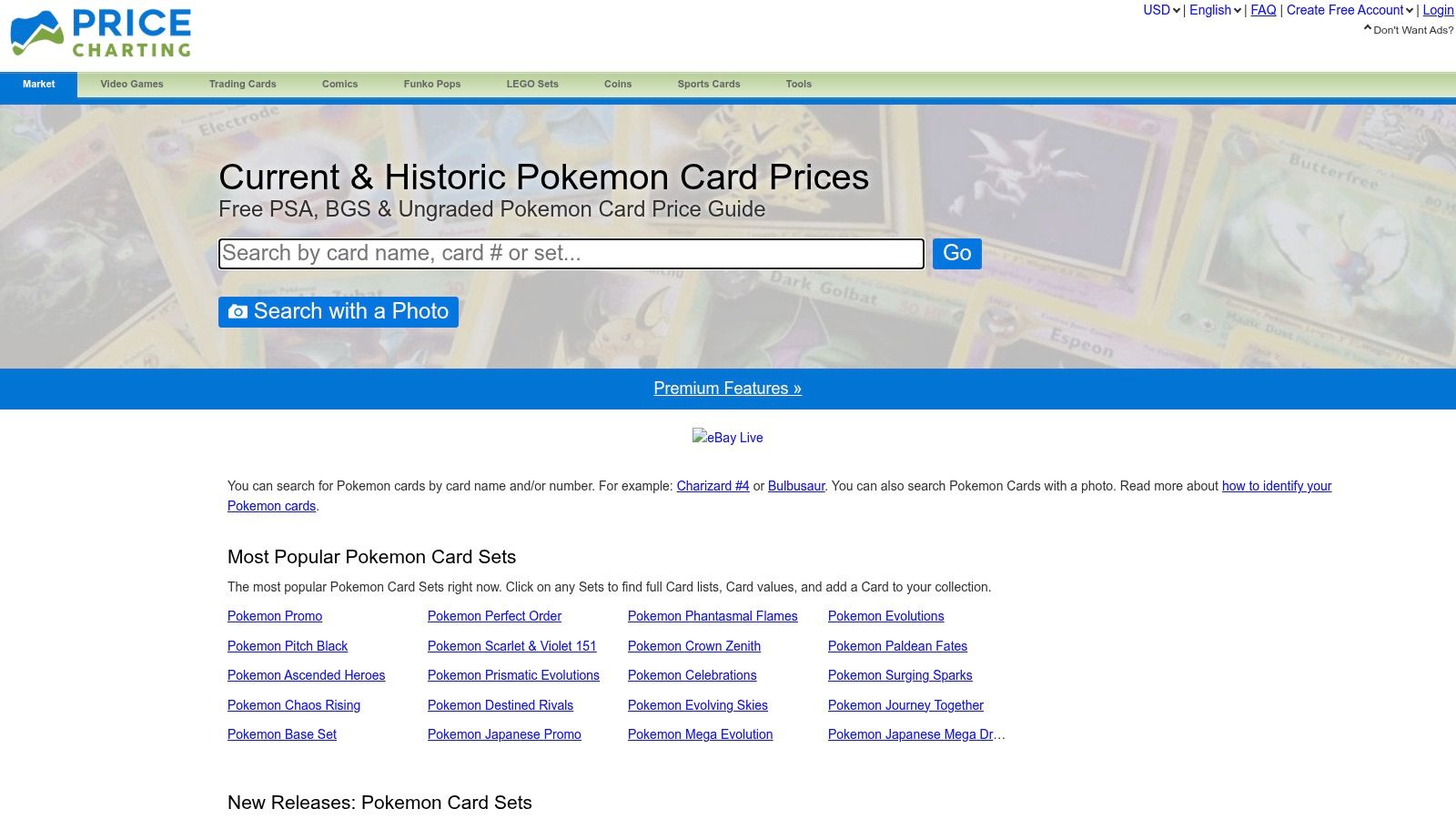
PriceCharting is popular because it makes quick valuation easy without hiding the structure behind the number. It shows raw and graded prices, historical charts, and recent sales references, which is enough for a lot of day-to-day pricing work. For collectors who want a clean portfolio view, it also adds collection tracking and reporting.
Where it fits best
The strongest use case is fast portfolio awareness. If you own a mix of modern hits and older slabs, PriceCharting gives you a way to keep tabs on what you hold without turning every check into a research project. It’s also useful for people who want a simple value reference that’s less intimidating than a deeper analytics stack.
The photo search and barcode search features help when you’re dealing with bulk or when you just want to identify items quickly. That can save time at home, at shows, or while sorting a buyout. The platform is especially practical when you need a fast answer before moving on to a more precise comp.
Where it needs help
Coverage quality can vary on thinly traded or niche items, so it works better as a first pass than a final verdict. Some of the more powerful exports and advanced features also sit behind paid access, which is worth it for active users but not necessary for everyone.
If you want a stronger workflow around the platform, Double Holo’s guide to checking Pokémon card prices pairs well with PriceCharting’s quick reads. The combination is useful because one tool gives the quick valuation and the other helps you turn that valuation into a market decision.
7. Card Ladder
Card Ladder is built for people who care about normalized comps, not just raw market noise. It pulls verified sales data from multiple venues and turns that into price guides, charts, and portfolio tools, which makes it especially strong for higher-end graded cards. If you’re buying or selling premium slabs, this is one of the more research-driven options.
Why it matters for high-end cards
Premium cards are where messy comps can cost real money. A sale from one marketplace may not mean much on its own if condition, auction dynamics, or buyer urgency skew the result. Card Ladder helps reduce that problem by focusing on a more curated sales base and a normalized valuation approach.
That’s useful when you’re looking at expensive grails or trying to figure out whether a particular slab is trending or just bouncing around because of one headline sale. It’s also strong for portfolio management, because you’re not just looking at a loose market number, you’re trying to understand value quality.
Trade-offs you should expect
The strongest features sit behind a paywall, so it’s more of a professional tool than a casual lookup site. Coverage can also be lighter on niche Pokémon SKUs than on broader sports-card inventory, so you still need to verify edge cases manually.
The best use is not “What’s the card worth right this second?” It’s “How strong is the pricing signal, and how much confidence should I put in it?”
If you already sell slabs regularly, Card Ladder fits into a pricing stack that includes market validation and inventory discipline. It’s especially strong when paired with a vendor system that lets you act on the comp quickly, which is why Double Holo’s vendor-focused deal tracking is a natural operational companion.
8. Mavin.io (CardMavin) eBay Sold Price Aggregator
Mavin.io is the fast answer tool when you need a quick comp and don’t want to spend time in a heavier platform. It aggregates eBay sold listings and gives you a simple average-price read, which is enough for a first-pass decision on a show floor or during a fast inbox quote. That makes it useful for casual pricing and rough buy signals.
Where it saves time
The interface is light, and that’s the point. You can get to a rough value faster than you can build a full research stack, which matters when you’re working through bulk or screening lots. For sellers who already know the market well, it’s a convenience tool that reduces friction.
It also works as a low-pressure sanity check. If you’re looking at a card you don’t see often, a quick Mavin lookup can tell you whether you’re in the right neighborhood before you dig deeper elsewhere. That’s helpful when time matters more than precision on the first pass.
The catch
The output is only as good as the sold listings and filtering choices behind it. If you don’t refine comparisons carefully, the average can be misleading, especially on variants, conditions, and cards with noisy sales histories. It’s not built to replace a deeper marketplace or a slab-specific pricing engine.
Mavin is best treated as a quick helper, not the final word. Use it when speed matters, then confirm with a source that gives you better historical context or condition control if the card is worth real money.
9. PokeDataio
PokeDataio is the Pokémon-specific tracker that tries to sit between a market checker and a portfolio manager. It combines prices from multiple sources, including eBay, TCGplayer, and Cardmarket, and it supports raw cards and multiple grading companies. That makes it especially relevant for collectors who want one Pokémon-centric workspace instead of jumping between general collectibles tools.
Why collectors use it
Cross-market triangulation is the main appeal. When a card is listed in one market but not another, or when U.S. and EU prices drift apart, a tool that brings those views together gives you a better read on actual value. That’s especially helpful for set-level work and for collectors with mixed-language holdings.
The mobile app adds convenience for on-the-go checking, and the portfolio and alert features make it more than a pure lookup page. If you’re trying to keep an eye on specific cards without manually rechecking every venue, that’s a meaningful workflow improvement.
Where the boundaries are
Advanced history and alerts can require paid tiers, and coverage can thin out on older or ultra-niche items. That’s typical for a focused tracker, but it means you still need manual verification when a card is rare enough that comp quality matters more than speed.
For collectors who want a Pokémon-first interface with cross-market awareness, it’s a sensible middle ground. For vendors running inventory at scale, it won’t replace a true operating system, but it can still make day-to-day monitoring easier.
10. PWCC Sales History (Fanatics Collect)
PWCC Sales History is strongest when the card is premium, graded, and the sale history needs auction context. Its searchable realized prices focus on premium slabs and sealed lots, which makes it useful for high-end comps and for spotting trends in the grail market. If the card is expensive enough that one bad comp could distort your decision, this is worth checking.
What it’s good at
The value here is validation. If you see a price elsewhere that feels too high or too low, PWCC’s sales history can help you decide whether that number is an outlier or part of a real pattern. That’s especially useful in low-volume segments where every transaction carries more weight.
It also complements PSA-oriented research nicely. When a slab is rare, the best answer often comes from comparing several high-end data sources instead of trusting a single marketplace. PWCC gives you another lens on realized value, which helps sharpen the final call.
Where it’s weaker
The dataset skews toward graded and premium lots, so it’s not the tool you want for everyday raw-card pricing. It’s also less useful for low-value cards or high-volume modern inventory, where broader marketplaces give you faster, cleaner signal.
Use PWCC when the card is expensive enough that correctness matters more than convenience. For the rest of the collection, it’s overkill.
Top 10 Pokémon Card Price Trackers Comparison
| Platform | Core features | UX & ★ | Value (💰) | Audience (👥) | Unique selling point (✨) |
|---|---|---|---|---|---|
| Double Holo 🏆 | Live bid/ask marketplace; pro market intelligence; Vendor Hub (inventory, slab scanner, repricing) | Professional, real-time tools; trusted by 90k+ ★★★★★ | 💰 4.9% seller fee (4.7% premium) + 2.9% and $0.50 processing; Premium bundles $54.99 & $169.99/yr; trial included | 👥 Serious collectors, pro vendors, graders | ✨ All-in-one marketplace + analytics + vendor OS; AI picks & slab insights |
| TCGplayer Price Guide & App | Market Price, Listed Median, Most Recent Sale; mobile scanning; APIs | Widely used US baseline; fast refresh ★★★★ | 💰 Free lookups; marketplace seller fees ~10.75% | 👥 US sellers & buyers, casual and pro listers | ✨ High-volume US comps & standardized condition tiers |
| eBay Price Guide / Sold Listings / Terapeak | Sold listings, Price Guide panels, Terapeak historical research | Largest comps universe but noisy; needs filtering ★★★★ | 💰 Free to view; seller fees ~12.9% | 👥 Broad general marketplace, large audience | ✨ Broadest real-transaction coverage across raw & graded |
| Cardmarket Price Trends (EU) | EU marketplace price trends; language/printing granularity | Strong EUR liquidity for regional variants ★★★★ | 💰 Free lookup; regional pricing in EUR (currency conversions apply) | 👥 EU collectors/vendors, multilingual releases | ✨ Granular language/printing coverage for EU/JP variants |
| PSA APR & Price Guide | Auction-realized prices for PSA slabs; searchable by grade | Trusted graded comps; grade-anchored values ★★★★ | 💰 Some paid/locked features; best ROI for slabs | 👥 Graded-card sellers, high-end collectors | ✨ Auction-verified PSA-grade comps and population context |
| PriceCharting (Pokémon) | Aggregated realized sales, historical charts, portfolio tracker, photo search | Quick at-a-glance valuations; exportable reports ★★★★ | 💰 Free/basic; paid tiers for advanced exports/features | 👥 Entry to power collectors tracking portfolios | ✨ Portfolio tracker + photo/barcode search for fast valuations |
| Card Ladder | Verified comps from auctions/markets; CL Value; portfolio tools | Research-driven, normalized graded analytics ★★★ | 💰 Most powerful features behind Pro subscription | 👥 Researchers, pro graders, high-end sellers | ✨ Normalization across auctions & marketplaces for high-confidence comps |
| Mavin.io (CardMavin) | eBay sold aggregation; filters for comparable comps | Very fast, lightweight interface for quick checks ★★★ | 💰 Free core use; fast eBay averages | 👥 Casual sellers, show-floor quick comps | ✨ Fast eBay-focused sold-price aggregation & filters |
| PokeData.io | Multi-market aggregation (eBay/TCGplayer/Cardmarket), portfolio & alerts, mobile app | Pokémon-focused UX; good cross-market views ★★★ | 💰 Free/paid tiers (expanded history & alerts paid) | 👥 Collectors triangulating US/EU markets, portfolio trackers | ✨ Cross-market triangulation + set-level insights |
| PWCC Sales History (Fanatics Collect) | Auction sales history focused on premium graded slabs | Strong for grails and premium trends ★★★★ | 💰 Free to view; auction-focused dataset best for high-value items | 👥 High-end graded collectors, auction researchers | ✨ Premium auction dataset for validating high-end slab sales |
Your Next Move From Price Tracking to Profit
The best Pokémon card price tracker is the one that matches how you buy, sell, and manage inventory. If you only need a quick answer, TCGplayer, eBay sold listings, or Mavin can get you close fast. If you trade slabs, chase Japanese cards, or move inventory across more than one channel, you need a system that helps you do more than look up a number.
That’s where the workflow matters more than the lookup. Good comping starts with one source, gets validated against another, and ends with a decision about whether the card belongs in your binder, grading stack, or sales queue. For graded cards, you want exact-grade comps. For raw cards, you want marketplace context. For vendors, you want repricing, inventory sync, and margins that don’t evaporate in fees.
Double Holo stands out because it brings those pieces together. It gives collectors a live Pokémon marketplace, AI-driven market intelligence, and alerts, then gives vendors the tools to run inventory, repricing, labels, accounting, and channel sync from one place. If your current tracker helps you see the market but still leaves you managing everything manually, that’s the gap worth closing.
If you’re ready to stop bouncing between tabs and start pricing with a real workflow, visit Double Holo and see how its marketplace, market intelligence, and Vendor Hub fit into your buying and selling process. It’s built for collectors and vendors who need better comps, faster decisions, and cleaner margins on every card.