

A PSA 9 can sell for less than raw on some modern chase cards, while a PSA 10 can still clear a far higher price than the same card ungraded. The spread is real, but it’s not a straight line, and that’s why PSA graded card values can surprise sellers more than buyers.
A collector can submit a card expecting a clean profit, then open the auction results and realize the math is tighter than the label makes it look. One graded copy might look like the obvious win, while the raw copy, the PSA 9, and the PSA 10 all sit in different parts of the market with very different buyers behind them.
Table of Contents
- What a PSA Graded Card Is Really Worth
- How PSA’s Grading Scale Maps to Card Condition
- The Nonlinear Spread Between PSA 9 and PSA 10
- Where to Look Up Real PSA Graded Card Values
- Why PSA Resale Prices Beat Other Graders
- When Grading Actually Destroys Value
- PSA Volumes, Fees, and the Real ROI of a Submission
What a PSA Graded Card Is Really Worth
A PSA slab can feel like a price tag, but the market does not treat it that way. The value changes with which grade the card received, what card it is, how buyers view that set, and whether grading costs left enough margin to matter.
Collectors often make the same mistake at this point. They spot one PSA 10 sale, ignore the PSA 9, skip the raw market, and then wonder why their own copy lands somewhere else. That is how grading fees can turn a card that looked profitable on paper into a sale with very little room left.
A PSA card is worth what a buyer will pay for that exact grade at that exact moment. PSA’s own Trading Card Values tools reflect that idea, but they still work best as a reference point rather than a final answer. PSA’s price guide can help you orient yourself, yet it does not replace live market checks.
The better habit is to read spread, not a single number. If raw copies are already close to PSA 9 pricing, grading may add little or nothing. If a PSA 10 sells for much more than raw, the same card can move from a weak submission to a reasonable grade candidate very quickly.
A simple check helps. If you cannot explain the raw price, the PSA 9 price, and the PSA 10 price in plain language, you do not really know the card’s value yet.
For a live market comparison, pair PSA comps with Double Holo’s Pokémon card market values guide and compare what buyers are paying before you decide whether to grade or sell.
How PSA’s Grading Scale Maps to Card Condition
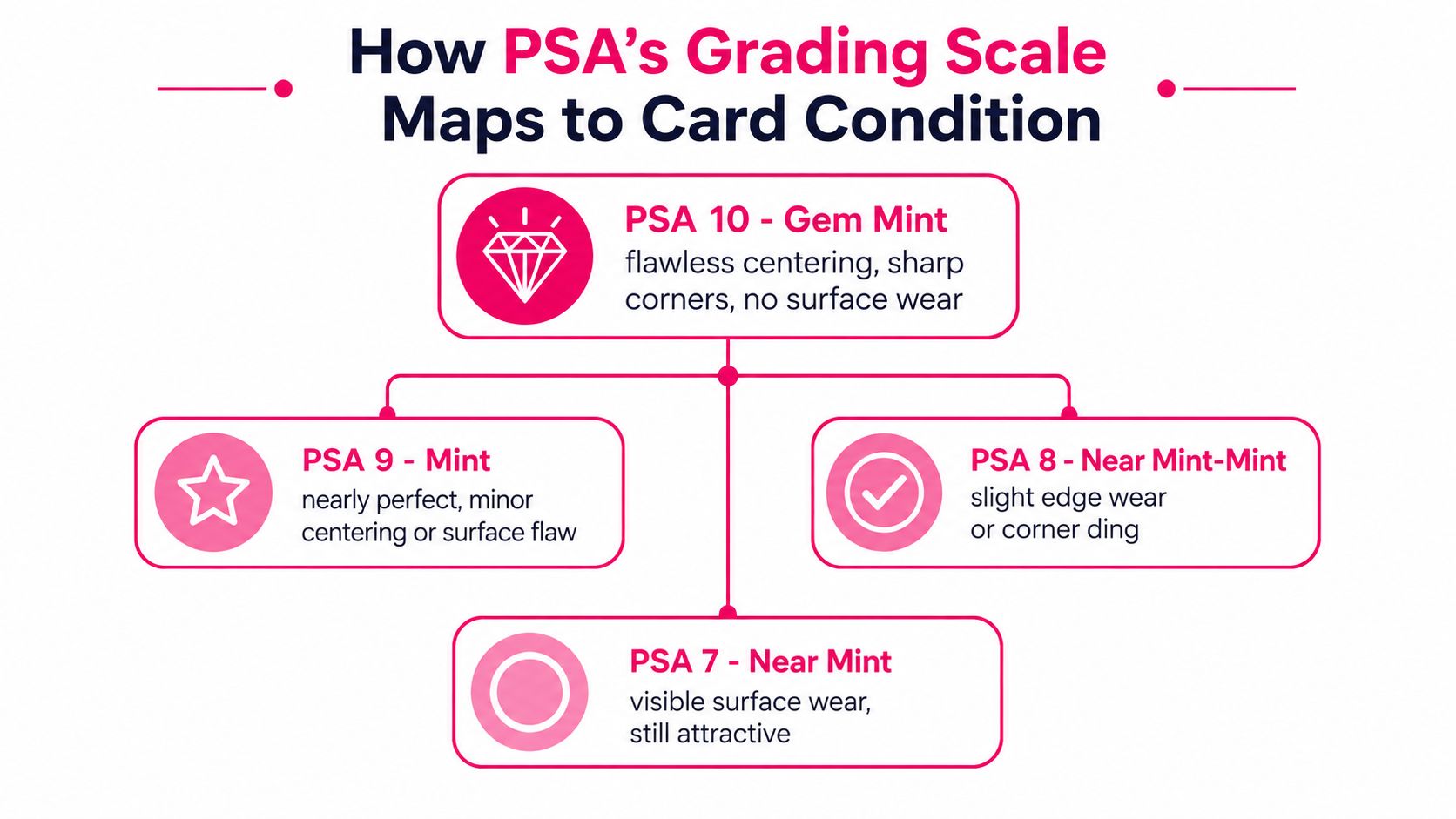
A card in a PSA slab is only useful if you understand what the grade signals to buyers. PSA frames its scale as a condition standard, and its own guidance says approximately 90% of Ultra-Modern Sport cards from 2017-present and Modern trading card games from 2003-present grade PSA 8 or higher, while about 80% of Modern Sport cards from 1986-2016 reach PSA 8+ and 80% of Vintage TCG cards pre-2003 reach PSA 7+. PSA also notes that these are approximate percentages and that every card is graded individually, not by population stats. PSA’s getting-started guidance explains the thresholds clearly.
Those ranges matter because they show where the market tends to cluster. For many modern cards, PSA 8 is the point where the card still looks clean and sellable, while lower grades start to feel more like discounted inventory than collectible pieces. PSA describes PSA 8 as near-mint/mint, so it usually marks the line where buyers stop treating obvious condition issues as acceptable and start thinking about value preservation instead.
The higher grades sit in a different price conversation. A PSA 9 is mint, which tells buyers the card is very close to perfect, while a PSA 10 is gem mint, the grade that usually draws the most attention from collectors who want top-condition copies. That gap is why the same card can behave very differently once it moves from one slab grade to the next.
Read the scale like a condition map, not a trophy chart. PSA 7 can still be appealing, but visible wear is part of the story. PSA 8 usually looks clean enough for most collectors who want a graded copy without paying for top-tier rarity. PSA 9 starts to carry a stronger premium because the card is close to ideal. PSA 10 sits at the top of the demand stack, where buyers often compete hardest for the cleanest examples.
For a closer look at condition thresholds, Double Holo’s grading scale guide gives a useful comparison alongside PSA’s own standards. Used together, they help newer collectors separate what a card looks like from what buyers are likely to pay for it.
Bottom line: PSA grades are price brackets tied to condition, not just labels. Once you treat PSA 8 as the floor, PSA 9 as the point where premiums start to widen, and PSA 10 as the chase grade, PSA graded card values become much easier to read.
The Nonlinear Spread Between PSA 9 and PSA 10
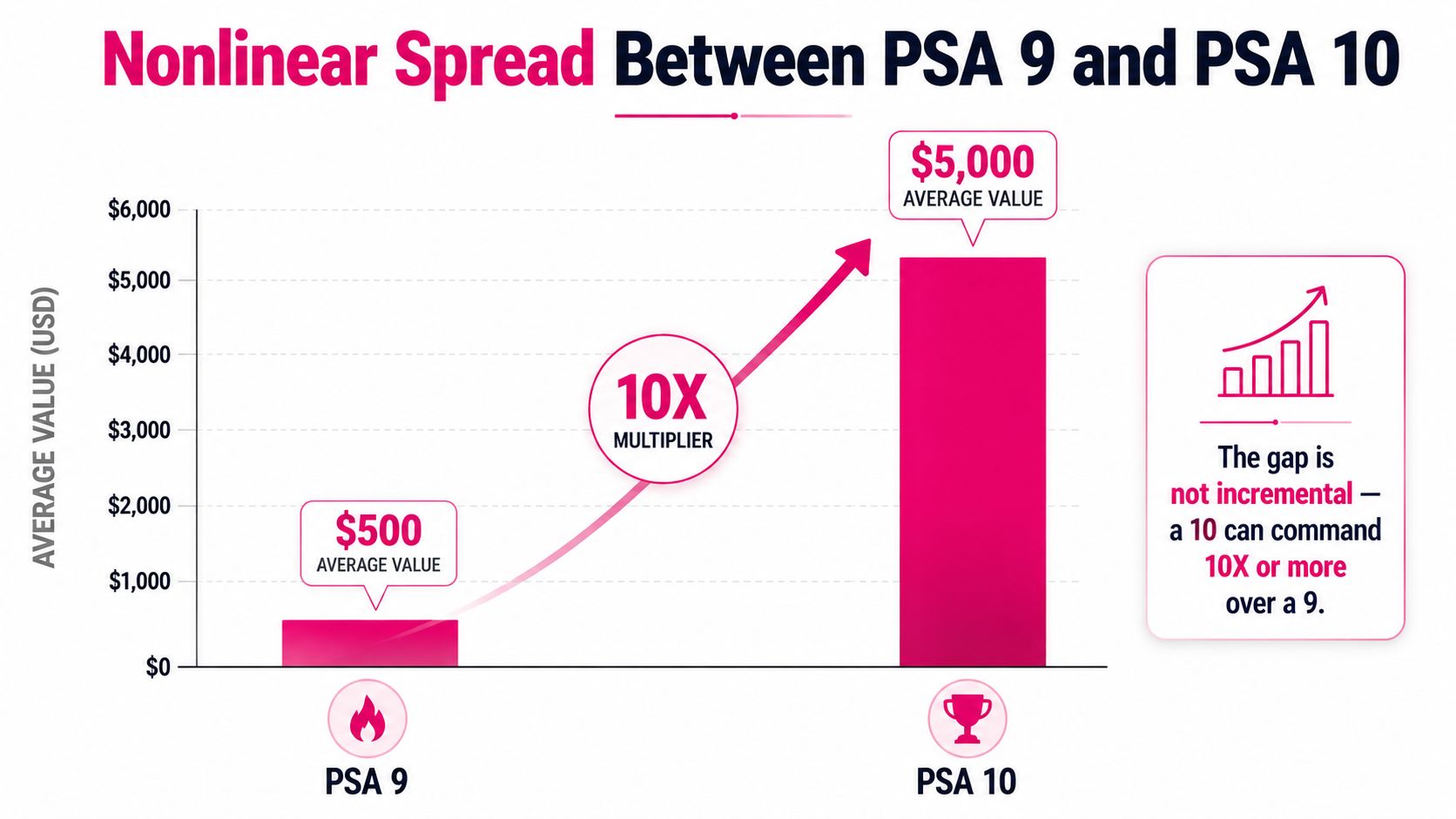
The gap between PSA 9 and PSA 10 is rarely incremental. On desirable chase cards, grading guides often put the PSA 10 at roughly 5x to 10x the PSA 9, which is why one grade can change the whole submission decision.
Why the jump isn’t even
The market doesn’t price each step of the PSA scale like a ladder with equal rungs. Instead, buyers often treat PSA 10 as the scarce endpoint and PSA 9 as the near-miss. That creates a cliff, not a slope.
Vintage and modern cards behave differently here. Vintage cards can still hold strong value at lower grades because scarcity and eye appeal matter more than raw condition alone. Modern cards, on the other hand, often have a tighter gap unless the card is a true chase issue with strong PSA 10 demand.
That’s the part many newer sellers miss. A PSA 9 isn’t automatically “almost as good” as a PSA 10 in pricing terms, and a card that looks mint to the eye can still land in a much lower market lane if collectors don’t view it as a premium grade.
What that means for your math
The question is not whether a PSA 10 is worth more than a PSA 9. It is. The question is whether the expected jump is large enough to cover grading, shipping, and selling costs.
Buyers don’t pay for effort, they pay for the grade on the label.
That sounds obvious, but it’s where a lot of submissions go wrong. A card with a modest PSA 9 premium can easily lose money once all the costs are counted. A card with a large PSA 10 gap can justify the gamble.
The same logic is why one card can be a no-brainer to grade and another can be dead on arrival, even if both came out of the same pack in similar condition.
Where to Look Up Real PSA Graded Card Values
A slab can look straightforward until you try to price it. One PSA 9 might sit close to raw value, while another card in the same grade carries a real premium because collectors care more about the exact issue, the population, and the room for a PSA 10.
Start with PSA’s own guide, then test it against sold comps and recent marketplace results. The guide gives you a reference point, but actual sales show what buyers were willing to pay.
A simple workflow that works
-
Start with the PSA Price Guide. Use it to anchor the exact card and grade in front of you. Treat it as a starting point, not the final answer.
-
Check sold listings for the same grade. Look for the exact slab grade, such as PSA 8, PSA 9, or PSA 10, because mixing grades hides spread.
-
Compare with recent market data. If prices have been moving, the latest sold result matters more than an old estimate.
That order keeps you from pricing off an asking price that never converted into a sale. A listing is a hope, a sold comp is evidence.
Add population context without overthinking it
Population data helps you see whether a grade is crowded or scarce for that card. PSA’s own grading guidance shows that many modern cards can reach PSA 8 or above, which means the value often comes from the top-end grades, not from grading alone. PSA’s get-started page is a useful place to start for that frame.
A good valuation routine takes minutes once you know what to check. You are trying to answer one question, whether the slab sits in a packed grade band or a thin one.
Don’t price the card you hope you have. Price the grade the market can actually see.
For collectors who want a more structured way to test the numbers before submitting, Double Holo’s grading ROI calculator can help frame the decision before the card leaves your desk. Use it as a filter, then confirm the result with sold comps.
A quick reality check
If the PSA 9 and raw prices are close, grading probably will not leave much margin. If the PSA 10 clears a meaningful gap, the card may still make sense to submit. The decision comes down to whether the spread still holds after grading fees, shipping, and selling costs.
Why PSA Resale Prices Beat Other Graders
A card can grade well and still sell for less if buyers do not trust the label. PSA has the stronger resale position because collectors recognize it first, and that recognition shapes what people are willing to pay when a slab hits the market. PSA says that in its comparable-sales sample, PSA cards sold for more than BGS, CGC, and SGC graded cards 9 out of 10 times, and PSA 10s outperformed those competitors 96% of the time. PSA’s grading value page makes that comparison directly.
Why the label matters
Collectors know PSA. Buyers trust the grade, the slab, and the price history attached to it. That familiarity creates liquidity, and liquidity usually matters more than theoretical slab quality once a card is listed for sale.
PSA’s own pricing ecosystem reinforces that center of gravity. The company’s valuation tools are built around PSA Price Guide language, which shows where PSA wants collectors to look first when pricing a card. PSA’s price guide reflects that ecosystem directly.
The result is straightforward. More buyers search for PSA slabs, more sellers list PSA slabs, and more completed sales cluster around PSA pricing. Once that loop takes hold, the label itself becomes part of the value.
How to think about alternatives
That does not mean other graders have no place. It means you should separate market preference from grading quality. A slab can be well made, a grade can be fair, and the resale market can still pay less for it than a PSA equivalent.
If your only goal is maximum resale value in a broad market, PSA usually gives you the most familiar exit. If your goal is subgrades, different slab aesthetics, or a personal collection emphasis, the calculation changes. The key is matching the grading brand to the end buyer you expect.
The market pays for the label it recognizes fastest.
That is why PSA stays at the center of so many grading decisions. The slab is only half the story. The other half is who is willing to buy it without hesitation.
When Grading Actually Destroys Value
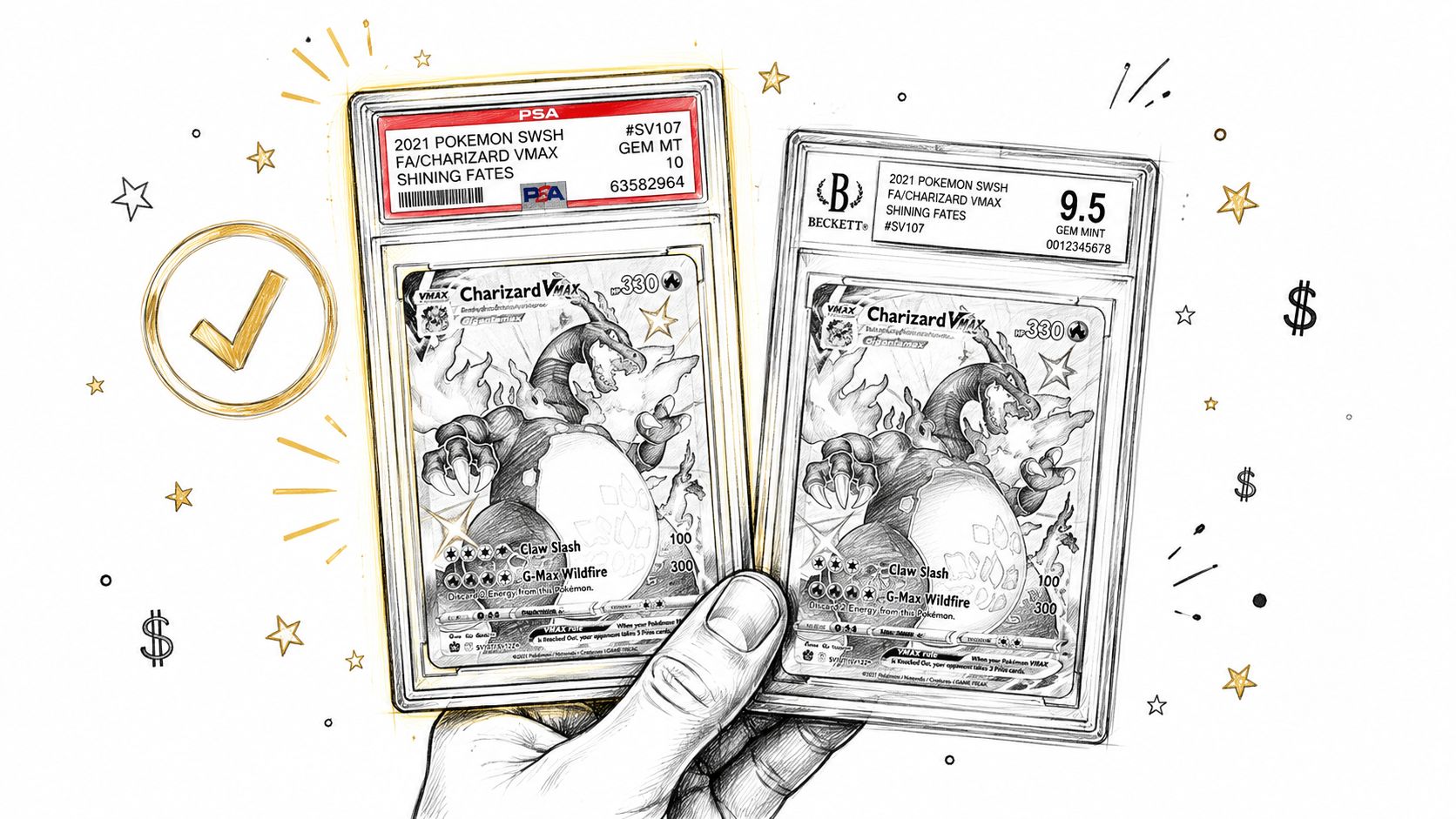
The default advice to “just grade it” breaks down fast on modern cards. A June 2025 New York Times and The Athletic report documented cases where PSA 9s sold for less than raw copies, including a Panini Giannis Antetokounmpo card priced at $100 in PSA 9 versus $124 raw. That’s the kind of inversion that newer collectors don’t expect, and it matters because the value gap is sometimes too narrow to support grading costs. The Athletic’s report shows why the assumption can fail.
When a slab hurts more than it helps
Modern cards often have plenty of supply and a crowded lower-end grade band. If the expected outcome is a PSA 9, the market may not reward that enough to cover the total submission cost, especially after shipping and selling fees.
That’s why the wrong grading decision can turn a decent raw card into a worse financial outcome. You pay for the slab, wait for the slab, and then discover the slab didn’t create enough price lift to matter.
A simple decision table
| Scenario | Expected Grade | Likely Outcome |
|---|---|---|
| Modern card with tight raw-to-PSA 9 spread | PSA 9 | Grading may erase margin |
| Modern chase card with strong PSA 10 demand | PSA 10 upside | Grading can make sense |
| Vintage card with buyer demand for condition clarity | PSA 7 to PSA 9 | Grading may improve liquidity |
| Common card with weak resale gap | Any grade below PSA 10 | Sell raw or skip grading |
The table isn’t a rulebook. It’s a filter. If the card only works when it gets a high-end grade, be honest about whether that grade is realistic.
The costs don’t disappear
Grading fees, shipping, and venue costs all come out of the same spread. If the card only gains a little after grading, those costs can swallow the difference. That’s especially true when the grade lands one step below the level you hoped for.
If you’re looking at a modern card and the raw sale already sits close to PSA 9 pricing, the safe move is often to sell raw. Grading should be a tool for expanding value, not a habit you use because the card feels special.
If the grade you’re likely to get doesn’t change the buyer pool, it probably doesn’t change the economics either.
PSA Volumes, Fees, and the Real ROI of a Submission
PSA’s published service levels make the economics easier to see. PSA lists Value at $20/card with a 10-card minimum and a $499 declared-value cap, Economy at $50/card with a $499 cap, Regular at $100/card with a $999 cap, Express at $200/card with a $2,499 cap, Super Express at $300/card with a $4,999 cap, and Walk-Through at $600/card with a $9,999 cap. Those tiers shape the cost of every submission. PSA service tier details lay out the published caps and pricing.
PSA’s grading volume also helps explain why PSA 10 scarcity can feel different from one card to the next. One 2026 grading study reported 19+ million cards graded in 2025, up from 15.3 million in 2024 and 13.5 million in 2023, with roughly 90,000 cards graded per day by June 2026. The same market data noted PSA graded 2.17 million cards in March 2025, up 16% month over month and 47% year over year.
Use a four-line ROI check
Start with the expected graded value. Subtract the raw value. Subtract the grading fee. Subtract shipping and marketplace costs. If what’s left is thin, you’re probably forcing the submission.
That simple framework works better than optimism. It forces you to ask whether the card has enough PSA 10 upside, enough liquidity, and enough margin to survive the process.
What to watch before you submit
-
Declared value limits: If the card could move into a higher price band, the fee structure matters before you ship.
-
Volume pressure: Heavy grading volume can make common grades less special.
-
Exit costs: Selling a slab isn’t free, so your final profit isn’t the same as the comp you saw online.
The point isn’t to avoid PSA. It’s to grade selectively. A card only deserves a submission if the likely sale result leaves room for the full cost stack.
For a practical pre-submission check, Double Holo’s grading ROI calculator is built for exactly this kind of decision, and it’s useful before you package a card that might be better sold raw.
If you want a clearer read on whether a card should be graded, sold raw, or held for a stronger market, use Double Holo to compare pricing, track the spread, and run the ROI math before you submit. It’s a cleaner way to avoid paying for a slab that won’t earn itself back.