

You’re staring at a slab label or a raw card in a sleeve, and the same question keeps coming up, is this thing really a PSA 9, a BGS 9.5, or just a card that looks better than it grades? That’s the practical problem behind the Pokémon card grading scale. The number matters, but only because buyers, sellers, and graders use it as a shortcut for condition, liquidity, and resale reality.
Table of Contents
How the Pokémon Card Grading Scale Works
A card enters grading with one question in mind, where does it land on the slab scale, and is that grade worth the fee. The system uses four physical checks, centering, corners, edges, and surface. Leading graders judge cards through those same four points, and PSA’s grading standards are built around that framework (PSA grading standards). The published scale runs from 1 to 10, with 10 at the top and 1 at the bottom (PSA get started guide).
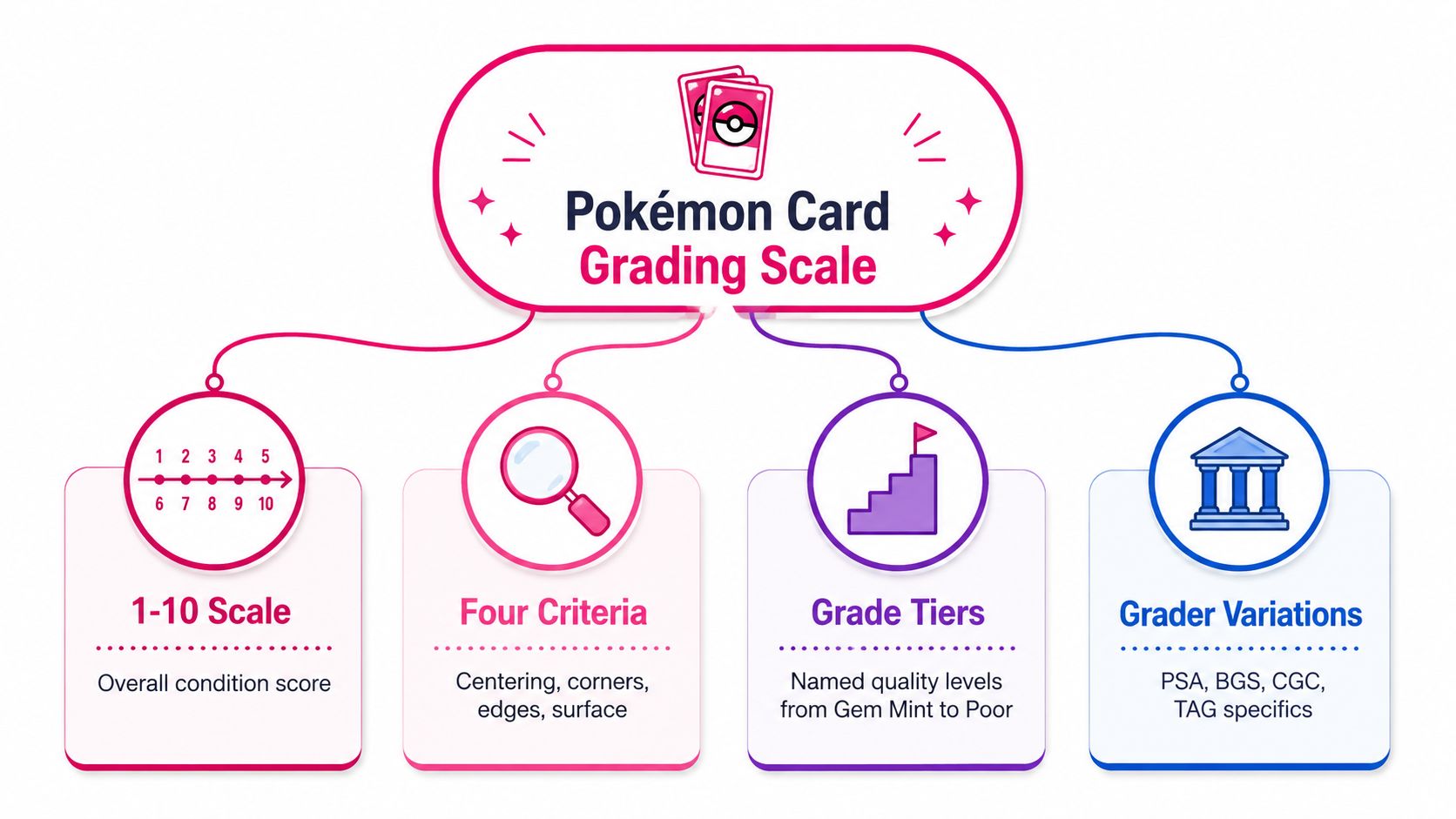
What the number means
A grade is a market judgment about defects. It tells you whether the card’s flaws stay inside a grader’s tolerance or push it down the ladder. PSA says a Gem Mint 10 has to be virtually perfect, with centering around 55/45 on the front and 75/25 on the reverse (PSA grading standards). That tolerance matters because a card can look clean in a sleeve and still miss the top tier once a grader measures it against the standard.
Practical rule: if you can spot a centering issue without tools, the card probably is not a clean 10.
Why the scale is also a market filter
The scale does more than describe condition. It sorts cards into different liquidity buckets. PSA notes that about 90% of Ultra-Modern Sport cards and Modern TCG cards have graded PSA 8 or higher, while about 80% of Vintage TCG cards have graded PSA 7 or higher (PSA get started guide). That tells you two things. Modern cards are easier to keep in high-grade shape, and vintage cards are judged against tougher preservation realities.
That is why buyers do not treat PSA 8, PSA 9, and PSA 10 as minor cosmetic steps. Each one lives in a different market tier. The label is small, the change in buyer behavior is not.
The Full Grade Ladder From Gem Mint 10 Down to Poor 1
A 10-point grading ladder is really a trading map. Each grade tells you where a card sits in the market, how harshly the flaws will be judged, and whether the slab belongs in a premium price bracket or a binder stack (Pokémon grading ladder reference). Sellers use that ladder every week because buyers do not pay the same money for a card that merely looks nice and a card that can carry a top-tier label.
Top end to mid-tier
A Gem Mint 10 card is the card everyone chases, but very few raw cards deserve it. It should present as clean, sharp, and free of anything that would bother a grader under close inspection. A Mint 9 still sells as a premium copy, but tiny print lines, a faint edge mark, or another trivial flaw can keep it out of the top slot.
Near Mint-Mint 8 is the point where the card still looks strong, but the market stops calling it near-perfect. A PSA 8 can still be very liquid if the card is desirable, yet it is no longer the kind of copy that commands top-dollar collector attention. Near Mint 7 and Excellent-Mint 6 are where the wear becomes obvious to anyone who looks carefully, with surface wear, small edge issues, or modest play wear showing up without much effort.
Lower grades and what they signal
Excellent 5, Very Good-Excellent 4, and Very Good 3 are play-copy grades for most cards in the market. They still have value, especially on older or harder-to-find cards, but they trade as condition copies, not premium slabs. Good 2 and Poor 1 are heavily worn cards, the kind collectors buy for binder fills, nostalgia, or a specific checklist gap.
Half grades like 8.5 do exist, but they are not universal across grading services, and you should never assume you will get one back just because the card sits between two tiers. Grading services make their own call, and the slab label is the final answer.
A card that looks “clean enough” in hand can still grade ordinary once corners, edges, surface, and centering are judged together.
How I read the ladder as a seller
If a card has strong eye appeal but one clear flaw, I treat it as a card that tops out below 10. If it has several minor issues, I stop pricing it like a gem candidate. That keeps you from paying submission fees on a card that was never a realistic shot at the top tier, which is where a lot of grading money gets wasted.
A PSA 9 is the clean market standard most sellers target first, but it does not translate the same way under every grader’s eyes. Under BGS eyes, a PSA 9 often looks like a card with a solid overall body and one or two visible weak spots that hold it back from the perfect label. Under CGC eyes, it is still a strong copy, but the card needs to stay clearly above average across the full surface, edge, and corner check. Under TAG eyes, the same card gets read as a condition profile, which is useful when you want a more analytical view before you spend on submission.
That translation matters because the right grading target depends on what the card can support. A modern card with clean print quality and strong centering may have a real shot at a top-tier result, so paying for a premium service can make sense. A card with visible wear, a soft corner, or obvious centering drift should be treated as a mid-grade submission at best. Grade the card for the result it can reach, not the result you want to see on the slab.
How PSA, BGS, CGC, and TAG Differ on the Scale
PSA keeps it simple, one number from 1 to 10 with named tiers, no visible subgrades. BGS uses half grades and subgrades, while CGC also grades on a 10-point scale with its own standards (grading company comparison). TAG uses tech-assisted grading and a numerical result, which is why collectors often use it for a more data-driven read when they want another opinion on condition.
| Grader | Scale | Half Grades | Subgrades | Best For |
|---|---|---|---|---|
| PSA | 1–10 | No | No | Liquidity and simple market recognition |
| BGS | 1–10 with half steps | Yes | Yes | Condition-sensitive submissions |
| CGC | 10-point scale | Yes | No on new submissions | Clear grading at a lower-friction entry point |
| TAG | Numerical grade with tech-assisted review | Yes, depending on result format | Technology-led condition analysis | Cross-checking condition with a more analytical workflow |
What that means in practice
PSA is the easiest label for the average buyer to read. That simplicity helps resale, because a PSA slab doesn’t make people decode subgrades before they make an offer. BGS is the most transparent when you want to know why a card scored the way it did. If the centering is clean but the surface is not, BGS makes that visible.
CGC sits in the middle. It uses a graded scale that feels familiar, but it doesn’t overload the label with the same kind of detail BGS does. TAG appeals to collectors who want a more tech-forward view of condition and a cleaner comparison when they’re testing crossover outcomes.
Which one I’d pick
If I’m selling into the broadest audience, I want PSA. If I’m chasing a card that needs subgrade proof to show its quality, I look at BGS. If I want a straightforward slab with a modern grading approach and I’m not chasing the same resale behavior as PSA, CGC or TAG can make sense.
Translating a Grade Across PSA, BGS, CGC, and TAG
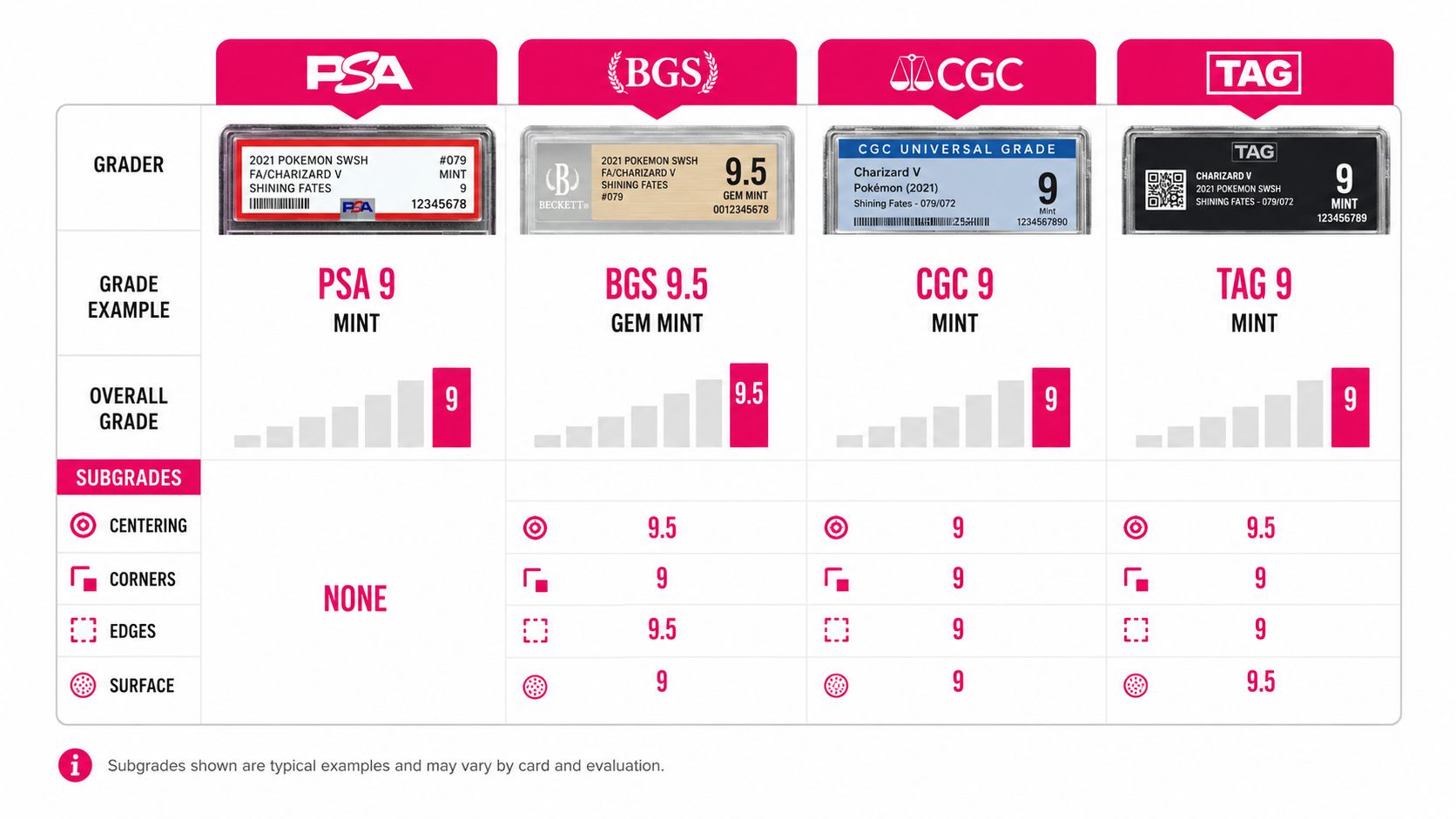
A PSA 9 is the card people cross-shop first because it sits in the middle ground between strong eye appeal and one visible flaw. If the card only has mild centering drift or a bit of surface noise, it often reads like a BGS 9 to 9.5 candidate once subgrades are broken out. The same card can also land as a CGC 9 if the overall condition is solid but not clean enough to push higher.
A PSA 9 is not always a near-miss PSA 10. Sometimes it is a card with one issue that a stricter grader will isolate more clearly. BGS does that with subgrades, so a clean front with weak centering or a light surface issue stops being vague and turns into a very specific reason for the final number. TAG approaches the card with tech-assisted measurement, so the result usually feels less subjective even when the final grade sits in the same general range.
For a PSA 10, do not assume another grader will read it the same way. Some clean PSA 10s can still look like a CGC 10 or a strong BGS result, but strict centering and subgrade transparency can push the card one step different depending on the exact flaw profile (grading company comparison). The cross-grading question is whether the card’s visible wear is small enough that another grader could reasonably split on it.
Straight rule: cross-grading only makes sense when the card’s flaws are subtle enough that another grader could plausibly score them differently.
The money decision comes before the submission fee. If the card’s value comes from eye appeal and broad buyer recognition, PSA usually gives the cleanest exit. If the card’s appeal comes from measurable condition detail, BGS makes the stronger argument. If you are trying to decide whether a second submission is worth paying for, the cross-grader translation is the filter that keeps you from paying for wishful thinking.
The Four Inspection Criteria in Practice
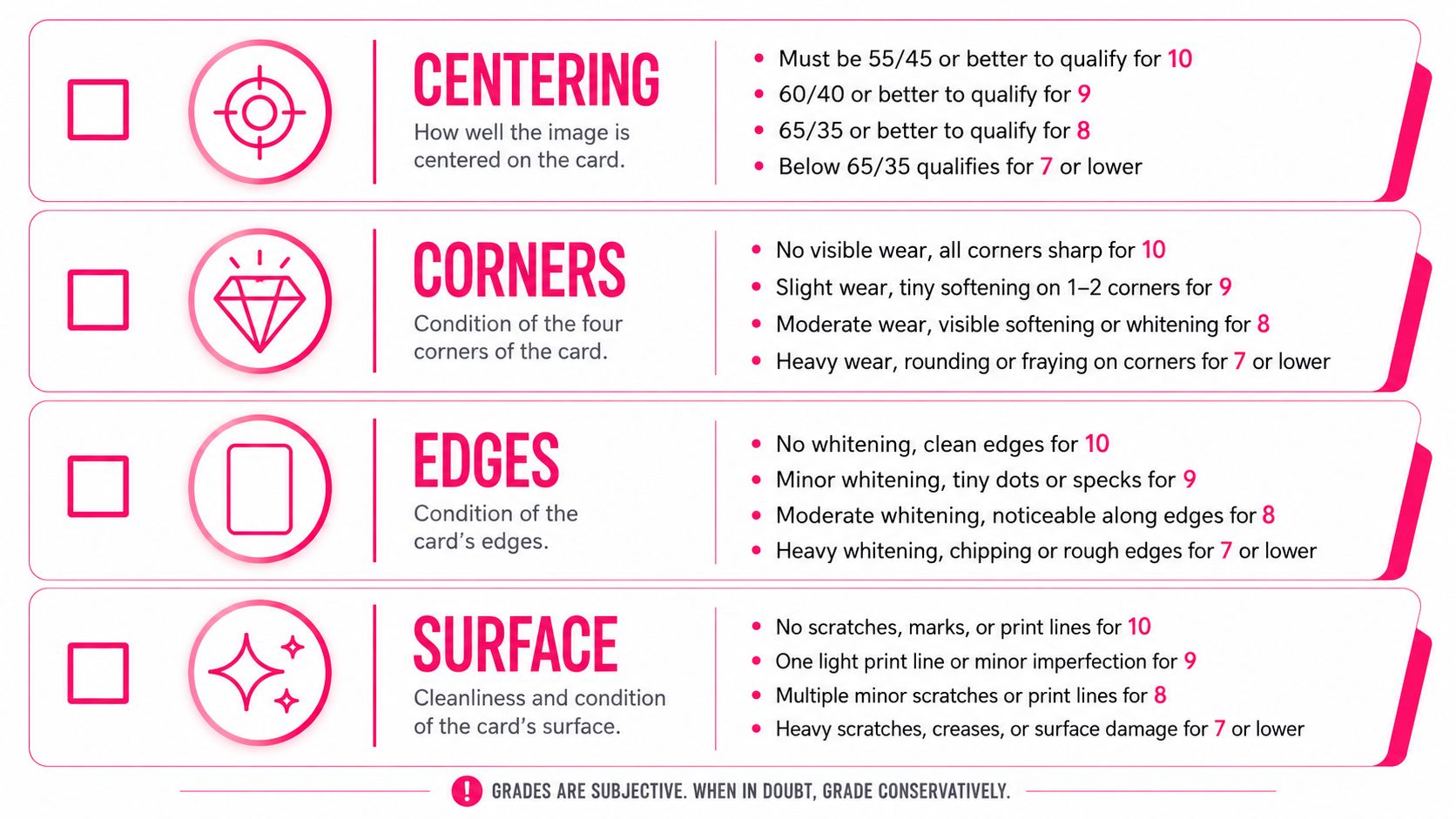
A card that looks clean in a sleeve can still fall apart under grading scrutiny. The four checks are simple, centering, corners, edges, and surface, but the market treats them differently depending on the grader. A PSA 9 with strong eye appeal may still read like a BGS 9 with one weak subgrade, or a CGC and TAG card that exposes the flaw more clearly once the measurement gets tighter. If you want to know whether your card is really worth a submission fee, use the grading decision guide before you send it in.
How I screen a card at the desk
Start with the borders. A card that looks lopsided in hand is already telling you it probably does not belong in the top tier. Then check the corners for whitening, dings, or rough cuts. After that, run through the edges and look for wear, then tilt the card under light and inspect the surface for scratches, print lines, and dull patches.
Desk test: if you catch the defect in one quick pass under a lamp, a grader probably can too.
The surface check is where a lot of collectors fool themselves. A card can have sharp corners and solid centering, then lose ground because the front shows a line or the holo has a visible mark. That is why naked-eye appeal and grading outcome are not the same thing.
A sealed product like Sealed Mini Tin Display - Scarlet & Violet 151 still matters here, because the grading conversation starts the moment a pull leaves the pack. The packaging does not change the criteria. The card does.
When a Card Is Actually Worth Grading
Most cards should not be graded. That’s my opinion, and it’s the one that saves people the most money. A card is worth grading only when the expected slab value beats the submission cost and the card has a realistic path to the grade you’re paying for. If you’re buying a submission slot on a hope, you’re probably paying to lose.
This grading decision guide is the kind of reference I’d use before I mailed anything out.
The numbers you should care about
Raw price matters, but it’s not enough. You also need the grading fee, the chance of landing the right tier, and the likely resale premium if the card comes back lower than hoped. A cheap modern holo with a decent chance at a middle grade usually doesn’t pencil out. A vintage card with a believable PSA 7 or PSA 8 ceiling can still make sense because the raw-to-graded spread is wider.
My rule of thumb
-
Grade modern hits only when the top grade is realistic. If the card is clean but not exceptional, the fee can eat the upside.
-
Grade vintage with caution but not fear. Older cards don’t need to be perfect to have value in a slab.
-
Skip low-value cards unless you’re bundling volume. One weak card won’t cover the mistake.
The common mistake is treating grading like a lottery ticket. It isn’t. It’s a margin decision. If the slab can’t beat the cost on paper, the best grade in the world won’t rescue the math.
A Worked Example of Grading ROI
The decision becomes mechanical. A raw modern chase card with strong eye appeal can look like an easy submission until you price the outcome by grade. If the card is most likely to land at a solid mid-high tier, the fee can make sense. If it only works when it returns a top grade, you’re betting on a narrow outcome.
For a submission model, I’d also keep opportunity cost on Pokémon grading in mind, because time and capital matter just as much as the label.
A simple way to frame it
Think in three buckets. First, the card’s raw value. Second, the fee to grade it. Third, the likely returned grade. If the graded card at a strong but not perfect tier still covers the fee and leaves room for profit, you have a real submission candidate. If only a 10 works, the card is too fragile for the fee structure.
A vintage card can behave differently. The ceiling is often lower than modern gem-mint chasing, but the spread between raw condition and slabbed condition can still be large enough to justify the expense. That’s why older cards sometimes make better grading projects than flashy modern cards that look more expensive than they are.
The cleanest submission is the one that still makes sense when it misses the top grade.
What I watch for before sending a card
I don’t want a card that only wins in the best-case scenario. I want a card that still returns acceptable value if it lands one tier below my dream grade. That’s the difference between a smart submission and a sunk cost.
Why that matters to buyers
A PSA 10 or an equivalent top-tier slab commands a premium because very few submitted cards reach that level. The market is not paying for a label alone. It is paying for the tiny slice of cards that clear the top of the scale cleanly, and collectors know that supply is limited before they even start searching listings.
Vintage cards are a different business. Older cards are harder to keep clean, and the usual ceiling is lower than what you see on modern submissions, as shown in PSA’s own get started guide. That is why a strong PSA 7 or PSA 8 vintage card can still bring real money, even when the raw card looks ordinary to a casual eye.
Where BGS can beat PSA
A BGS 9.5 with strong subgrades can beat a PSA 10 on certain cards when buyers care about visible condition detail more than label simplicity. That is common with collectors who want evidence, not just a headline grade. BGS can also make a card easier to evaluate at a glance because the subgrades show where the card is strong and where it is weak. The tradeoff is liquidity, since the broad market still moves fastest when the label says PSA.
A card’s population at the top matters even more than the label when you are deciding what to submit or what to pay. Population data changes what you should pay for because the premium only holds when the top grades stay scarce.
Quick Reference Guide to Pokémon Card Grades
| Grade Name | Numeric Value | Allowed Wear | Market Position |
|---|---|---|---|
| Gem Mint 10 | 10 | Virtually perfect, strict centering, no visible flaws | Trophy |
| Mint 9 | 9 | Tiny imperfections only | Premium |
| Near Mint-Mint 8 | 8 | Very light wear, strong overall appeal | Mid to premium |
| Near Mint 7 | 7 | Noticeable but limited wear | Mid |
| Excellent-Mint 6 | 6 | Clear wear, still presentable | Mid |
| Excellent 5 | 5 | Moderate wear | Entry |
| Very Good-Excellent 4 | 4 | Heavier wear, still intact | Entry |
| Very Good 3 | 3 | Significant play wear | Entry |
| Good 2 | 2 | Heavy damage or strong wear | Lower entry |
| Poor 1 | 1 | Severe damage | Lowest entry |
Half-grade means a service can split the scale with a step like 8.5.
Subgrade means the grader shows separate scores for centering, corners, edges, and surface.
Crossover means sending an already graded card to another company for a different result.
Gem mint means the card sits at the very top of the scale with near-perfect condition.
Common Mistakes Collectors Make With the Grading Scale
The biggest mistake is assuming a clean-looking card must be a 10. It doesn’t. A card can look gorgeous in a sleeve and still miss the top grade because centering, surface, or a single corner isn’t good enough.
Three bad assumptions I hear all the time
-
“Highest grade always means highest profit.” Not true. A lower grade can be smarter if it’s cheaper to obtain and still sells well.
-
“The same number means the same thing across graders.” It doesn’t. PSA, BGS, CGC, and TAG don’t read condition the same way.
-
“A modern chase card is always worth grading.” Only if the fee and likely grade leave room for profit.
A clean 9 in a low-pop set can beat a 10 in a saturated modern release if buyers want the card and the slab has room to move. That’s the part casual collectors miss. The scale is only half the story, the other half is what the market is willing to pay for that grade in that specific card.
Frequently Asked Questions About Pokémon Card Grading
Should I resubmit a card that came back a 9?
Only when you can explain why it missed the next grade and the card is worth the extra fee. A blind resubmission is a bad bet. If the centering is borderline, the surface has visible wear, or the corners already look soft, another trip through grading usually just adds cost.
Is crossover grading worth it?
It can be, but only when another grader is likely to read the card differently. A card that is clean enough for a stricter holder, or a slab that looks undergraded compared with the market, has a real shot. If the flaw is obvious, the crossover fee is money thrown away.
Do vintage and modern cards grade the same way?
They use the same core criteria, but the market does not treat them the same. Vintage cards usually have a lower practical ceiling because age makes pristine preservation harder, while modern cards are judged against much tighter factory and print quality. PSA’s published thresholds reflect that difference, as noted in the PSA get started guide.
Are half grades like 8.5 worth chasing?
Only if the grader uses them in a way the market respects and the card sits near that line. Half grades exist, but I would not build a submission plan around them. A strong full grade is easier to price, easier to sell, and usually easier to explain to a buyer.
If you are deciding whether a card belongs with PSA, BGS, CGC, or TAG, the question is what grade the card can realistically earn before you pay the fee. Double Holo gives you the marketplace and the grading context in one place. Use Double Holo to compare raw and slabbed cards the way sellers price them, then submit only the cards that still make sense if they miss your top target.