

What matters now isn’t whether Pokémon cards are valuable. The question is how value forms, where it concentrates, and why the same card can mean three very different prices depending on condition, tier, and how fast you need to sell it.
Table of Contents
The Pokemon Card Market Has Become a Multi-Billion-Dollar Asset Class
Heritage Auctions’ Pokémon category revenue grew 34% year over year through Q1 2026, and average PSA submission volume for Pokémon cards rose 22% in Q1 2026 versus the same period in 2025. That combination matters because it points to active grading demand and steady high-end price discovery, not just nostalgia chasing.
Practical rule: when a market scales this far, the headline price is only the starting point. The real work is figuring out whether a card is liquid, grade-sensitive, or trapped in the long tail.
The infographic’s 2024 market-size framing and 2032 projection are useful as design context, but the verified data already shows the bigger point. Pokémon cards are no longer priced by “rarity” alone. They are priced by a mix of collectability, condition, and the speed at which a buyer will pay up.
The Three Components of Every Card’s True Value
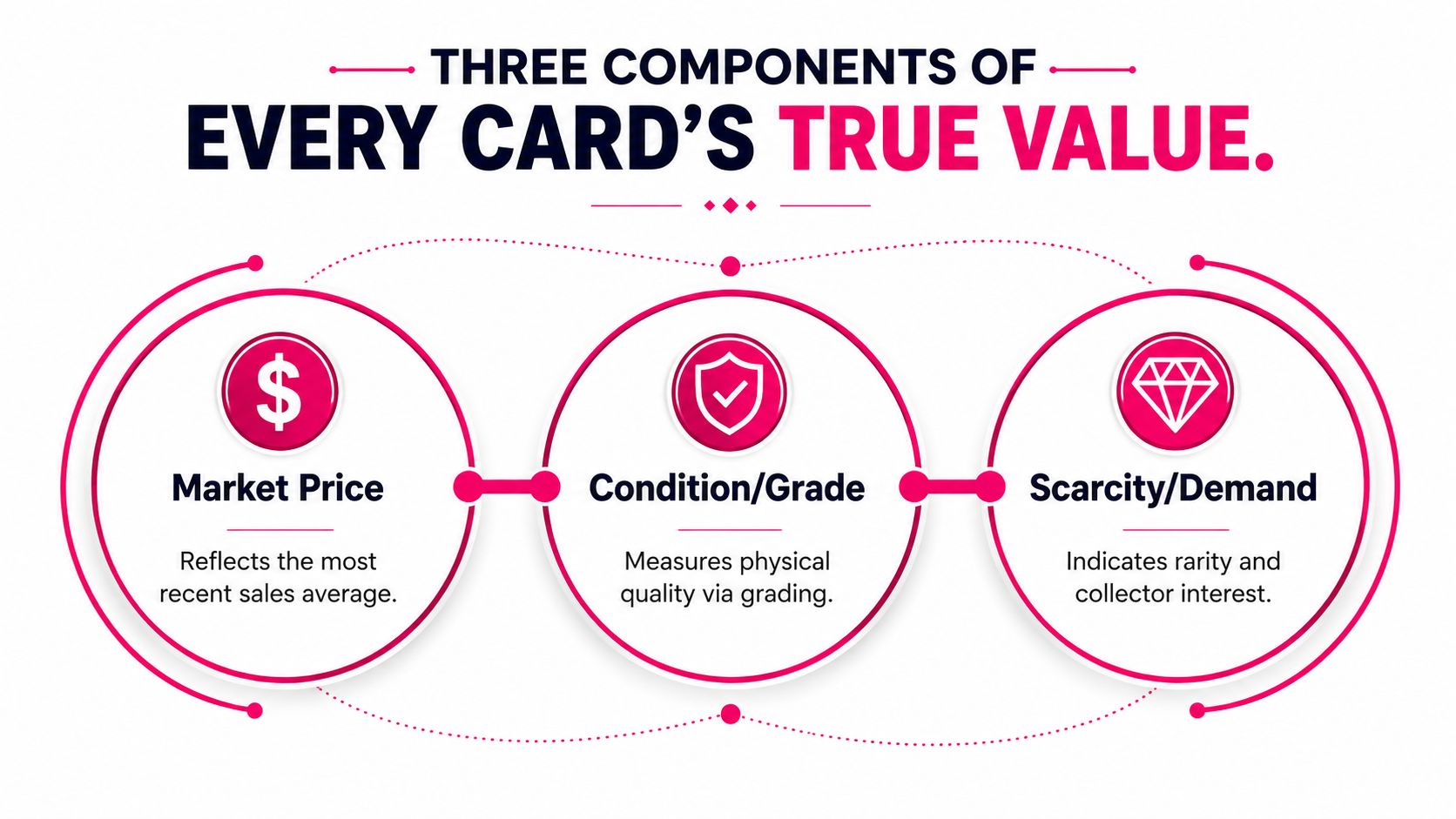
A card’s value breaks into three layers, and mixing them up is where most pricing mistakes start. The first is raw market price, which is what an ungraded copy trades for. The second is the graded premium, which is the extra value buyers assign to a card after it receives a strong grade. The third is the liquidity discount, which is the haircut you accept when you need cash quickly instead of waiting for the ideal buyer.
A clean way to think about it is this: a card can be worth one amount to a collector, another to a grader, and a lower amount to a dealer. One analysis says a PSA 10 can command a 5× to 10× premium over a raw copy, while a fast liquidation sale to a dealer may realize only 60% to 70% of market value. That spread isn’t a technicality, it’s the market.
Raw price, graded premium, and liquidity haircut
Raw price is the easiest layer to misunderstand because it looks simple. Buyers see a listing, assume that number is the market, and stop there. But the graded premium can completely change the economics of a card, especially when condition is strong enough to justify certification.
Liquidity is the part most sellers ignore until they need money fast. A dealer offer can be rationally lower than public-market value because the dealer is absorbing resale risk, spread, and time. That’s why two people can both be “right” about a card’s value and still disagree by a large margin.
A card’s value is not one number. It’s a range defined by condition, buyer type, and how fast you want out.
The implication for Pokémon card market values is simple. If you don’t separate these layers, you’ll overprice some cards, undergrade others, and misread how much capital is really sitting in your binder.
How Value Concentrates in a Small Fraction of Cards
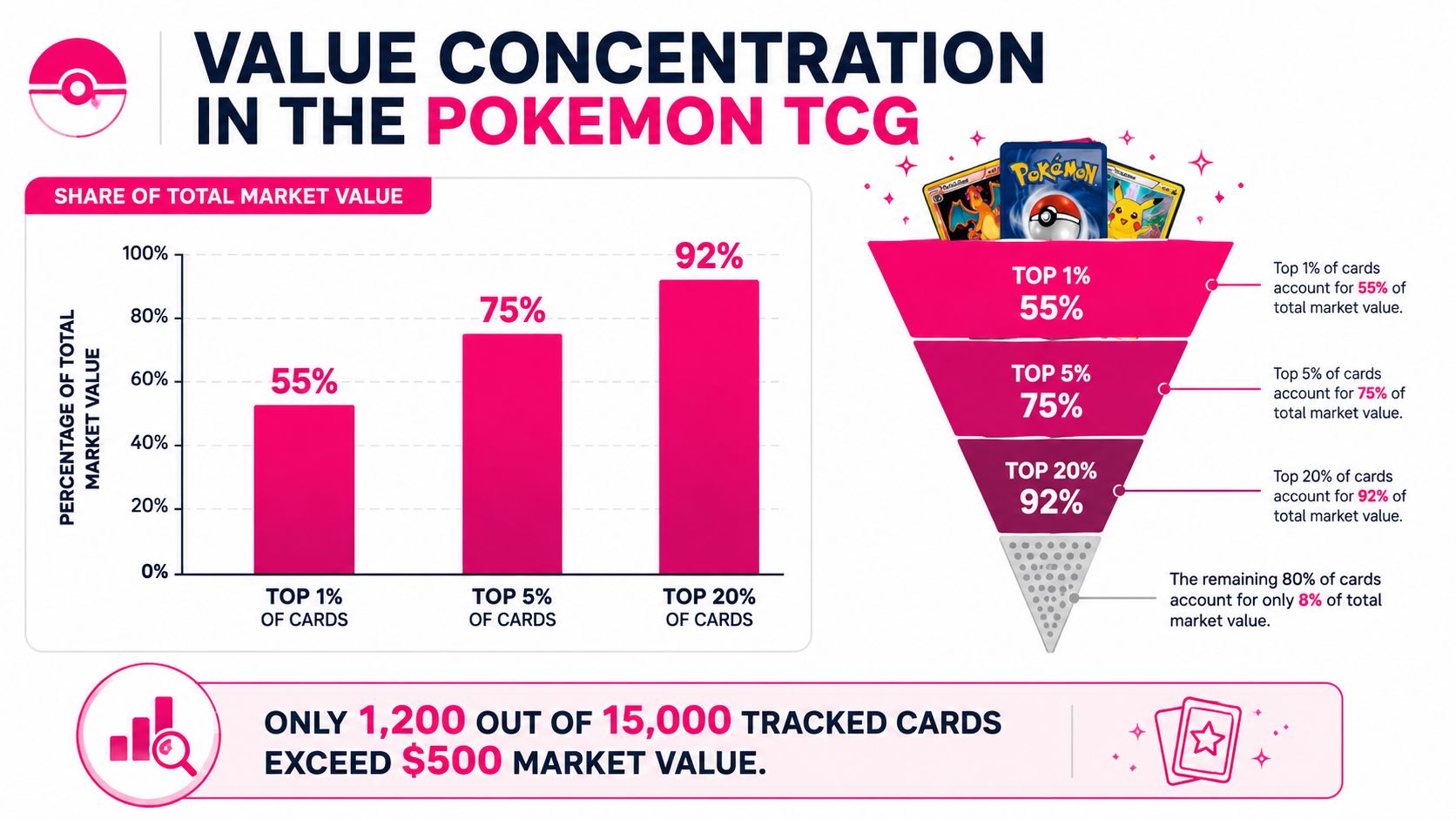
The market is extremely top-heavy. One live index tracked 84,660 Pokémon cards across 775 English and Japanese sets and promo series, and found only 3,349 cards worth $100+ ungraded, with just 435 cards worth $1,000+ ungraded. That means roughly 0.6% of priced cards cleared the $1,000 threshold, a blunt sign that most inventory sits far below the cards people talk about online.
The same dataset estimated the combined market value of one copy of every tracked card at $5.2 million, and found a 12.0× median PSA 10 premium versus raw cards across 20,621 cards priced at $5+. That premium matters because it shows how grading can pull value upward, but only in the right segment of the market.
The long tail is real, not theoretical
An academic study of 300 Pokémon cards sold on eBay found a median sale price of €1.95, while rare cards made up only 19.1% of sold cards but contributed 58.8% of total revenue source. The same study reported 73.3% of the cards sold during the study period, for €923.60 in total revenue, with a maximum observed price of €145.00 source.
That distribution tells you how to read your own collection. A stack of common and mid-tier cards can look impressive in volume, but still contribute very little to total value. The money sits in a narrow band of rare, desirable, and usually well-graded pieces.
Common mistake: collectors often count cards, then estimate value. The market does the opposite. It prices a few standout pieces and lets the rest drift into the long tail.
Are old Pokémon cards worth anything is a useful question only if you separate nostalgia from resale reality. Most old cards sit in the low-value majority, and the market data above is blunt about that.
The Tier Split That Defines the 2026 Market
What top tier really means
Top tier is not just “expensive.” It usually means cards with broad collector recognition, proven liquidity, and enough demand to absorb inventory without collapsing under supply. PSA 9 and PSA 10 copies tend to sit in this tier because buyers can compare them easily and move them quickly.
Mid-tier cards are where many collectors get stuck. They are desirable enough to feel valuable, but not scarce or iconic enough to attract consistent premium bidding. That’s why flat performance in the middle can coexist with strength at the top.
Low-tier cards are a different problem entirely. These cards often have decent aesthetics or set relevance, but weak demand concentration. When that happens, even strong-looking copies can slide because there isn’t enough buying pressure to hold the line.
Why tier segmentation matters
The practical lesson is to stop valuing by set alone. Two cards from the same era can behave very differently if one has broad chase appeal and the other doesn’t. Supply elasticity and demand concentration are much stronger at the top of the market, which is why PSA 9 to PSA 10 liquidity is structurally better than mid-grade or bulk-modern liquidity.
If you’re deciding whether to hold, sell, or grade, the first question isn’t “Is this rare?” It’s “Which tier does this card trade in?” That answer changes the entire pricing model.
When Grading Actually Makes Financial Sense
Grading only works when the upside beats the full cost stack. That includes the grading fee itself, turnaround risk, and the liquidity haircut you avoid or accept by certifying the card. A PSA 10 premium can be huge, but it doesn’t matter if the card can’t realistically reach that grade or if the premium won’t cover the process.
The decision changes by card, not by mood. A card with strong raw demand, clean centering, and a high-end buyer base has a very different grading math than a common card with only speculative upside. That’s why the 12.0× median PSA 10 premium from the earlier section is a benchmark, not a promise.
The basic grading test
Use a simple filter before you submit anything:
-
Raw value first. If the ungraded card is too cheap, the premium usually won’t justify the effort.
-
Condition second. A card with visible wear usually needs a very strong market reason to grade.
-
Premium third. Ask whether a higher grade would meaningfully change resale behavior.
-
Exit route last. If you plan to sell fast, the graded premium has to exceed both costs and delay.
A card like Tool Scrapper - Rebel Clash #208 is a useful reminder that not every card belongs in a grading strategy. The name may be easy to identify, but easy identification doesn’t mean easy monetization.
For deeper comparison logic, the graded card price guide gives a better way to think about raw versus slabbed value than blanket “grade everything” advice. That matters because grading is an investment decision, not a ritual.
Working rule: if the expected graded premium doesn’t comfortably clear the combined friction of fees, wait time, and resale spread, keep the card raw.
Why Headline Prices Can Be Misleading
A headline price is not the same thing as realized value. Sellers anchor to a recent sale or a strong listing and assume the market will meet them there, but the market often won’t. The missing variable is liquidity, which is just a fancy way of asking how fast the card can sell at that level.
That distinction matters most in a bifurcated market. Independent coverage says the Pokémon market is fragmenting, with top-tier PSA 9 to PSA 10 cards rising while mid-tier PSA 7 to PSA 8 cards stagnate, and it reports average days on market of 4.2 days for the top 5% of cards. That leaves a huge gap between what a seller asks and what a buyer will clear quickly.
Asking price versus exit price
The top of the market can support aggressive pricing because buyers are concentrated and motivated. The middle can’t always do that. A card that looks “worth more” on paper may be hard to convert into cash without discounting.
That’s why vendors should price by both value and expected time to sale. A card that sells fast at a slightly lower number can be more useful than a card that sits for weeks at a prettier headline. Collectors who need liquidity should think the same way.
In practice, the right question is not “What is this card worth?” It’s “What will someone pay for it in the timeframe I care about?” Those are different numbers, and in a fragmented market, the difference can be large.
A Practical Framework for Evaluating Any Card’s Market Value
The cleanest valuation process starts with classification, not guesswork. First, place the card in the right tier by demand and collectability. Then look at actual completed sales, not just asking prices, because completed sales show what buyers are willing to do.
After that, test the grading case. Ask whether the raw copy has enough condition quality and premium potential to justify submission. If the answer is yes, compare the expected return against the friction you’ll absorb along the way.
A repeatable checklist
-
Identify the tier. Decide whether the card behaves like top-tier, mid-tier, or long-tail inventory.
-
Check recent sales. Focus on actual transactions, because listings alone can overstate value.
-
Measure grading upside. Compare the raw copy against the likely slabbed outcome.
-
Estimate liquidity. Decide whether you need top dollar or fast cash.
-
Adjust for timing. If the market is moving unevenly, the same card can price differently by week.
A tool layer can help here, but it should support judgment, not replace it. Double Holo fits naturally into this kind of workflow because it combines marketplace activity, price discovery, and vendor operations in one place, which is useful when you’re trying to decide whether a card should be sold raw, graded, or held.
Pokémon card price tracker articles are only useful if they help you compare signals against actual market behavior. The point of the framework is to make the card’s value legible before you commit time or capital.
Staying Ahead in a Maturing Market
A maturing market rewards people who use better data, not louder opinions. The collector who watches only splashy sale posts is usually late. The vendor who tracks inventory, liquidity, and grade sensitivity sees the market earlier and prices with fewer mistakes.
That’s where modern tooling starts to matter. Real-time bid and ask behavior, daily buy/sell/hold signals, alerts for price spikes and underpriced listings, and charting tools that show momentum can all help serious buyers and sellers react faster. Double Holo is built around that kind of workflow, with marketplace activity, market intelligence, and vendor tools in one system.
The broader lesson is straightforward. Pokémon card market values are no longer driven by one simple scarcity story. They’re shaped by tier splits, grading incentives, and the speed at which buyers and sellers can meet in the middle.
If you’re pricing cards, deciding whether to grade, or trying to separate real market value from a noisy headline, use Double Holo to work from actual marketplace behavior instead of guesswork. It brings price discovery, grading context, and vendor workflow into one place, which makes it easier to know what to buy, what to sell, and what to send in.