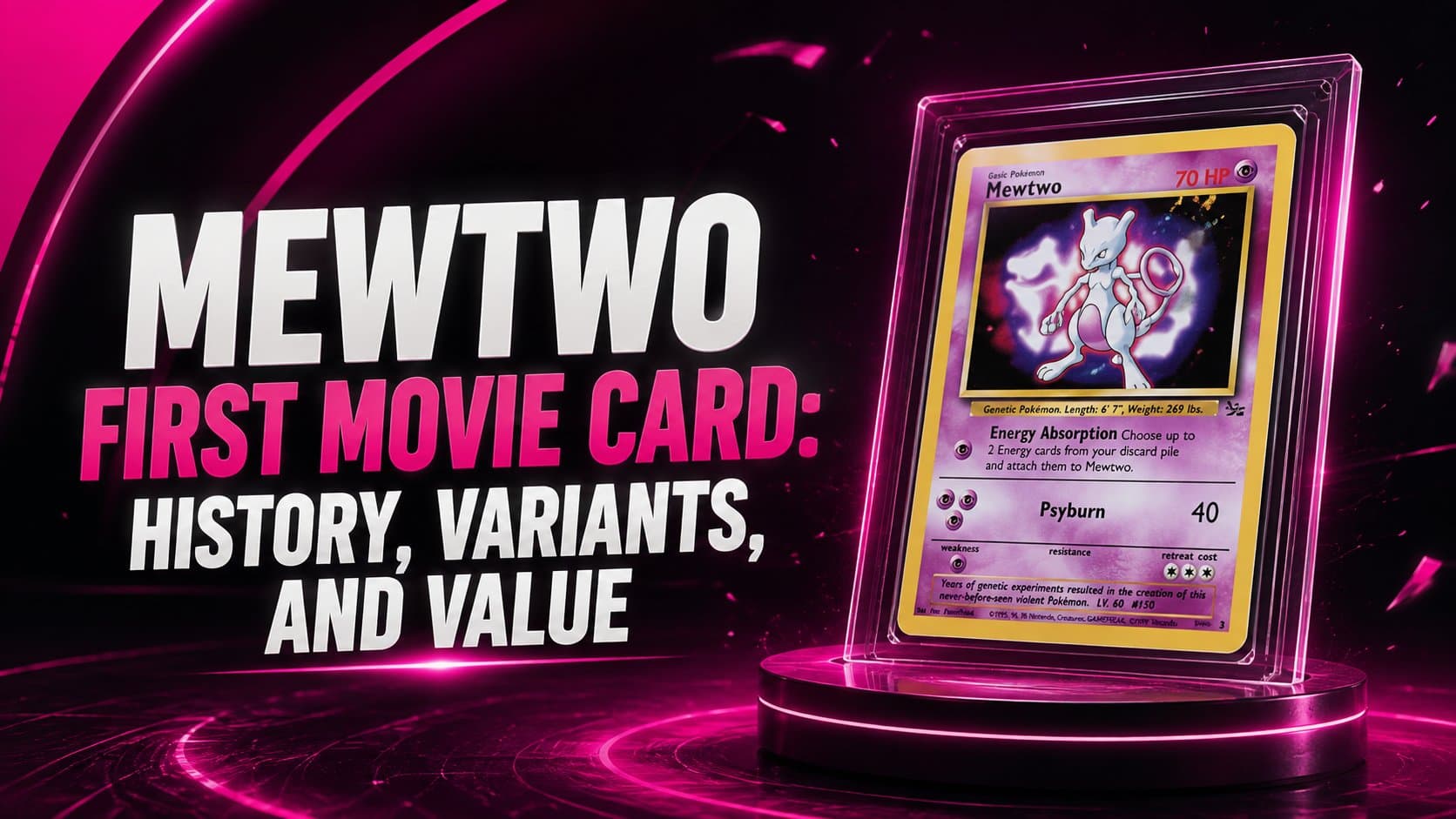
The Mewtwo Movie Promo #3 was released on November 12, 1999, and it’s tied to Pokémon: The First Movie, which opened in North American theaters on November 10, 1999 and in Japan on July 18, 1998. The separate Topps movie card product is a different collectible entirely, and that split is where a lot of new buyers get turned around.
If you’ve ever seen a listing for a “first movie Mewtwo” and wondered whether it’s the theater giveaway or the Topps card set, you’re not alone. The two products sit close together in memory, but they live in different parts of Pokémon collecting history, and they deserve to be judged differently.
Table of Contents
Why the Mewtwo First Movie Card Still Matters
A kid in line for Pokémon: The First Movie in November 1999 probably didn’t think they were holding a future collector talking point. They just wanted the ticket, the movie, and the promo card that came with it. That everyday theater moment is part of why the Mewtwo first movie card still feels larger than a normal old promo.
What gives it staying power isn’t just age. It’s the fact that the card is tied to a real theatrical event with a documented box-office footprint, including a $31,036,678 domestic opening weekend across 3,043 theaters and a $163,644,662 worldwide total according to Box Office Mojo. (Mewtwo #3 Promo) That kind of origin story makes collectors treat it like a milestone piece, not a random giveaway.
Why origin matters more than nostalgia
Old cards can be old for boring reasons. A promo can sit in binders for years without a clear cultural anchor. The first movie Mewtwo is different because it sits inside one of the franchise’s most visible moments, the North American release of the first Pokémon film, and that context is still easy to explain to newer collectors.
Practical rule: when a card’s story is tied to a major release event, buyers tend to care about authenticity, condition, and version details more than simple age.
That’s why serious collectors look at this card with more care than they give to many other Wizards-era promos. If you understand where it came from, you’re less likely to overpay for a loose memory and more likely to recognize a real historical piece. For broader context on related legendary cards, the collection guide at All Pokémon Legendaries Cards fits naturally alongside this one.
What the Mewtwo First Movie Card Is
A collector usually meets this card in one of two ways. The first is the Wizards Black Star Promo version, promo #3, the English theatrical giveaway tied to Pokémon The First Movie. The second is the Topps Movie Trading Card material that often gets lumped into the same conversation, even though it belongs to a different product line. Keeping those separate matters, because a movie tie-in is not the same thing as a movie trading card set.
The card itself is a Basic Psychic-type Mewtwo with 70 HP. Its attacks are Energy Absorption and Psyburn, with Psyburn dealing 40 damage. Those basics matter because the card is still a real Pokémon card from the Wizards promo era, even if collectors now treat it more like a display piece than a deck staple.
The front and back tell you a lot
Mewtwo’s Pokédex profile gives it a 2 m / 122 kg body profile, and that scale fits the character’s role as the movie’s heavy hitter. The card art follows that same idea. It presents Mewtwo as a serious, high-impact figure from the film era, not as a mascot or a novelty.
Turn the card over and the layout is still easy to recognize. The Smithsonian’s object record notes that the reverse side includes a Pokémon character image with listed weight and height, plus a Pokétrivia question at the bottom with the answer printed upside down beneath it. That format separates the movie promo from a normal battle card layout, and once you have handled one in person, it becomes hard to miss.
The English print also carries a gold foil stamp in the top-right corner that reads “Kids’ WB Presents Pokémon The First Movie.” That stamp is a marker of the theatrical giveaway, not decoration. If you are examining a copy closely, the stamp, the promo identity, and the Wizards-era card stock should all point to the same conclusion.
A collector who has seen a few examples can describe it plainly: Wizards Promo #3, Basic Psychic Mewtwo, 70 HP, 1999 movie tie-in, gold stamp on the English release. That kind of description keeps the conversation tied to the card’s real identity and prevents confusion with later movie products.
The Four Promos From The Theatrical Release
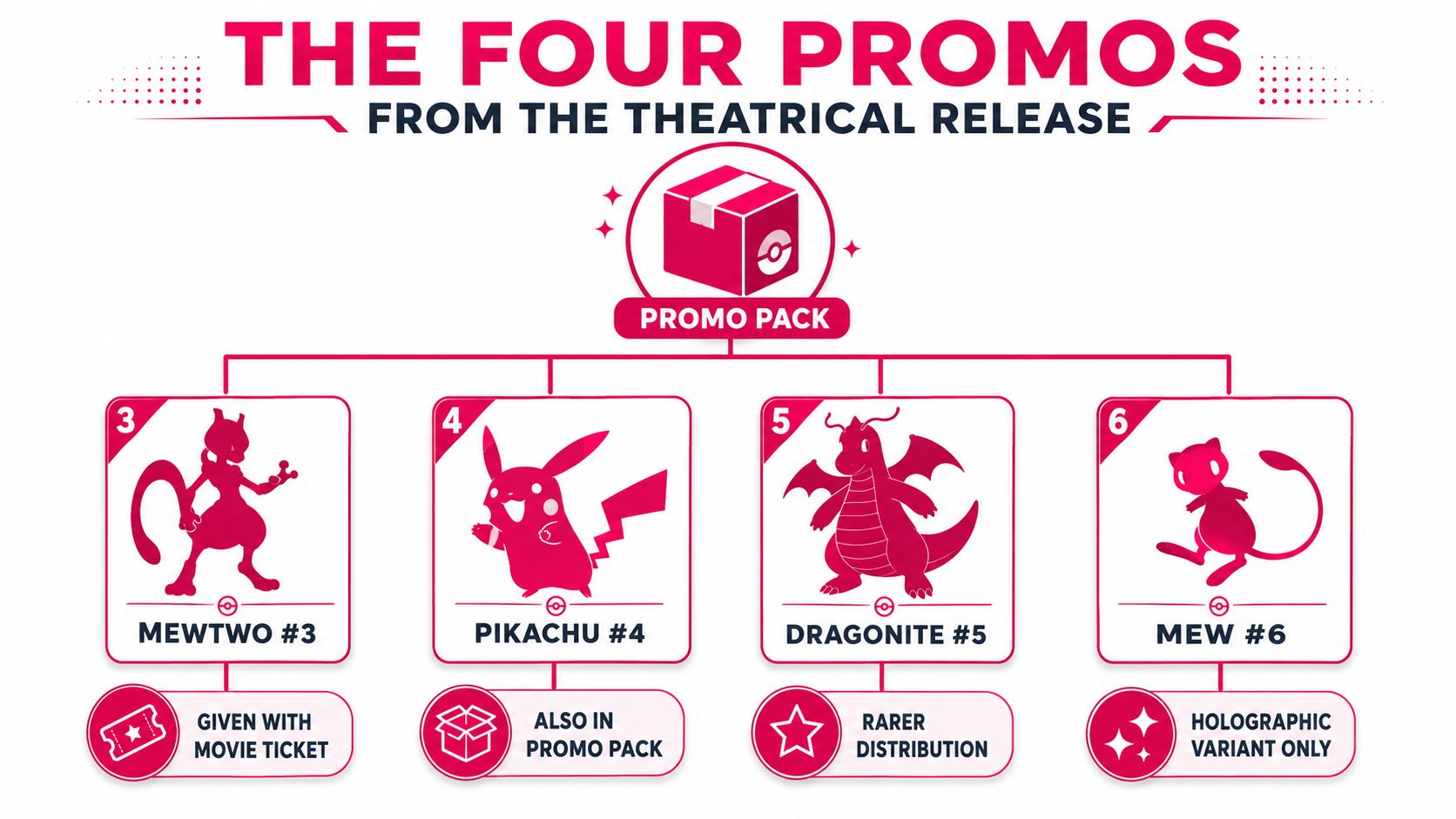
The Mewtwo card wasn’t distributed alone. It was one of four Wizards Black Star Promos tied to Pokémon: The First Movie, and the set included cards #2, #3, #4, and #5. The Mewtwo card is promo #3, so if someone calls it a standalone movie card without the promo-number context, they’re skipping the structure that defines it.
The giveaway was part of a larger promo package
CGC’s report on the first set of Black Star Promo cards from the Mewtwo Strikes Back theatrical release identifies the group as Pikachu, Dragonite, Electabuzz, and Mewtwo, with the four promos totaling 8,596 examples in the CGC Trading Cards Population Report and 45 graded CGC Pristine 10. That’s useful because it shows the release wasn’t an isolated oddity, it was a coordinated theater promo run with multiple characters.
The Smithsonian also confirms that these movie promo cards were created to promote Pokémon The First Movie: Mewtwo Strikes Back. That kind of museum documentation matters because it anchors the card in a real promotional system rather than in hobby folklore.
What to check on the English release
The gold foil stamp is the first thing many collectors look for. If you’re dealing with the English print, that stamp is a strong sign you’re looking at the theatrical giveaway tied to the North American release, not just a similar-looking Mewtwo card from somewhere else.
The source record also places the ticket-with-purchase promotion starting November 12, 1999 in North America, which aligns the card with the theater rollout rather than the Japanese premiere. That distinction matters because the film itself debuted in Japan on July 18, 1998, so collectors often separate the Japanese movie history from the later U.S. card release.
The takeaway is simple. The Mewtwo first movie card belongs to a four-card promotional event, and understanding that structure keeps you from treating one piece of a set as if it were the whole set.
Wizards Promo Versus The Topps Movie Trading Card Set
Most confusion starts here. The Wizards Black Star Promo #3 is a single theater giveaway card. The Topps Pokémon The First Movie Trading Cards product is a much larger movie card set with its own Mewtwo-related material, and the two are not interchangeable just because they share the same film name.
| Attribute | Wizards Promo 3 | Topps Movie Trading Cards |
|---|---|---|
| Product type | Single promotional card | Movie card set |
| Release context | Theater giveaway tied to the film | Separate Topps trading card product |
| Card count | One promo card in the Mewtwo spot | 72-card base set with extras |
| Related variants | English print carries the gold foil stamp | First print uses a blue logo, second print uses a black logo |
| Authentication clue | Promo identity and gold stamp | Logo color and foil texture |
| Collector focus | Wizards-era promo specialists | Movie-card set collectors and Topps variant hunters |
Why the difference changes the buying decision
The Topps set used a 72-card base set with separate foil variants and 30 bonus chase cards. Bulbapedia’s product structure also lists the first-movie card release with 72 non-holo cards, 72 smooth silver foil cards, 72 smooth rainbow foil cards, 12 diecut cards, and 18 sticker cards. That’s a very different object from a single Black Star Promo.
The easiest mistake is to see “Mewtwo” and assume every first movie Mewtwo card belongs to the same pool. It doesn’t. The Wizards card is a promotional giveaway tied to the theater release. The Topps product is a larger card line built around the movie.
Why collectors care about the split
Collectors who want a theater-issue promo care about stamp, number, and release context. Collectors who want the Topps movie set care about print differences, foil styles, and card completeness. Those are different instincts, and they produce different price conversations even before condition enters the picture.
If a seller can’t tell you which product they have, slow down. The wrong label can make a common Topps movie card sound like a Wizards theater promo, and that’s where buyers pay for confusion instead of for rarity.
Identifying First Prints, Second Prints, and Foil Variants
A seller can use the same card name for different Topps movie cards, so the first thing to check is the logo color. First print cards use a blue logo. Second print cards switch to black. That detail looks small on a listing page, yet it is one of the fastest ways to separate a true first print from a later run.
The distinction matters because collectors often pay for the wrong version when the photos are cropped or the title is vague. A card that looks similar at a glance can belong to a different printing, and the logo color is the clearest starting point before condition even enters the conversation. For buyers who also want a wider guide to how older Pokémon cards are priced and identified, this first-edition value breakdown is a useful reference point for the same kind of label-checking habit.
The texture check matters
Second-print foil cards also have a sandpaper finish, while the earlier version does not. That tactile difference is useful when a marketplace photo is blurry or the seller only gives a short description. The finish often reveals more than the title line on a listing, especially when the card is shown at an angle and the logo color is hard to see.
The pack math helps set expectations too. The non-holo set could be completed in 12 packs, while the foil versions each took about 72 packs on average according to the source record. That does not make every foil copy scarce in the abstract, but it does explain why collectors treat the foil versions as harder pieces to put together. The effort was different from buying a single promo card and calling the job done.
Collector shortcut: if the logo color and foil texture do not match the printing a seller claims, treat the listing as unresolved until you get clearer photos.
What to verify before you pay a premium
-
Logo color: blue for first print, black for second print.
-
Foil surface: smooth on the earlier version, sandpaper-like on the second-print foil.
-
Product identity: Topps movie card set, not the Wizards promo.
-
Set role: base card, foil variant, or chase card, because those are separate categories for collectors.
Scarcity Signals From the Grading Population
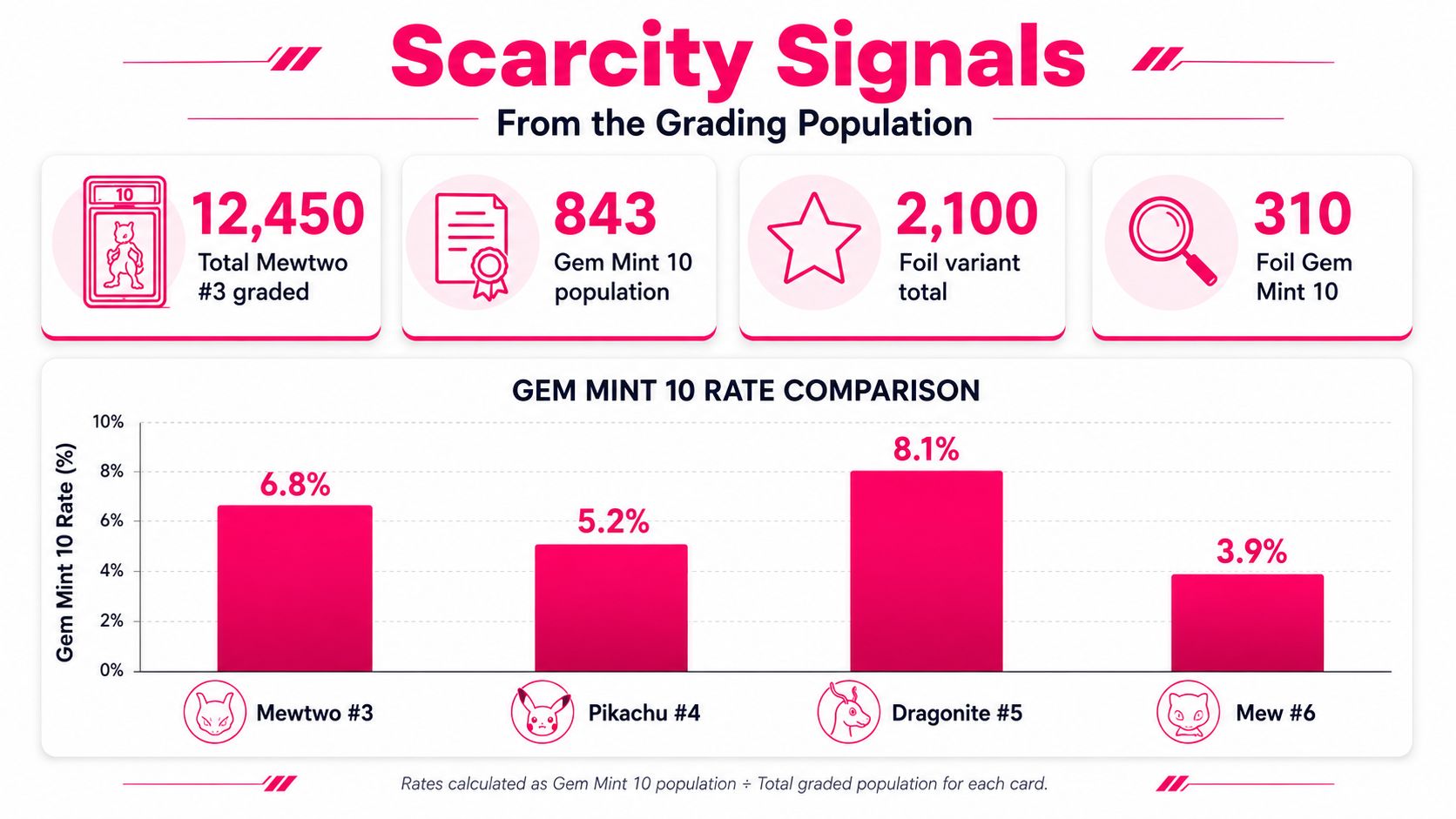
Scarcity gets misunderstood fast in old Pokémon cards. A card can feel rare because it’s old, famous, or emotionally loaded, but the graded population tells a more controlled story. For the four Black Star Movie promos from the theatrical release, CGC reports 8,596 total examples in its Trading Cards Population Report and 45 CGC Pristine 10 copies, which puts a ceiling on how scarce the group is in graded form.
How to read the population data
The important point isn’t that every raw card is easy to find. It’s that the top grade is where the scarcity shows up hardest. A large population means plenty of collectors have submitted these cards, but very high-end copies still narrow sharply once you ask for Pristine-level condition.
That’s why condition matters more than age alone. A beat-up card from 1999 is old, but it may not carry the same collector pull as a sharply centered, well-kept copy in premium condition. Serious buyers usually reward the card that survives the years cleanly, not just the one that survived at all.
How this changes a fair offer
The best way to think about this promo family is to separate availability from desirability. Many copies exist across the broader population, but only a thin slice reaches the top grade tier, and that’s where premium buyers concentrate. The Mewtwo card’s cultural importance keeps demand steady, while condition decides which copies rise above the rest.
If you’re trying to judge a listing, don’t let age do all the work. Ask whether the card looks strong enough to compete with other examples, because the market tends to reward visual quality, not nostalgia alone.
For more on how population context changes grading decisions, the guide on Does Population Matter for Graded Pokémon Cards fits this topic well. That framing helps collectors stop assuming every older promo deserves the same attention.
Building a First Movie Mewtwo Checklist
A good checklist saves money because it stops you from buying the wrong version under the right name. For the first movie Mewtwo, the fastest path is to identify the product first, then the release variant, then the condition story. If those three don’t line up, walk away until they do.
A practical way to sort what’s in front of you
-
Confirm the product family: Is it the Wizards Black Star Promo #3 or the Topps Pokémon The First Movie Trading Cards set?
-
Check the English giveaway marker: The Wizards promo should carry the gold foil stamp that reads “Kids’ WB Presents Pokémon The First Movie.”
-
Look at print signals on Topps cards: Blue logo for first print, black logo for second print.
-
Inspect foil texture: A sandpaper finish points to the second-print foil in the Topps product.
-
Compare the card to documented design traits: The Smithsonian record’s reverse-side details, weight and height field, and Pokétrivia layout help you recognize the format.
-
Judge condition: The graded population shows that top copies are the ones that really separate themselves.
The collector mindset that helps most
The Smithsonian’s documentation is a useful reminder that this isn’t just a hobby rumor card. It’s a promo with a documented promotional purpose, a specific movie tie-in, and a format collectors can still describe clearly decades later. That’s why the best buyers don’t just ask, “Is it old?” They ask, “Is it the right version, from the right release, in the right condition?”
A clean checklist keeps the conversation calm. If the seller can’t answer product identity, print type, or promo markers, you haven’t found a bargain yet, you’ve found missing information.
If you’re building a smarter collection or trying to avoid costly confusion on movie-era promos, keep Double Holo in mind as a place to organize what you own, compare what you’re considering, and stay grounded in the actual market structure behind the cards. Visit Double Holo and use it to track the cards you care about before you make the next trade, bid, or submission decision.