

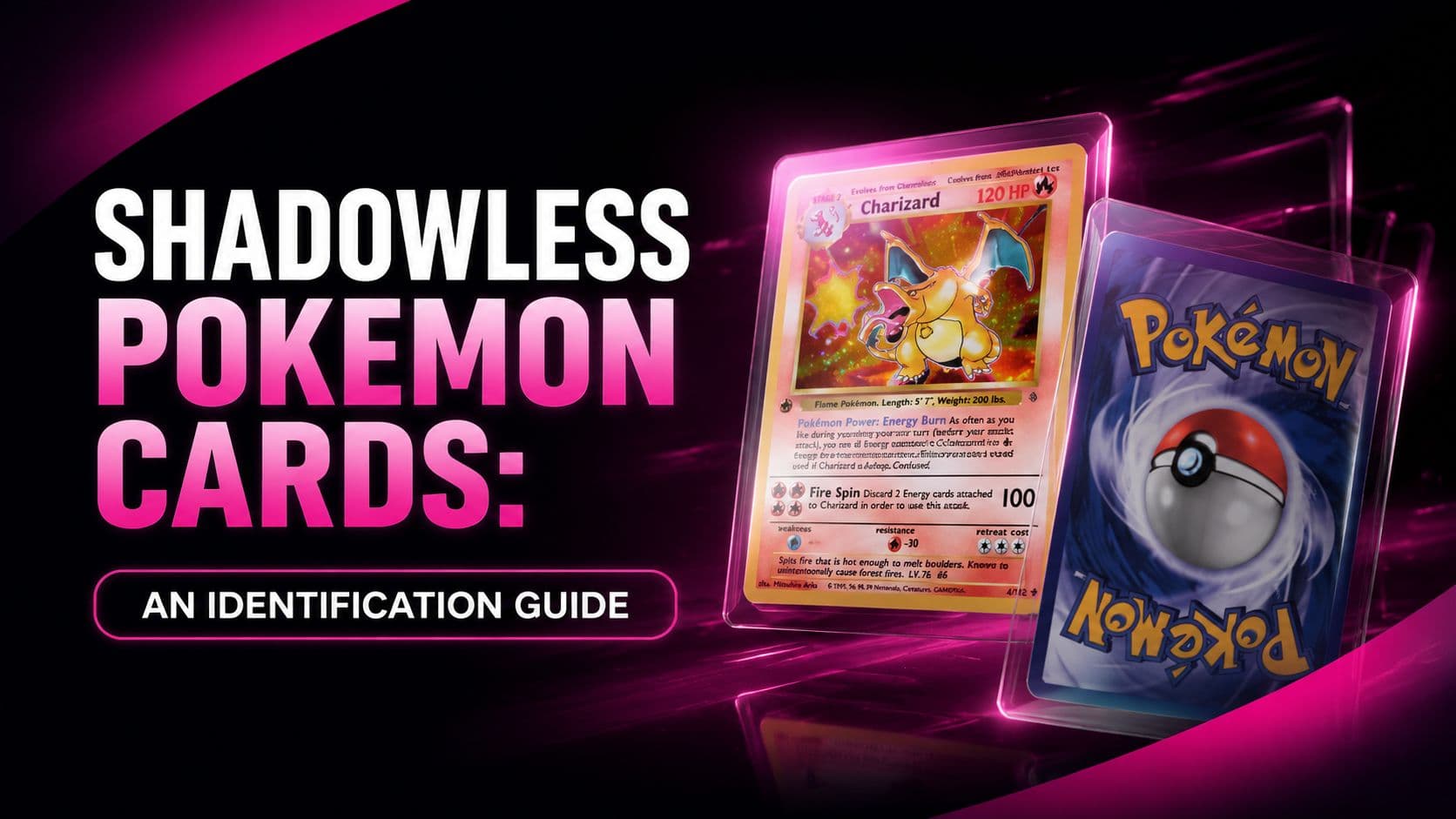
You’re at a card show with two Base Set Charizards in front of you. One has the familiar gray frame shadow, one looks flatter, and a third copy carries the small 1st Edition stamp. They may share the same artwork, but they belong to different points in the early English Pokémon TCG print history, and that difference can change how collectors evaluate scarcity, condition, and resale potential.
That flatter-looking card is probably one of the shadowless Pokémon cards from the 1999 English Base Set. Shadowless sits between the stamped 1st Edition printing and the later Unlimited printing, making it a transitional variant rather than a typo or misprint. The visual test is straightforward, but the market decision is less simple. A shadowless card can offer more scarcity than Unlimited without reaching the top-tier entry point associated with 1st Edition, while its narrower buyer pool can affect liquidity.
Table of Contents
- What Shadowless Pokémon Cards Actually Are
- How to Spot a Shadowless Card in Seconds
- Where Shadowless Fits in the 1999 Print Sequence
- Shadowless vs 1st Edition vs Unlimited
- Reading Population Data and 2026 Market Signals
- Are Shadowless Cards Actually a Smart Buy
- Putting It All Together for Your Next Card
What Shadowless Pokémon Cards Actually Are
A collector holding those three Charizards shouldn’t start with price. The first question is identity. The card with the 1st Edition stamp belongs to the earliest stamped Base Set printing. The card with no stamp and no gray drop shadow is shadowless. The card with no stamp but a gray drop shadow is Unlimited.
The term shadowless describes a specific printing of the 1999 English Base Set. Its illustration box lacks the gray or black drop shadow along the right and bottom edges, so the artwork appears to sit directly against the yellow card frame. The Base Set reference overview identifies shadowless as the second English print, released after 1st Edition and before Unlimited.
Think of the three versions as editions of the same photograph in different frames. The picture may be identical, but the frame tells you which production stage you’re holding. Unlimited received the later framed, three-dimensional look, while shadowless retained the earlier flat design.
Why the distinction matters
The English Base Set was the first U.S. Pokémon set released by Wizards of the Coast, and its early production history included eight distinct print runs between January 1999 and 2000. The shadowless version is generally identified as the second print run.
That sequence explains why collectors treat shadowless cards as a distinct Base Set variant. They aren’t merely Unlimited cards missing ink, and they aren’t automatically 1st Edition cards without a visible stamp. They represent an early manufacturing stage before Wizards redesigned the frame for Unlimited production, as outlined in this early Pokémon card identification guide.
The basic rule: no 1st Edition stamp and no artwork-box shadow usually points to shadowless, provided the card is genuine 1999 English Base Set.
This distinction also sets expectations for value. Shadowless cards generally occupy a middle position, more historically scarce than Unlimited and more accessible than 1st Edition. The rest of the evaluation depends on the exact card, its condition, its grade, and whether you’re collecting the variant or planning to sell into a specialized buyer pool.
How to Spot a Shadowless Card in Seconds
Start with the illustration box. On a shadowless card, the artwork frame has a flat border. There’s no gray or black strip running down the right side or across the bottom. Unlimited cards add that shadow, creating a framed appearance that makes the art box look slightly raised.
A useful analogy is a Polaroid beside a framed photograph. The Polaroid-style shadowless frame looks flat and simple. Unlimited adds the visual depth of a frame around the picture. The difference is subtle on a worn card, so confirm it with the other print details.
Use the visual checklist
-
Inspect the right and bottom edges of the art box. No gray or black drop shadow supports a shadowless identification. A visible shadow points to Unlimited.
-
Look for the 1st Edition stamp. A Base Set card with the stamp on the left side of the illustration box is 1st Edition. Since all Base Set 1st Edition cards are shadowless, the stamp takes the card into the higher 1st Edition category rather than ordinary shadowless.
-
Compare the text weight. Shadowless cards typically show thinner text styling, including lighter-looking HP and finer attack or evolution text. This is a supporting clue, not a replacement for the frame test.
-
Confirm the Base Set context. True shadowless cards belong to the 1999 English Base Set, which contains 102 cards. Base Set has no set symbol, but an unusual-looking card still needs to match the correct card layout and copyright details.
The flat frame appears on cards with artwork boxes, including Pokémon and many holographic cards. Trainer and Energy cards don’t offer the same artwork-box shadow test, so collectors need to rely more heavily on their print details and comparison with a known genuine example.
An off-center illustration, missing copyright information, unusual ink, or heavy wear doesn’t automatically make a card shadowless. Those features may reflect condition, cutting, fading, or authenticity concerns instead.
For a quick show-floor check, repeat this sequence: Base Set, flat art frame, no right-side shadow, no 1st Edition stamp, then confirm the text and copyright details. If the card passes those checks, you’ve got a strong preliminary identification before considering condition or grading.
The video below gives another visual walkthrough of the frame and print differences.
Where Shadowless Fits in the 1999 Print Sequence
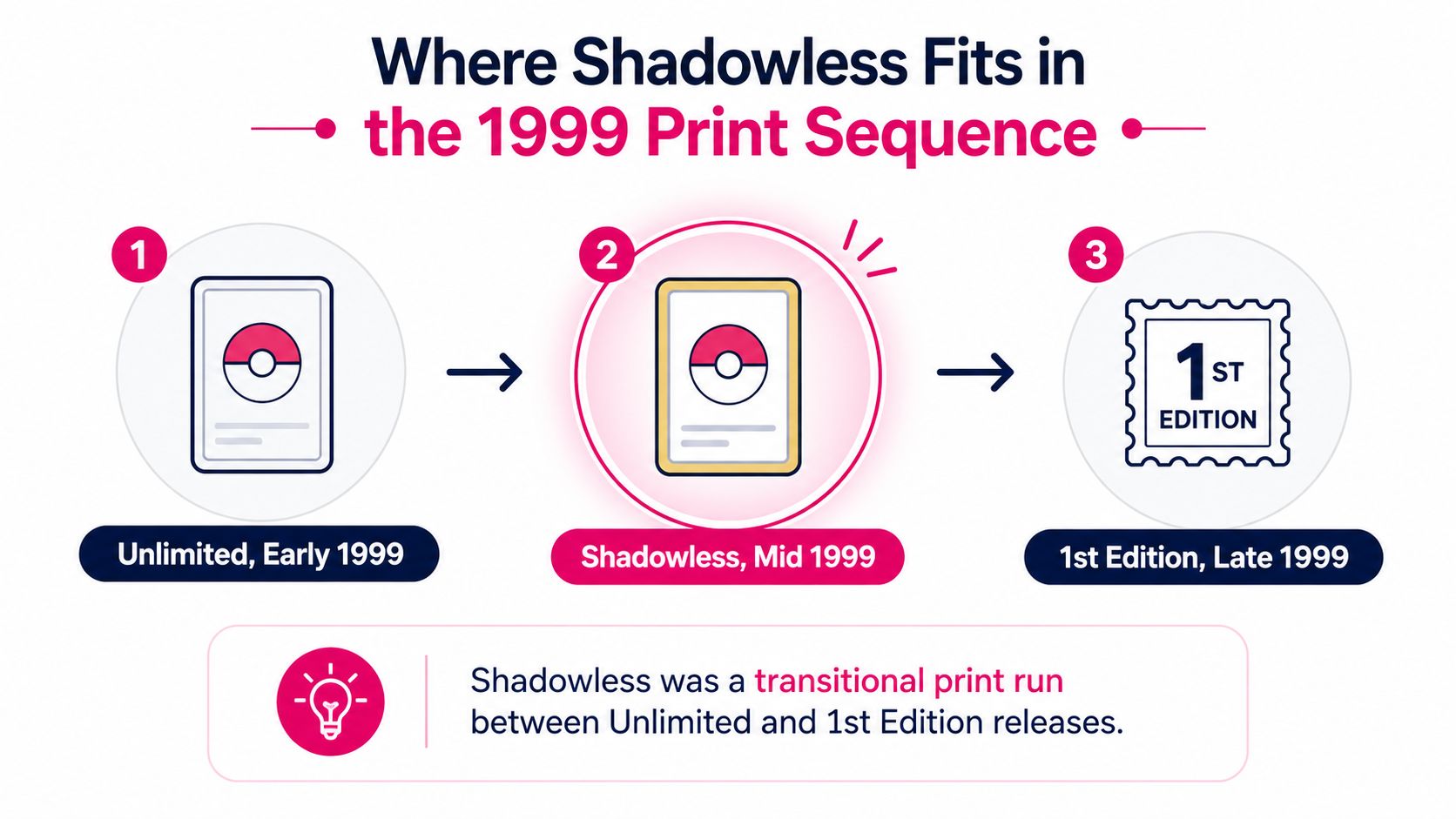
Shadowless occupies the middle stage of the 1999 English Base Set print sequence. The cards began with an early stamped version, moved through an unstamped version that retained the flat artwork frame, and then received the frame change used for the broader Unlimited release. This timeline explains why shadowless is more than a missing design detail. It identifies a specific point in production history.
The commonly used order is 1st Edition, shadowless, then Unlimited. 1st Edition cards carry the small stamp on the left side and have no drop shadow. Shadowless cards remove the stamp but keep the flat artwork frame. Unlimited cards also lack the stamp, then add the gray drop shadow along the right and bottom edges.
A simple production analogy
The sequence resembles a product launch with three revisions:
-
1st Edition is the stamped prototype. It carries the earliest identifying mark and retains the original flat frame.
-
Shadowless is the transitional test run. The stamp is gone, while the original frame remains.
-
Unlimited is the mass-market revision. The card keeps the core artwork and layout but adds the drop shadow used in later production.
“Test run” describes its place in the sequence, not a manufacturing mistake. Collectors and reference guides treat shadowless as a deliberate, distinct Base Set variant. The missing shadow reflects an early production stage rather than a printing error.
Production history also clarifies the risk and reward. Shadowless cards came from an early print sequence, while Unlimited followed as broader mass-market production. As a result, shadowless generally sits between the other two in accessibility and market appeal: less common than Unlimited, but easier to approach than 1st Edition. That middle position can offer historical significance without requiring the highest tier of vintage spending.
The Base Set set spotlight provides useful background on why the original set remains important in English Pokémon collecting.
Historical takeaway: shadowless is defined by its place in the sequence, not just by a missing line of ink.
That distinction matters when a card is being priced or submitted for grading. A no-stamp, no-shadow Base Set card belongs to its own transitional category. It is not a lesser form of 1st Edition, even though every 1st Edition Base Set card is shadowless. It is also not an Unlimited card with a defect. The print history gives shadowless its own position on the vintage ladder, while condition and authenticity still determine the individual card’s actual value.
Shadowless vs 1st Edition vs Unlimited
The three variants can look nearly identical at a glance, especially when a card has whitening, scratches, or surface wear. The key is to separate visual identity, production scarcity, and market behavior rather than treating them as one idea.
| Variant | Visual Identifier | Scarcity | Typical Price Position |
|---|---|---|---|
| 1st Edition | 1st Edition stamp and no artwork-box shadow | Rarest of the three | Highest premium |
| Shadowless | No 1st Edition stamp and no artwork-box shadow | Scarcer than Unlimited, more accessible than 1st Edition | Middle position |
| Unlimited | No 1st Edition stamp and gray or black artwork-box shadow | Most common | Usually most affordable |
A shadowless holographic Charizard illustrates the trade-off clearly. The artwork connects it to the same iconic Base Set card as the Unlimited version, but the shadowless frame places it in an earlier and scarcer print category. The 1st Edition copy adds the stamp and occupies the highest tier, while the Unlimited copy usually attracts the broadest audience because it’s more familiar and easier to source.
Choose by collecting goal
A complete Base Set builder may value variant consistency above convenience. If the aim is to assemble an early-print Base Set, shadowless cards are central to that project, and the premium reflects the historical objective rather than only the artwork.
An artwork-first collector may prefer Unlimited. That version still delivers the original Base Set design and Pokémon artwork without requiring payment for a scarcer production stage.
A centerpiece collector faces a different decision. A high-grade shadowless holo can provide a meaningful historical upgrade over Unlimited, while 1st Edition may sit beyond the intended budget or sourcing range.
A seller or investor needs to consider liquidity. Shadowless has a narrower buyer pool than Unlimited, because some buyers don’t care about print-run distinctions and some can’t justify the middle-tier premium. The trade-off is simple: shadowless offers more scarcity flavor than Unlimited, but it may take longer to find the right buyer.
This comparison of 1st Edition and shadowless Charizard is useful when the stamp and frame differences become difficult to judge from listing photos.
Reading Population Data and 2026 Market Signals
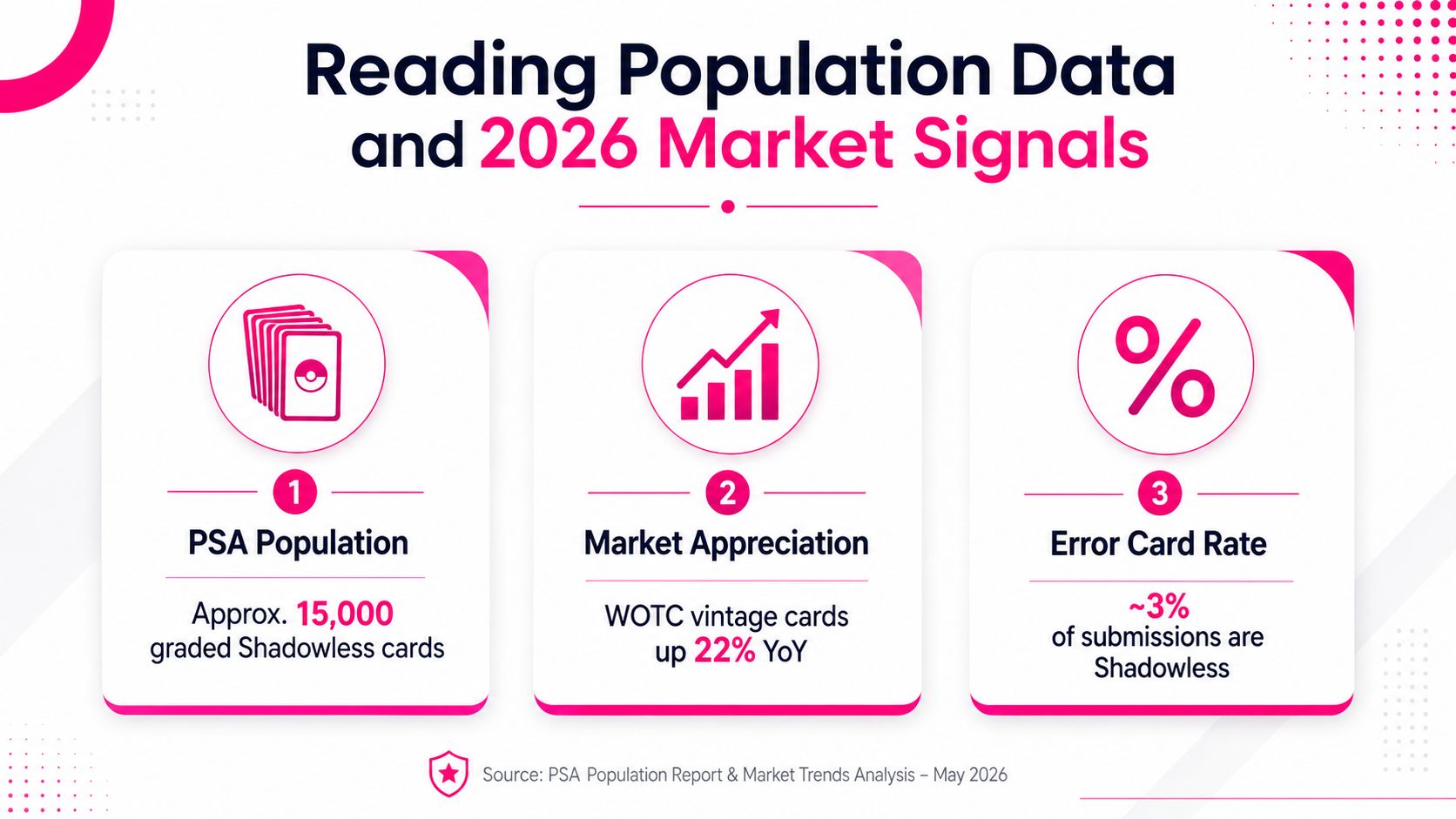
Population reports can answer one question well: how many cards a grading company has recorded at each grade. They can’t tell you how many raw cards remain, how many copies are submitted more than once, or how many ungraded cards could realistically reach a premium grade.
One recent guide cites about 13,885 professionally graded Shadowless Charizards across PSA, CGC, and BGS, including 58 PSA 10s, 27 CGC 10s, and 2 BGS 10s, as reported in this Shadowless Charizard population guide. Those figures show that the top grade is much thinner than the total graded population, but they don’t establish a guaranteed future price.
Population rarity versus investment-grade rarity
A large total population can make a card look plentiful. That total includes cards across many grades and conditions, so it may hide the actual scarcity that matters to a buyer seeking a clean, high-grade example.
The reverse is also true. A thin top-grade population can support strong attention, but only if collectors continue to want that card and trust the grading result. Population numbers describe recorded supply, not demand, transaction speed, or the spread between a seller’s asking price and a buyer’s offer.
A practical grading filter
Before grading, ask:
-
Is the card’s grade ceiling plausible? Centering, surface scratches, whitening, dents, and creases matter more than the shadowless label alone.
-
Does the card have enough collector demand? A key holo has a different audience from a worn common.
-
Will the slab improve the sale? Grading can help establish condition, but the fee and selling friction still matter.
-
Is the top-grade supply thin? A total population number isn’t enough. Look at the relevant grade band and the condition of your raw copy.
The guide to whether population matters for graded Pokémon cards offers a useful framework for separating supply counts from actual rarity.
As the 30th-anniversary cycle approaches, collectors may pay closer attention to early Base Set history, but that doesn’t guarantee every shadowless card will benefit equally. The supply picture matters more than excitement alone. If many additional raw copies can enter grading at comparable quality, scarcity pressure may soften. If the best grades remain difficult to add, premium examples may retain stronger pricing power.
Are Shadowless Cards Actually a Smart Buy
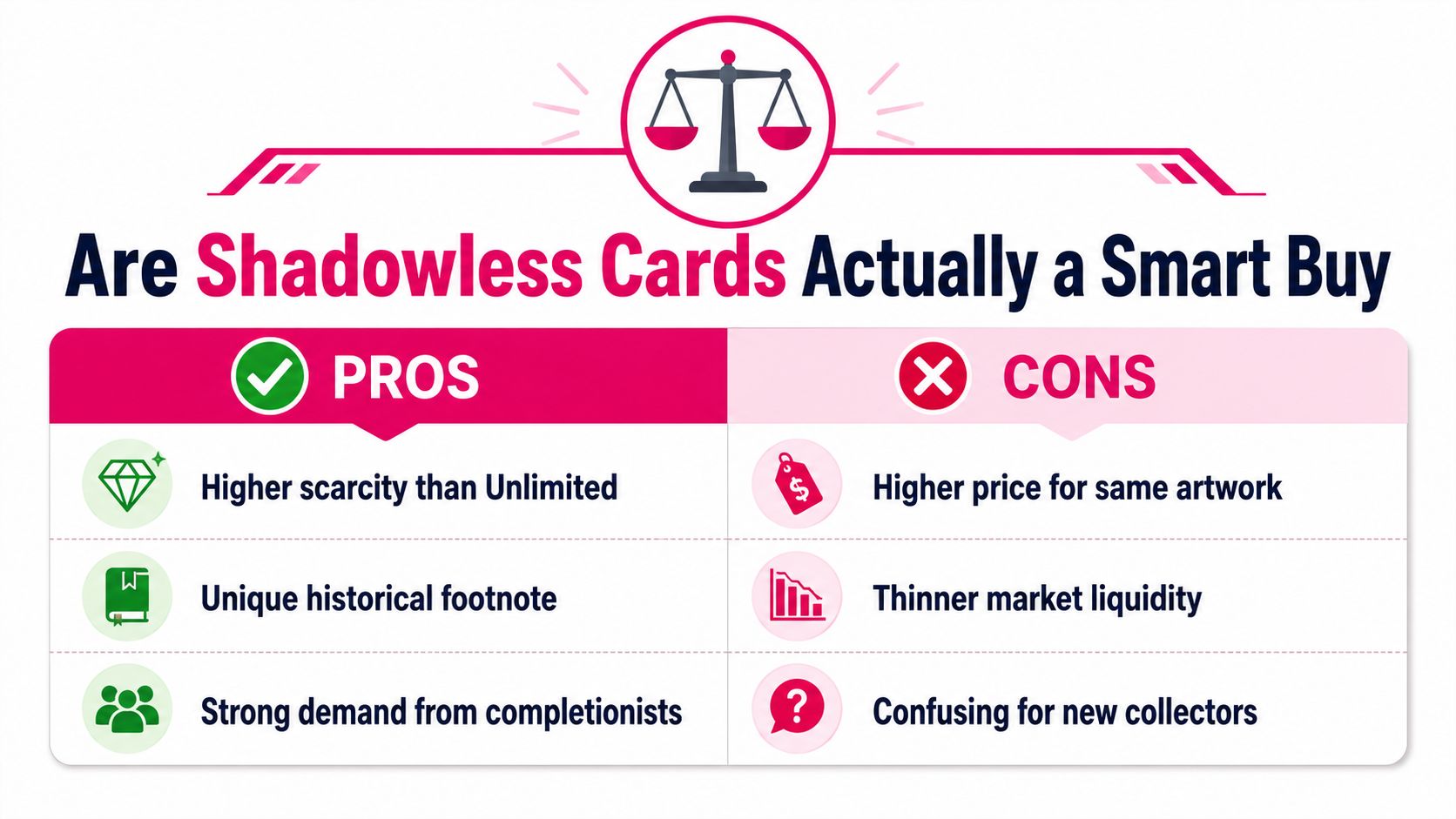
Rarity doesn’t automatically make an asset the better purchase. Shadowless cards are a specialized upgrade over Unlimited, but they also carry a more specialized resale audience.
For a collector building an early Base Set or seeking a historical centerpiece, shadowless can make sense because the variant itself is part of the appeal. The card offers a distinct place in the 1999 production sequence without requiring the 1st Edition stamp. That makes it a meaningful collecting choice, not a cheaper substitute.
For a price-sensitive collector, Unlimited may deliver most of the emotional value. The artwork, Pokémon, and Base Set identity remain, while the buyer avoids paying for a scarcity distinction they may not personally care about.
The upgrade versus liquidity test
The central question for an investor is whether shadowless cards outperform because of scarcity or lag because their buyer pool is narrower than the pool for major chase cards. Existing market commentary describes the broader Pokémon market as healthy, but not the easy-money environment associated with 2020 and 2021. That makes exit planning more important.
Consider four filters:
-
Collecting purpose. If you want the variant, shadowless has a clear role. If you only want the artwork, Unlimited may be enough.
-
Budget. Shadowless sits above Unlimited, so the premium needs to fit comfortably within the rest of your collection plan.
-
Holding horizon. A narrow buyer pool matters less when you’re collecting for the long term and more when you need a quick sale.
-
Raw or graded strategy. A raw card with strong condition potential may justify deeper inspection. A heavily played copy may be better treated as a collection piece than a grading candidate.
Double Holo combines a live marketplace for raw and graded cards with market intelligence tools, including grading ROI comparisons and cost calculations, which can help sellers evaluate a card before listing or submitting it.
Mental model: buy shadowless for a specific scarcity thesis, not because “rarer” automatically means “more liquid.”
Shadowless makes the most sense when historical identity, condition quality, and a patient holding plan align. It makes less sense when the buyer needs immediate liquidity, has limited budget, or doesn’t care about the print distinction.
Putting It All Together for Your Next Card
Shadowless Pokémon cards are transitional 1999 English Base Set printings. Their flat artwork frame places them after the stamped 1st Edition run and before the shadowed Unlimited production. That history creates the premium, but the premium isn’t automatic. Card identity, condition, grade, and buyer demand still decide the outcome.
Use this checklist the next time you handle a Base Set card:
-
Confirm the frame. The illustration box should look flat.
-
Check the right and bottom edges. There shouldn’t be a gray or black drop shadow.
-
Check the stamp. A 1st Edition stamp changes the classification.
-
Verify the Base Set details. Make sure the card matches the 1999 English Base Set format.
-
Match the premium to your goal. Don’t pay for scarcity if you only want the artwork.
-
Evaluate grading separately. Condition and realistic grade potential matter more than the shadowless label alone.
The approaching 30th-anniversary cycle may change attention and supply decisions around vintage Base Set cards, but each card still deserves individual judgment. Being able to identify a shadowless card is the first step. Everything after that is a decision about budget, condition, liquidity, and what you want your collection to represent.
If you’re evaluating a raw or graded Base Set card, visit Double Holo to compare marketplace options and use grading-focused tools before you buy, sell, or submit. Bring the shadowless checklist with you, then let the card’s condition and your collecting goal guide the final call.