

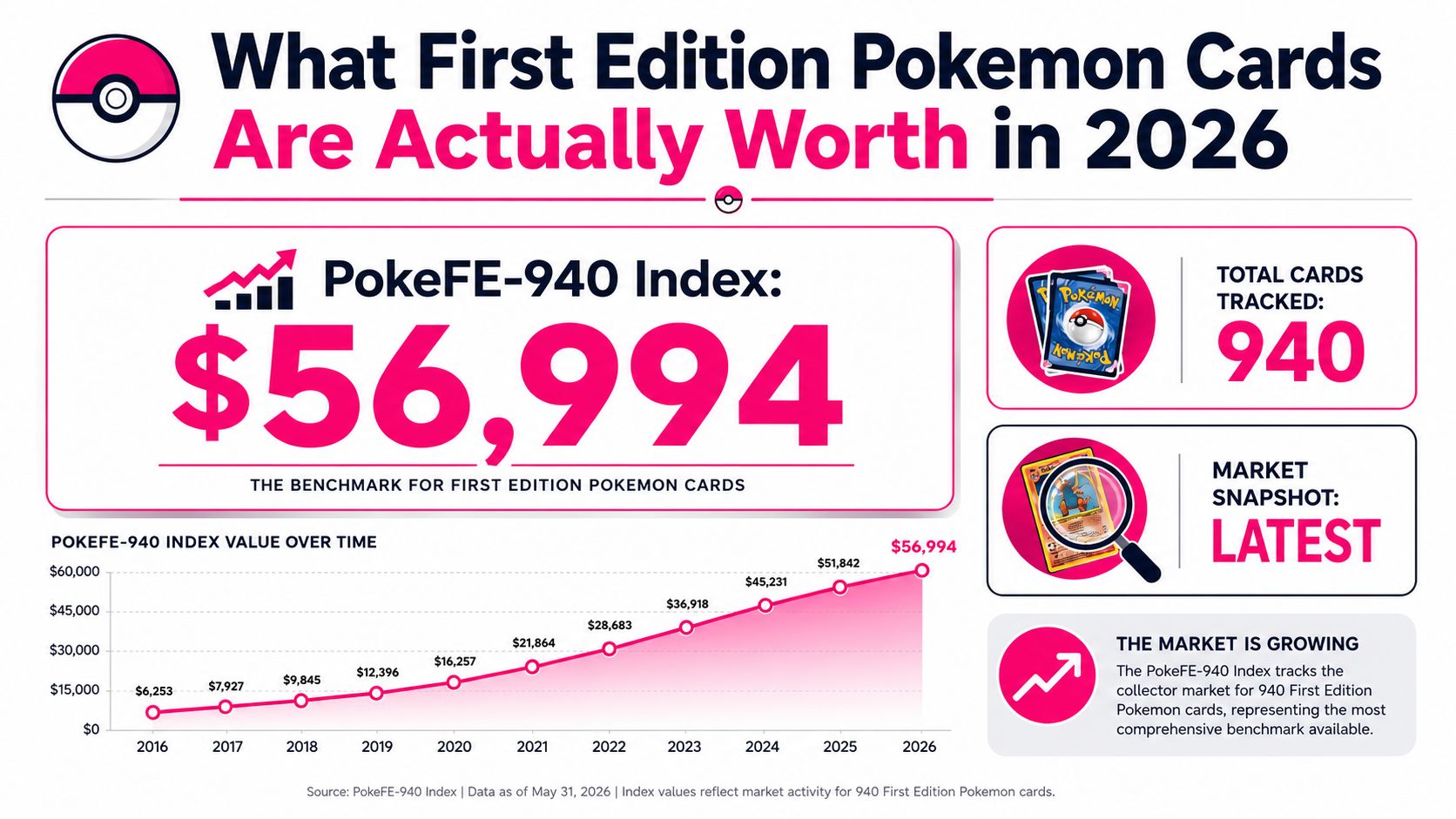
First edition Pokémon cards are worth anywhere from roughly a few dollars to six figures, and the stamp by itself usually means very little unless the card is already scarce and the condition is clean. The market for all 940 first-edition vintage cards in the original Base Set through Neo Destiny sits at about $56,994 today, which tells you this is a broad vintage segment, not just a Charizard story.
Table of Contents
What First Edition Pokemon Cards Are Worth in 2026
The cleanest way to price first edition Pokemon cards worth in 2026 is to treat the market as broad, uneven, and data-driven. The A line chart showing the rising market value of 940 first edition Pokemon cards from 2016 to 2026. shows the combined market value of all 940 first-edition vintage cards from Base Set through Neo Destiny at about $56,994, with the index up $26 (+0.05%) over 7 days and built from verified sales across major marketplaces in near-mint condition. That is the right lens for the Wizards of the Coast era from 1999 to 2003.

Worth means sold comps, not wishful listings
Sellers overprice cards because they stare at active listings and confuse asking price with value. I do not care what a seller hopes to get. I care what sold in the right condition band. If you want a real number, start with sold comps, then compare them to the card’s exact set, rarity, and grade.
Practical rule: If you cannot point to a recent sold comp, you do not know the card’s worth yet.
A lot of pricing guides miss the point because they treat “1st Edition” like a value stamp by itself. It is one input, not the whole answer. A stamped card can be cheap if it is common or damaged, and a stamped holo can bring serious money when the card is iconic and the copy is clean.
The three levers that decide the number
Every price in this market comes back to set, rarity, and condition. Those three factors decide whether the stamp adds a small premium or a large one.
-
Set identity: Base Set holos do not price like later-era commons.
-
Rarity tier: A holo rare has a very different demand profile from a common.
-
Condition: The same card can sit in completely different price bands once graded.
That is the core of the hobby in 2026. If you want to price a first-edition card correctly, stop asking whether it is “valuable” and start asking which exact card it is, how scarce it was, and what shape it is in. Everything else is noise.
Where First Edition Stamps Came From and Why They Matter
A 1st Edition Pokémon card is the first print run of a set, marked by a small black stamp on the card. In the English vintage era, that stamp belongs to the Wizards of the Coast years from 1999 to 2003, and the canonical run stretches from Base Set through Neo Destiny.
The stamp was never meant to be a value badge. Publishers used it to separate the first run from later Unlimited printings, and collectors later gave it weight because the early run was scarcer. It sits in a visible spot, so buyers can spot the print-run version fast. That speed matters in a market where the stamp is the first thing many people check.
The era that collectors care about
English vintage first edition cards come from a narrow window, and that is why modern English releases do not create the same pricing conversation. The substantial money sits in the older sets, especially where the card itself already had demand before the stamp entered the picture.
The benchmark for 940 cards across the era makes that obvious. It shows the market is spread across the full set list, not locked to one flagship card. That is useful because it keeps collectors honest, a binder full of stamped vintage cards is not automatically a windfall.
How to spot it fast
On English vintage cards, the stamp is the quickest ID check in the hobby. It is a tiny visual mark, but it changes where the card sits in the market once the rest of the card already matters.
-
Check the stamp first: If the card has the first-edition mark, you have the print-run variant you are looking for.
-
Check the set era: Base Set through Neo Destiny is the zone that matters here.
-
Check the card type: The stamp’s position can vary by card type, so do not trust memory alone.
The historical point is simple. First edition matters because it marks the earliest print run of a relevant vintage set, not because the words themselves carry value. The card still has to earn that value through desirability and condition.
Why the 1st Edition Stamp Is a Multiplier, Not a Magic Word
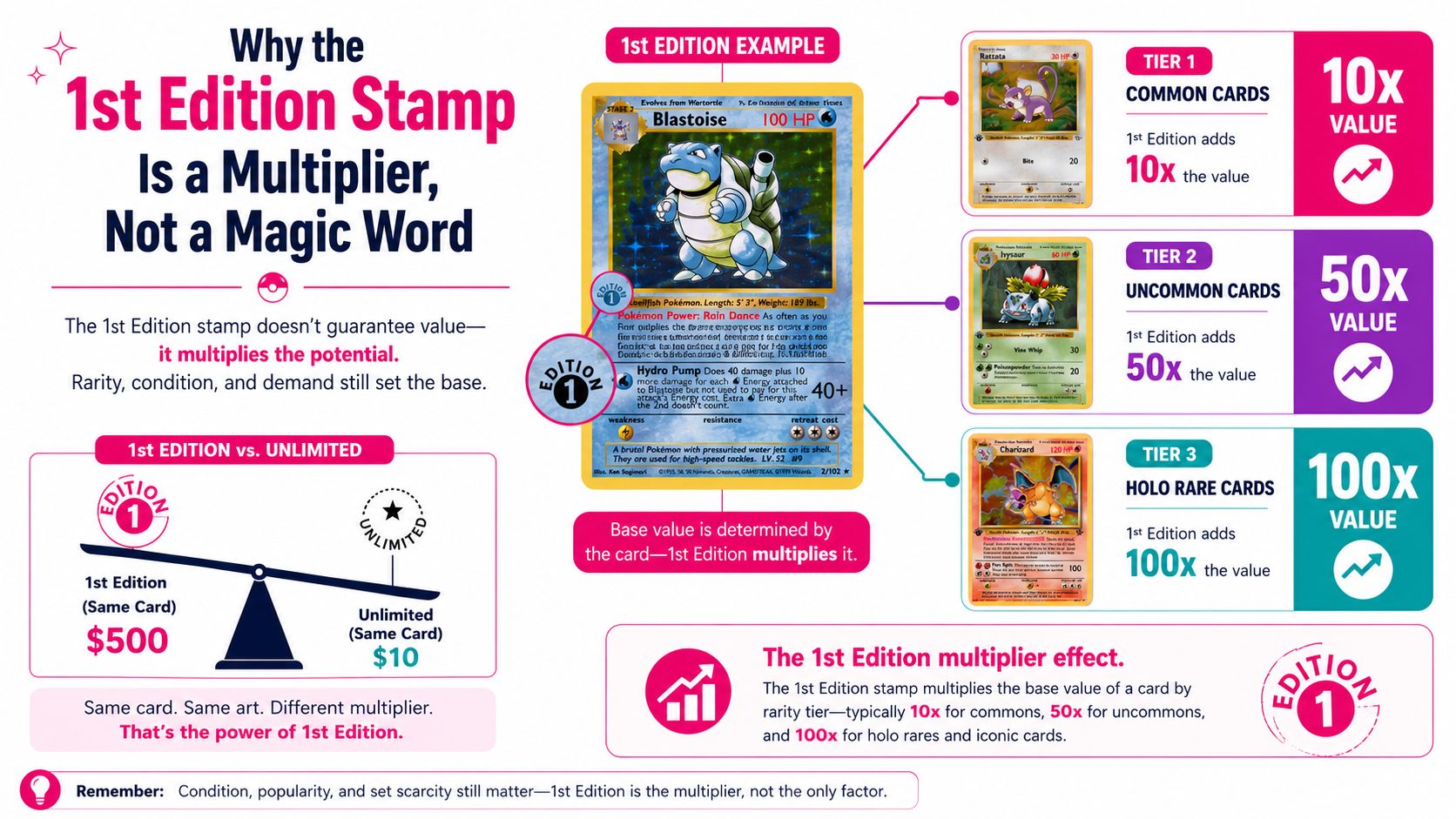
The biggest mistake I see is people assuming every stamped card is automatically expensive. It isn’t. In vintage Pokémon, the 1st Edition stamp is a multiplier, and the size of that multiplier depends on what the card already is.
Independent pricing guides put Base Set 1st Edition holos at roughly 10x to 50x Unlimited prices, and some sources extend the gap even further for the biggest chase cards. For the headline card, a 1st Edition Base Set Charizard can run from the low thousands in raw near-mint form to hundreds of thousands when graded gem mint, while the same card without the stamp is often estimated around $5,000 to $15,000 or less depending on condition.
The stamp only really explodes on already-rare cards
The money gets serious when the stamp lands on a card people already want. That’s why Charizard, Blastoise, and Venusaur sit in the conversation first, not because every copy is priceless, but because the card identity, holo status, and stamp stack together.
By contrast, a 1st Edition common often stays low-value because the card was never scarce enough to begin with. A stamp can improve the price, but it doesn’t rewrite the card’s role in the set. That’s why you can’t judge a stamped common the same way you judge a stamped holo.
Practical rule: Stamp plus already-rare card equals a real premium. Stamp plus already-common card usually means a small bump.
The three-way interaction that actually matters
The right way to price these cards is to think in layers.
-
Scarcity gives the card its baseline.
-
Desirability gives it buyer demand.
-
The first-edition stamp pushes the card into a higher tier only when the first two are already strong.
That’s the whole playbook. If you’re staring at a stamped common and hoping the stamp alone makes it valuable, you’re reading the market backwards. If you’re holding a stamped holo from a sought-after vintage set, then you’ve got something real.
How Condition and Grading Multiply Or Crush Value
Condition is where the market stops being theoretical and starts paying up or walking away. The same Base Set 1st Edition Charizard is cited around $3,000 to $6,000 raw near-mint, around $75,000 to $120,000 in PSA 9, and roughly $300,000 to $550,000 in PSA 10, which shows a 50x+ uplift from raw NM to gem mint.
What actually moves a grade
Grading isn’t magic, it’s a set of visible defects getting priced by a third party. Centering, surface wear, corner sharpness, and edge wear are the four obvious things that decide whether a card stays in the raw lane or jumps into the premium slab tier.
A seller who understands that will stop guessing. A buyer who understands it will stop paying PSA 10 money for a card that clearly tops out below that tier. The grade isn’t just a label, it’s the market’s shorthand for condition-adjusted scarcity.
Raw, mid-grade, and gem mint are different markets
A raw near-mint copy, a PSA 9, and a PSA 10 do not compete in the same pool. They attract different buyers, different budgets, and different expectations. That’s why asking prices can be useless if they don’t line up with sold comps in the exact grade band.
Sold comps in the exact grade band beat asking prices every time.
That rule matters most on cards where one or two premium grades anchor the whole market. The top-grade result becomes the reference point, and everything below it gets priced relative to that ceiling. If the card is damaged, off-center, or heavily worn, the upside can collapse fast.
What to do before you pay for grading
Be honest about the card in your hand.
-
Grade it: when the card is scarce, desirable, and visually sharp.
-
Sell it raw: when the condition is decent but not slab-worthy.
-
Leave it ungraded: when defects are obvious and the card won’t clear the fee hurdle.
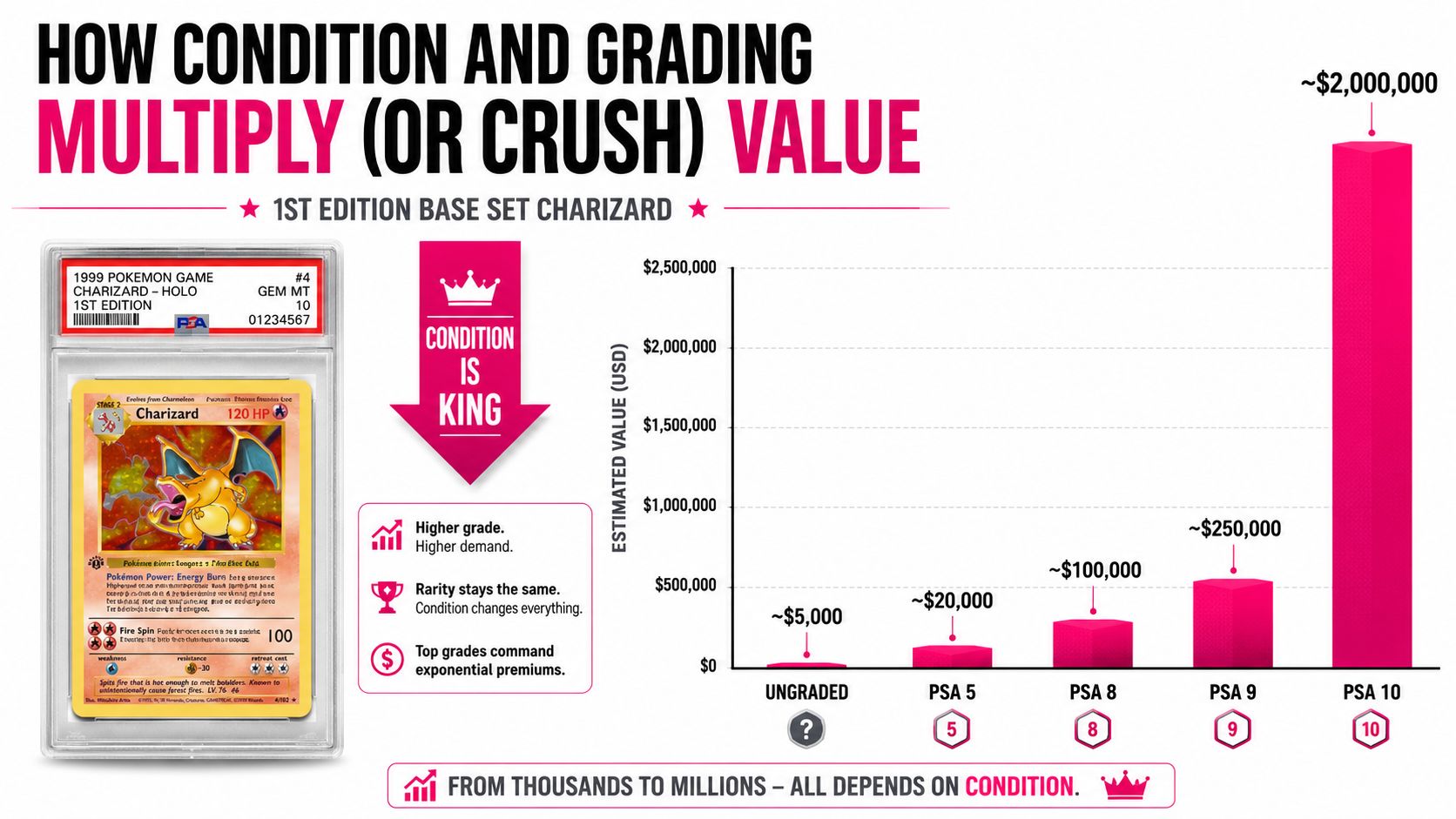
The blunt takeaway is this. Condition isn’t a detail, it’s the main engine of value. If the card can’t clear the next grade tier, the premium you imagine usually doesn’t exist.
Choosing a Grader for Vintage First Edition Cards
PSA still anchors vintage first-edition pricing because buyers know the slab, know the comps, and trust the market depth. That doesn’t mean the other graders are useless. It means you should choose the slab that matches your card’s upside, not your personal preference.
| Grader | Vintage demand | Top-tier signal | Typical starter fee |
|---|---|---|---|
| PSA | Deepest buyer pool | PSA 10 | Varies by service level |
| BGS | Strong for elite copies | Black Label | Varies by service level |
| CGC | Solid and practical | High numeric grade | Varies by service level |
| TAG | Growing visibility | Clean modern label | Varies by service level |
Match the slab to the card, not the hype
A high-end vintage holo with a real shot at premium resale belongs where the buyer pool is deepest. That’s usually PSA. If you own an elite copy where perfection matters and the card can justify chasing a prestige signal, BGS has a different appeal. CGC and TAG are valid options when your goal is a clean, modern grading result without pretending every slab has the same resale gravity.
The important thing is ROI, not branding. A grader only helps when the market rewards the label enough to cover the fee and the wait. If the card is not strong enough, the slab just adds cost.
Use the market, not tribal loyalty
I’ve seen collectors pay for the wrong label because they were attached to the brand instead of the exit price. That’s a bad habit. The slab should help you sell, not reassure you.
Double Holo’s grader comparison article breaks down the opportunity cost across PSA, CGC, and TAG if you want to compare paths before you ship a card out.
Practical rule: Grade for resale, not for ego.
If you’re sitting on a top-tier vintage first edition holo, use the grader the market already pays for. If you’re dealing with a lower-value card, don’t overcomplicate it. The wrong slab can cost more than it adds.
How to Research the Value of a Specific First Edition Card
A first-edition stamp means little until you pin down the set, card number, and rarity tier. A first-edition common and a first-edition holo do not trade in the same market, and the gap is wide enough to change the whole pricing call. Start with sold comps in raw near-mint condition, then compare them with the relevant graded bands.
A fast research workflow works effectively
-
Identify the exact card. Use the set name, card number, and rarity symbol before anything else.
-
Check raw sold comps. Focus on the most recent near-mint sales, not active listings.
-
Check the slab comps. Compare PSA 9 and PSA 10, or the equivalent tiers for other graders, for the same card.
-
Compare against the vintage benchmark. Use the Double Holo market indices to check whether the broader first-edition segment is moving or flat.
That index matters because it gives you a market-health backdrop instead of forcing you to judge one listing in isolation. It matters even more when you are pricing a binder full of vintage cards, because the Double Holo market indices helps you see whether first-edition demand is firm or fading across the board. If the overall market is stable, you can hold your ask tighter and avoid chasing bad comps.
Use pricing tools that show the actual spread
Use Double Holo’s market intelligence tools, then cross-check them with the best way to check Pokemon card prices guide, which lays out a cleaner comp workflow for sellers who need to separate sold history from wishful asking prices. Its sales histograms and market ranges are built for this kind of work, where slabbed cards need more precision than a quick marketplace search.
A card can look expensive on a listing page and still sell soft in practice. The gap between what sellers want and what buyers pay is where bad pricing starts. I always tell sellers to anchor on sold comps first, then adjust for condition and grade.
Practical rule: If your comp set only includes listings, your number is still a guess.
Use the same workflow whether you are pricing one card or a binder. The process stays the same, only the volume changes. Tight research beats hobby folklore every time.
When a Stamped Card Is Still Worth Less Than You Think
A lot of stamped cards are not worth grading, and some aren’t even worth the effort to list individually. The blunt truth is that a 1st Edition common is often under $5 stamped, and lower-rarity cards rarely justify the gap between raw value and grading cost.
The cheap-card problem is real
A stamped common or uncommon can look special and still be financially boring. The stamp is real, but the demand isn’t there to support a big spread. That’s why people get disappointed when they learn a card with a cool black mark still trades like pocket change.
| Card type | Market reality |
|---|---|
| Common 1st Edition | Usually modest value |
| Uncommon 1st Edition | Small premium if the card is clean |
| Non-holo rare 1st Edition | Better than common, but still not a home run |
Grading fees can swallow the upside
If a raw card is worth only a few dollars, a grading fee plus return shipping can wipe out the margin before the slab even comes back. That’s the part collectors ignore when they chase every stamp in a binder. A card has to earn its slot in the grading queue.
A cheap stamped card is still a cheap card if the fee eats the entire spread.
The rule I use is simple. If the card is common, worn, or not a chase piece, I leave it raw unless there’s a special reason to slab it for personal collection purposes. Dealers make money by skipping low-upside submissions, not by turning every card into a project.
The card has to clear a real hurdle
A stamped card deserves grading when the condition is strong enough that the slab will likely push it into a different buyer pool. If it won’t do that, the card stays in the “nice vintage item” category instead of becoming a tradeable investment piece. That’s the line most beginners miss.
Quick Decision Checklist for First Edition Sellers
Ask three questions. Is it a real Wizards of the Coast-era first-edition card, is it a chase holo or otherwise scarce card, and does the grade upside clearly beat the fee? If the answer is yes, grade it. If not, sell it raw or hold it, and don’t waste time pretending every stamp matters.
For a clean exit strategy, compare comps and selling channels using Double Holo’s 2026 selling guide. Stamp is a multiplier, condition is the biggest lever, and graders are not interchangeable. Use those three rules and you’ll stop overpaying for weak cards and stop underpricing the strong ones.
If you want a faster read on whether your first-edition card should be sold raw, graded, or held, use Double Holo to check live market price, compare sold comps, and pressure-test the grade math before you ship anything out. It’s built for collectors and sellers who want fewer guesses and better exits on vintage Pokémon.