

You’re at a card show, holding a clean-looking Charizard under bad fluorescent lights, and the seller keeps saying the price is “fair because it’s raw.” The card feels right at first glance, the back looks close enough, and if you’re new, it’s easy to tell yourself you can check it later. That’s exactly how pokemon bootleg cards end up in a binder, a trade, or a payment you wish you’d paused.
The problem isn’t just sloppy knockoffs anymore. PSA’s 2026 fraud reporting described counterfeit and altered trading cards as a modeled market worth more than $200 million, with Pokémon accounting for 6 of the top 10 most counterfeited cards and fake Pokémon submissions rising 125% year over year, while counterfeit submissions grew 250% as a share of total submissions (USA Today). That’s why this is now a baseline buying skill, not a niche hobby trick.
A good collector doesn’t memorize one magical test. A good collector builds a short workflow that catches the obvious mistakes, then confirms the details that counterfeiters usually miss. That workflow matters whether you’re buying a binder card, sealed product, or a single chase card from a stranger online, and it matters even more when a listing looks “almost too clean” to question. If you’re also comparing bigger purchases, the way you think about authenticity should be the same as when you evaluate booster boxes for sale, slow down, compare, and verify before money moves.
Table of Contents
- The Card That Almost Got You
- What Counts as a Bootleg Card
- Physical Checks That Catch Most Counterfeits
- Reading the Printed Details Counterfeiters Get Wrong
- Why Single Tests Are Not Enough
- A Buyer Workflow That Reduces Risk
- The Risks of Holding or Selling a Bootleg
- Your Personal Authentication Checklist and Common Questions
The Card That Almost Got You
A lot of bad purchases start with a seller who seems normal. They answer messages quickly, they know the set name, and the card photo is just sharp enough that you stop noticing the tiny things that feel off. The price lands in that awkward middle zone where it isn’t cheap enough to scream scam, but it’s low enough to make you think you’re just getting lucky.
That’s how bootlegs win. They don’t need to fool everyone, they just need to look good long enough for one buyer to skip the last check. Once you see that pattern, the goal changes from “spot every fake instantly” to “build a habit that makes rushed buying harder.”
Practical rule: if your first reaction is “this looks fine,” force yourself to ask one more question before you pay.
The scale of the legitimate market helps explain why this keeps happening. One industry analysis says more than 85 billion Pokémon cards have been produced in 16 languages and distributed across more than 90 countries, and Statista reported 9.7 billion new cards produced in 2023, up from 9.1 billion in 2022 and 3.7 billion in 2021 (Bleap Finance). More cards in more places means more inventory for counterfeiters to imitate, especially where fast resale rewards speed over caution.
A useful way to think about the hobby now is simple. The market is big enough that bad cards can hide in plain sight, and the cost of not checking has gone up. That’s why authentication isn’t a bonus skill anymore, it’s part of buying responsibly.
What Counts as a Bootleg Card
Collectors usually run into three kinds of non-official cards, and mixing them up causes most of the confusion at the table or in a binder. Counterfeit cards are made to deceive buyers into thinking they are real retail product. Fan-made cards are made for personal use, gifts, or creative projects, and they are not presented as official releases. Proxy or reproduction cards copy real cards on purpose, usually to stand in for the original rather than pass as one.
That difference matters because the intent is different. Counterfeits are fraud. Fan-made cards can sit in a legal and ethical gray area, especially when the design borrows heavily from official artwork or card frames. Proxies are usually easy to recognize as substitutes, but they still are not tournament-legal, and grading companies will not treat them as authentic product. Pokémon Aaah! separates fan-made cards, counterfeit cards, and proxy or reproduction cards (Pokémon Aaah!).
How to label them in your collection notes
If you keep a spreadsheet or binder log, use plain labels instead of guesses.
-
Counterfeit: mark it as non-authentic, and note the signs that gave it away.
-
Fan-made: record the creator if you know it, plus whether it was gifted, custom-printed, or homemade.
-
Proxy or reproduction: note that it is a stand-in or reference copy, not an official card.
That kind of cataloging saves headaches later. If a card turns out to be fake, you do not want your own notes saying “custom” just because that felt safer at the time. A counterfeit does not become legitimate because someone renames it.
A collector can run into a gray-zone card that looks polished, carries no obvious official match, and still is not a real Pokémon release. Sometimes it is a fan project made in good faith. Sometimes it is a proxy meant for display or testing a deck. Sometimes it is a bootleg built to look like a product that never existed. Once you know which bucket the card belongs in, you can decide whether it belongs in a display, a reference binder, or nowhere near a resale listing.
Physical Checks That Catch Most Counterfeits
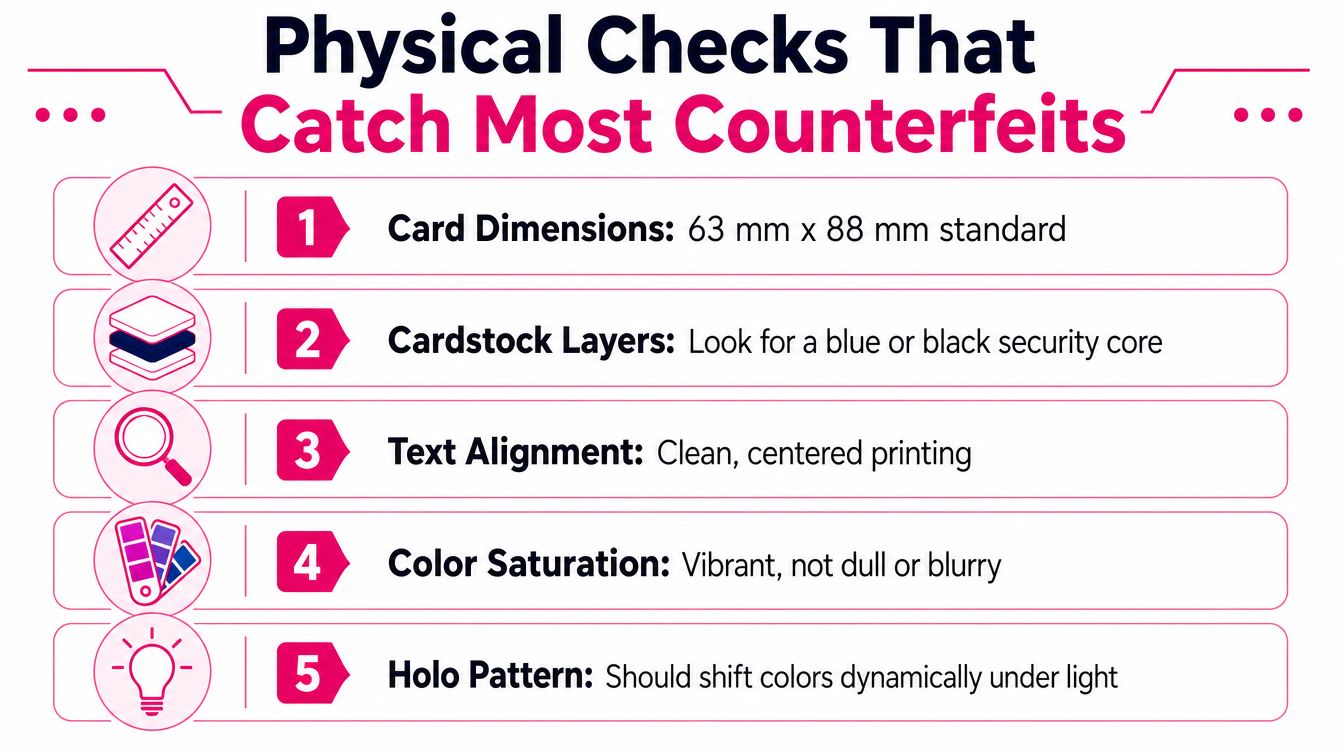
That layered body matters because it reflects how the card was made. A counterfeit can match the outer shape closely and still miss the internal construction, the cut, and the finish.
Size, edge, and texture
A card that is even slightly off in size or trimming deserves a closer look. Card stock can be cut to standard dimensions, so size alone does not prove anything. The stronger clue is the way the card is built, the edge finish, and the texture on cards that are supposed to have it.
Real Full Art cards are textured. If a Full Art feels flat and smooth all over, treat that as a serious warning. Some bootlegs try to imitate texture with a repeating crosshatch pattern, but that is only a surface pattern, not the card-specific embossing used on genuine pulls (Reddit discussion on texture checks).
A useful way to read those signs is to ask what part of production had to go wrong. A cutter can make the outline look correct, but it cannot create the layered core that comes from authentic card stock. A printer can add a fake surface pattern, but it cannot easily reproduce the exact pressure and finishing used on the genuine product. Vintage cards follow the same basic construction, and you can see how that layered build shows up in practice when evaluating vintage booster boxes.
Why those flaws happen
The reason is simple. Counterfeiters can copy the dimensions well enough to get past a casual glance, but they usually fall apart on the materials and finishing. That is why a card can look acceptable across a table, then feel wrong the moment you pick it up.
A quick inspection sequence helps during trade nights and card-show visits:
-
Check the edge: look for the dark center layer.
-
Run a finger lightly across the surface: modern premium cards should have the right texture.
-
Feel the stock: cheap paper can feel too thin, too stiff, or oddly papery.
-
Watch the finish in light: a real card should shift differently than a flat print.
A simple habit helps keep the checks grounded. Ask what material detail a fake would struggle to copy, then look for that detail first.
When a card passes one check but still feels off, keep going. A clean edge does not save a card with the wrong stock. A convincing texture does not help if the finish, weight, or stiffness feels unlike other cards from the same era. That is also where gray-zone items show up, such as fan-made cards and proxies. They may be made openly and with no intent to deceive, but they still do not belong in the same category as an official Pokémon release.
Reading the Printed Details Counterfeiters Get Wrong
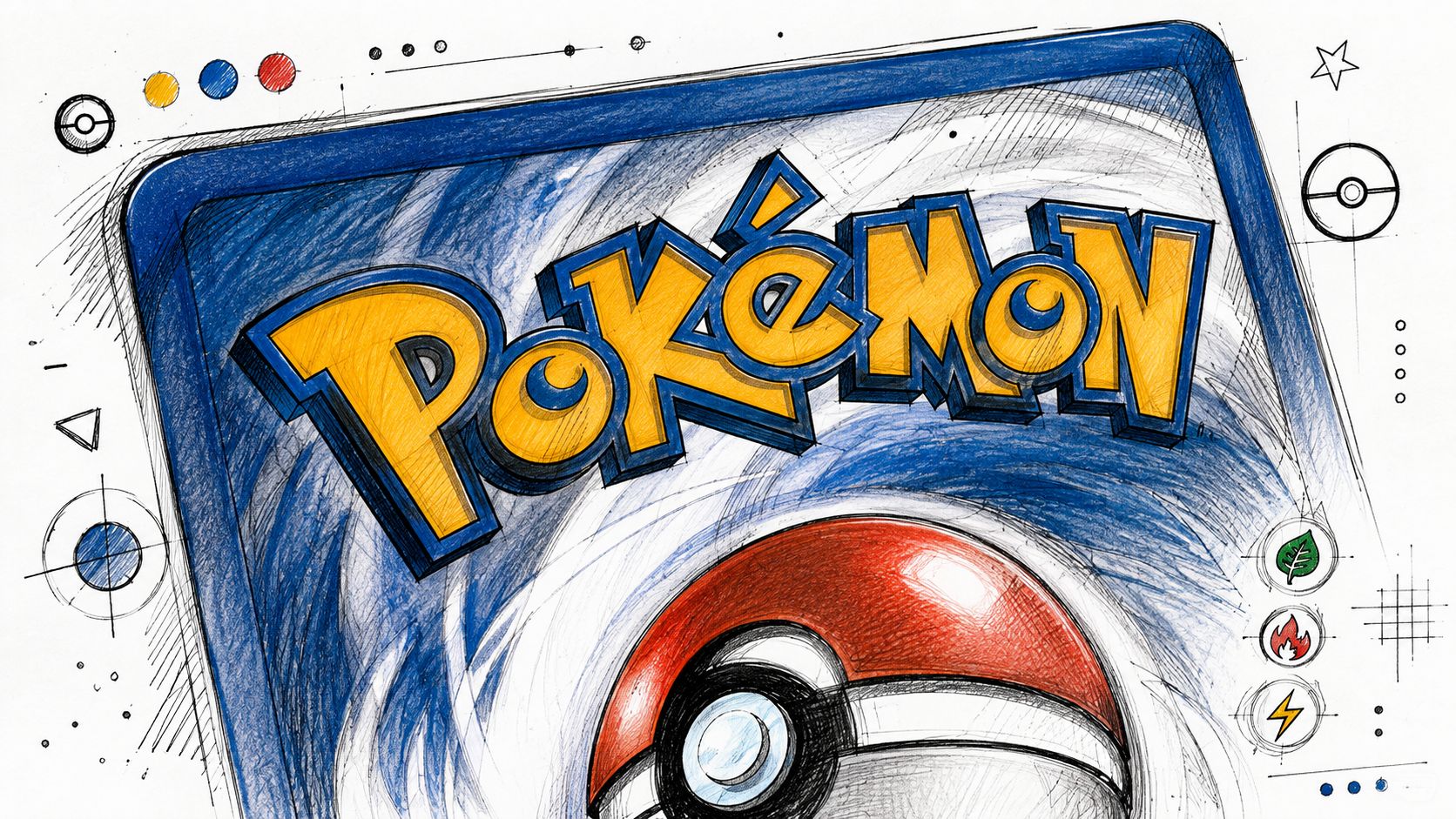
A suspicious card often gives itself away in the printed surface before it gives itself away anywhere else. The Pokémon wordmark should be crisp, the accent mark should look correct, and the back should show the deep blue gradient in the Poké Ball area rather than a flat, washed-out field. The back is especially useful because it gives you a fast comparison point against a known genuine card from the same era.
What to look for on the print itself
Bootlegs often show blurred text, misspelled names, bloated symbols, wrong set symbols, or borders that feel slightly off-center. You’ll also see holo patterns that look printed on instead of shifting with the viewing angle, and backs that read as flatter blue rather than layered and saturated (PokéGym fake card guide).
The classic mistakes are easy to miss if you only skim. A typo like “Pokèmon,” a misshapen energy symbol, or an awkward regulation mark can hide in a busy design. That’s why I like comparing the suspect card to a trusted reference from the same set or print era instead of staring at it alone.
Why the print breaks down
Those mistakes usually come from lower-resolution artwork scans, cheaper inks, and non-factory holographic films. Counterfeiters can get close on the big picture, but fine typography and smooth holo behavior are harder to fake convincingly. If the surface looks right but the letters look tired, the card is still suspect.
Good authentication is cumulative. One clean detail doesn’t redeem three bad ones.
That’s the part many newer buyers miss. A card can pass texture and still fail on the back. It can pass the back and still fail on the holo. You want multiple signals to agree, not just one surface cue that feels reassuring.
Why Single Tests Are Not Enough
Social media loves shortcuts. The flashlight test, the rip test, the smell test, the bend test, and the magnification test all get treated like magic answers. Some of them came from older, bulkier fakes where the paper and print were obviously bad. The trouble is that counterfeiters learned the same lessons buyers did.
A light test can still be useful, but only as one signal. A rip test tells you about the core, but it destroys the card and makes no sense for anything you might own or resell. Smell and bend tests are even shakier, because paper age, handling, and storage can change how a real card feels or smells. Magnification helps reveal print issues, but only if you already know what the genuine version should look like.
The smarter approach is to stack checks that cover different parts of the manufacturing process.
-
Physical surface: texture and edge cross-section.
-
Printed surface: typography and holo behavior.
-
Source check: seller reputation and how the listing is presented.
If a card passes four checks and fails one, that failure still matters. High-demand cards deserve more skepticism, not less, because counterfeiters aim for the places where buyers relax. The more money involved, the less room there is for “probably fine.”
A working routine should feel boring. That’s a good thing. You compare the card to a real reference, inspect the texture, read the back, check the edges, and then think about the seller and the price. When people skip any of those layers, they usually do it because the deal feels urgent.
The buyer workflow matters as much as the card itself. A solid routine keeps you from deciding too early, and that alone prevents a lot of mistakes.
A Buyer Workflow That Reduces Risk
Start before the card is in your hand. A seller who will not provide extra photos, will not answer direct questions, or pushes you to pay fast is already showing you the risk. A clear seller with good photos and a realistic asking price gives you room to verify instead of guess.
Ask for front, back, and edge shots under different lighting. That matters because some flaws only show up when the holo shifts or when the edge exposes the cardstock core. If the card is priced like a deal, compare it against recent sales and ask whether the number fits the card’s condition and demand.
For higher-value purchases, third-party authentication belongs in the risk plan, not as a last-minute add-on. PSA, BGS, CGC, and TAG all play a role in the hobby’s trust layer, especially when a raw card sits near the edge of what you are comfortable spending. If you want a platform with market intelligence layered into buying decisions, Double Holo is one option that combines raw and graded singles, pricing tools, and vendor workflow in one place.
Use the seller, the card, and the market together. If one of the three feels off, pause.
A repeatable order keeps you from improvising under pressure.
-
Vet the seller: check whether the listing history and responses make sense.
-
Request better photos: front, back, edges, and angled light.
-
Compare the price: ask whether the number fits the market and the condition.
-
Inspect in hand: run the physical and print checks in the same order every time.
-
Verify after purchase when needed: use third-party grading for cards where the downside is too large to judge by eye.
That rhythm works at a table, in a local trade chat, or in an online marketplace. It is not glamorous, but it is far better than trying to remember every fake-card tell in the moment.
If you also buy sealed product, keep the same mindset when you evaluate how to buy Pokémon cards. The process is the same even when the packaging changes. Verify first, then pay.
The Risks of Holding or Selling a Bootleg
Owning a fake card is one problem. Selling it is another. If you submit a counterfeit to grading, the grading company will usually reject it or flag it, and the submission fee plus return shipping can still end up on the seller’s side of the ledger. The risk grows because grading companies are already seeing more counterfeit submissions, which means the problem is not staying hidden in private collections.
That cost does not stop with the card itself. A buyer who learns the card is fake may ask for a return or start a chargeback, and a seller without strong protection can lose both the money and the card. In a local collecting scene, one bad sale can also follow you for a long time, because trust is part of how deals get done.
The market pressure is concentrated in the cards that people chase most aggressively. In reporting by USA Today, PSA said Pokémon accounted for 6 of the top 10 most counterfeited cards, a reminder that high-demand cards attract the most fraud (USA Today PSA fraud report). That does not mean every expensive card is fake. It means buyers and sellers need stronger provenance, clearer photos, and more patience before money changes hands.
Collectors also run into a gray zone that gets overlooked. Fan-made cards and proxy cards can be interesting as art, practice pieces, or placeholders, but they are not official retail product, and they should not be mixed into legitimate inventory. If a card passes a few surface checks but still feels wrong, the safest response is to slow down and verify where it came from, because a card can look convincing while still being outside the official market.
For a collector, authentication is self-protection. For a seller, it is liability control. For both, it is part of staying credible in a market where one bad card can create a long cleanup trail.
Your Personal Authentication Checklist and Common Questions
A simple checklist is usually enough if you use it every time.
-
Seller vetting: does the person answer clearly, show history, and avoid pressure tactics?
-
Listing review: do the photos show the front, back, and edges under normal light and angled light?
-
Physical checks: does the size, edge layer, feel, and texture match a real card?
-
Printed checks: is the typography crisp, is the back gradient correct, and does the holo move properly?
-
Post-purchase verification: is this valuable enough to justify grading or a second opinion?
That’s the entire habit in one pass. Most buyers don’t need a giant checklist, they need a repeatable one.
Common questions collectors ask
What if I already own a bootleg?
Keep it labeled as such. If it’s historically interesting, file it with your notes so it doesn’t get mixed into trade stock.
Do fan-made cards have collector value?
Sometimes, but it’s a different kind of value. They can be interesting as art or memorabilia, yet they aren’t official cards and shouldn’t be treated like authenticated retail product.
What if a seller pushes back on a return?
Stay factual, keep the photos, and document the signs that didn’t match. If the platform offers buyer protection, use it.
When is grading worth it?
When the card’s value or rarity makes a mistake expensive enough that a professional review is cheaper than guessing.
Collectors who build this habit early save themselves a lot of friction later. Counterfeiters keep improving, but buyers who check the same signals every time are harder to fool.
Double Holo gives collectors and sellers one place to compare cards, watch market movement, and manage buying decisions with more context than a casual listing page. If you want to tighten your own verification routine and keep your next purchase from becoming a problem, visit Double Holo and take a look at the tools built for serious Pokémon TCG buyers.