
Navigating Battle Styles: From Commons to Chase Cards is easier when you stop treating the set like a flat checklist. Released in March 2021, Sword & Shield, Battle Styles introduced the Single Strike and Rapid Strike mechanics, and that alone gave the set a long tail in both collecting and play history. The set contains 183 total cards, with 163 main-set cards and 20 Secret Rares according to the official checklist, while independent collector checklists note that a full master set reaches 306 cards once reverse holos are included, which is why completion feels much bigger than the printed count suggests (official Battle Styles checklist).
If you’re sorting binders, pricing singles, or deciding what to grade, the key question isn’t just what’s rare. It’s why certain cards keep drawing attention while most of the set sits in the long tail. The pokemon battle style card list looks simple on paper, but value concentrates around a small group of alternate arts, trainer cards, and style-defining chase pulls that still matter in a mature market.
Table of Contents
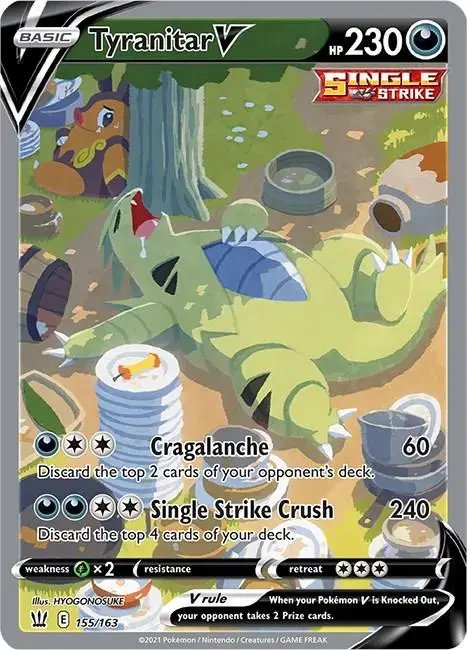
1. Tyranitar V (Alternate Full Art) #155/163
Artwork and collector demand
Tyranitar V at #155/163 is the card most enthusiasts refer to when they talk about Battle Styles’ chase tier. Market guides put it near the top of the set, with one tracker listing the holofoil version around $272.94 and another set overview placing Tyranitar V at about $266.12 on the open market. That price gap with ordinary Battle Styles inventory is the whole story, because this card is not valuable just for being rare, it’s valuable because collectors still want the alternate-art presentation.
The appeal is visual, but it’s also psychological. Tyranitar is a marquee species, and the alternate full art breaks away from the usual battle pose template. Collectors who chase modern alternate arts tend to pay for cards that feel like scenes, not just attacks, and this one has the kind of story-driven artwork that keeps it near the top of want lists.
Practical rule: If a Battle Styles buyer says they want “one card from the set,” they usually mean this one, or they mean a close rival from the same alt-art tier.
How to treat it in a trade or grading pile
Raw copies deserve close inspection because the upside is concentrated at the top end. The grading guide for Battle Styles shows that condition matters sharply across the set, with 33 of 37 cards (89%) showing positive expected value at PSA 10, while the average gem rate sits at 47.9% and average EV at $19.68. That doesn’t guarantee every raw Tyranitar is a grading win, but it does explain why collectors and vendors treat premium copies differently from loose binder cards.
For practical sorting, keep this card out of bulk-priced piles. It belongs in a high-attention folder with clean sleeves, a hard case if needed, and a separate trade conversation from the rest of the set. If you want a deeper comparison on how another major alt art behaves in grading and resale, the logic behind Moltres V alternate art is a useful parallel, especially if you’re deciding what belongs in a slab queue versus a quick flip stack.
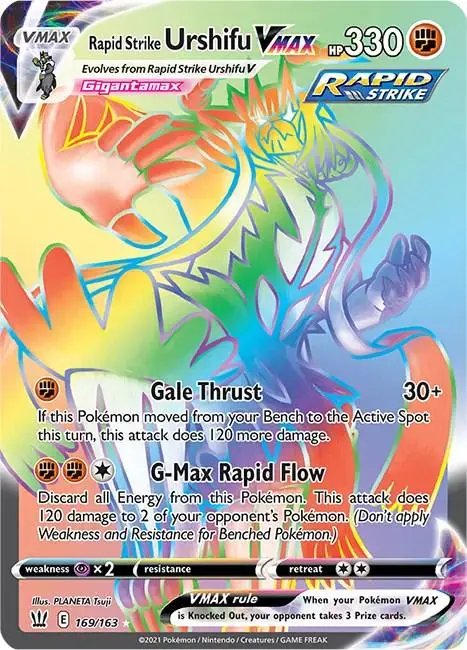
2. Rapid Strike Urshifu VMAX (Alternate Art Secret) #169/163
Why the Rapid Strike version stays relevant
Rapid Strike Urshifu VMAX at #168/163 matters because the card does three jobs at once. It’s a mascot-level chase, it carries the Rapid Strike identity that Battle Styles is known for, and it appeals to collectors who want a set-defining alternate art instead of a generic rainbow treatment. The market has kept it relevant, with one pricing guide listing the rainbow version of the card around $77.09 and another guide placing the overall Battle Styles market near $779.05 with a 30-day trend of +4.4%.
That kind of demand doesn’t happen because the card is merely playable. It happens because the art style and the mechanic identity reinforce each other. Battle Styles was the first English expansion to introduce Single Strike and Rapid Strike mechanics, and the rulebook framing gives the styles real thematic weight, with Rapid Strike Pokémon described as more proficient with sneaky, technical attacks (Battle Styles TCG history)). Collectors respond to that theme because it gives the card a place in the set’s story.
Why sellers still separate this from bulk VMAX cards
The practical mistake is lumping this into the same pricing lane as lower-end VMAX pulls. Battle Styles has 6 Holo Rare VMAX cards and a much broader chase structure than casual sellers expect, which means the spread between ordinary VMAX inventory and premium alt art remains wide. Sellers who understand that spread list this card separately, photograph it carefully, and avoid burying it in mixed lots.
Buyers pay for cards that are easy to identify at a glance, and this one is easy. If you’re building inventory for resale, keep the image-driven cards isolated from the deck-play cards and the normal holos.
If you’re checking prices before listing, a better workflow is to compare card condition, finish, and centering against a live market view rather than relying on a memory of last month’s binder trade. That’s the same reason many sellers use a structured way to check Pokémon card prices instead of guessing from old completed listings.
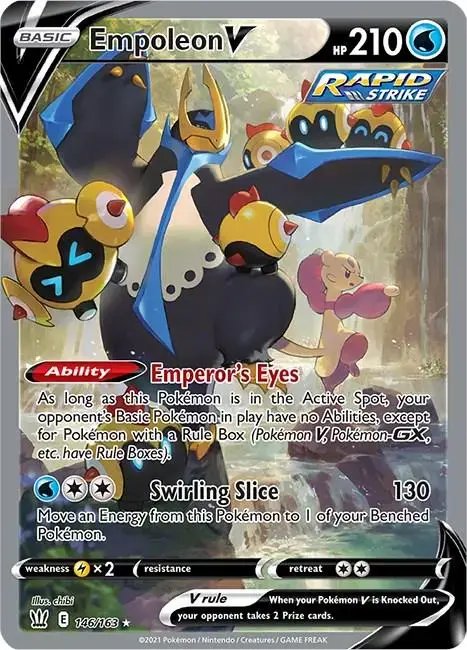
3. Empoleon V (Alternate Full Art) #146/163
Why the quieter artwork still sells
Empoleon V at #146/163 is the kind of Battle Styles card that teaches collectors not to confuse loud art with lasting demand. One market tracker places the set’s Empoleon V copies at $73.32 for a top version and $4.75 for another, which shows how strongly presentation can affect value inside the same numbered family. That spread is useful for vendors because it reminds you that even similar-seeming cards can belong in completely different pricing buckets.
The card works because it leans into atmosphere. Empoleon in Battle Styles isn’t framed as a pure combat icon, it’s shown in a calmer environment, which gives the card a different kind of appeal than the more aggressive alt arts in the set. Collectors who buy for display often prefer that kind of scene because it reads like a self-contained illustration, not just a trading card with foil treatment.
When this is the better pickup than a flashier chase card
Empoleon V can be the smarter buy when the Tyranitar lane is too expensive for the budget. Battle Styles’ value is heavily concentrated, with one guide showing card values ranging from $0.06 to $275.36 and an average near $4.71, while another overview pegs the average tracked card at $4.48. That means you don’t need to buy the top of the set to buy a card with real collector weight.
For trade tables, Empoleon V is a practical middle-ground card. It’s recognizable, it has a premium art style, and it’s easier to move than many deep-cut ultra rares because buyers can understand the appeal immediately. That matters in a mature set where people are not opening packs for completion anymore, they’re selecting the few cards that still carry display value and market depth.
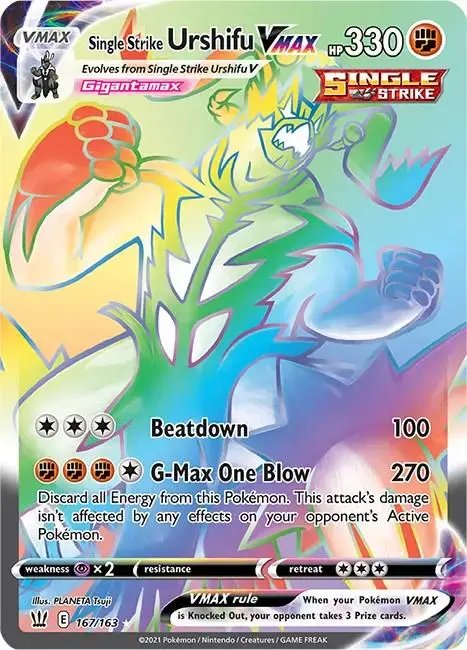
4. Single Strike Urshifu VMAX (Alternate Art Secret) #167/163
What the perspective does for the card
Single Strike Urshifu VMAX at #167/163 works because the art sells scale before it sells rarity. The angle looks upward at the Pokémon, which makes the form feel imposing and gives the card the same kind of gravity that the best alternate arts use to create demand. In the Battle Styles family, that matters because the set’s identity is built around the split between Single Strike and Rapid Strike, and this card is the raw-power counterpart to the more fluid Rapid Strike version (Battle Styles TCG history).
The market also reflects that role. One independent guide lists the rainbow version at $31.60, while the same family of trackers places the regular VMAX and related Urshifu cards lower, which tells you the alternate-art framing is doing the heavy lifting, not just the Pokémon name. For collectors, that’s the difference between “strong set card” and “must-have mascot chase.”
Why set completion collectors care
This card also matters because it anchors the top-end chase cluster. Battle Styles has 22 Ultra Rare, 20 Rare, 20 Secret Rare, 16 Holo Rare, 12 Holo Rare V, and 6 Holo Rare VMAX cards, so the set’s value is structurally top-heavy rather than evenly spread. When a collector builds toward the higher tiers, this card sits in the group that makes the set feel complete on a display shelf.
If you sell Battle Styles often, don’t describe this as just another VMAX. Buyers who know the set are looking for the alternate-art secret rare lane, and they usually know exactly which art they want.
The same logic applies in grading. Premium art plus strong set identity gives the card staying power, but only if the copy looks worth slabbing in the first place. A clean raw card with sharp corners belongs in a grading review pile, while a worn copy should be priced to move. That’s the kind of judgment call a seller makes faster when the market is already familiar with the card’s role in the set.
5. Phoebe (Full Art) #161/163

Why trainer collectors keep targeting Phoebe
Phoebe at #161/163 is the clearest example of how a trainer card can outperform expectations in a Pokémon-heavy set. In Battle Styles, the full art version is tracked around $14.55, while the rainbow version sits around $8.64, which shows that collectors still place a premium on the full art presentation when the character interest is strong. Phoebe’s appeal comes from character recognition, design cleanliness, and the fact that trainer collectors buy by identity, not just by attack relevance.
That’s especially useful for vendors who sort by audience. Pokémon chase cards usually draw the widest attention, but trainer cards create a separate lane of demand from collectors who prefer character art, color balance, and display-friendly layouts. In a set with a high concentration of chase cards, a standout trainer often becomes the card that non-player collectors choose when they don’t want a V or VMAX.
How to think about it against Pokémon VMAX cards
Phoebe’s role in the set is stronger than its position in the numbered checklist suggests. Battle Styles has a total of 183 cards, but the market doesn’t treat every numbered slot equally, and the data makes that clear by showing a small number of premium cards carrying most of the attention (official checklist). Phoebe is one of the cards that survives that sorting process because it competes on aesthetics and trainer popularity, not on battle power alone.
If you’re deciding whether to hold, trade, or grade, trainer full arts deserve a separate review pass from the Pokémon chase stack. They can move differently depending on buyer type, and that means a clean copy sometimes belongs in a portfolio of display cards rather than a deck of short-term flips. In practice, a well-organized market view matters more than a blanket price list, because the buyer pool for a character card doesn’t behave like the buyer pool for a mascot VMAX.
5-Card Battle-Style Comparison
| Card | 🔄 Acquisition difficulty | ⚡ Cost & availability | 📊 Market performance | 💡 Ideal use cases | ⭐ Key advantages |
|---|---|---|---|---|---|
| Tyranitar V (Alternate Full Art) #155/163 | 🔄 Very high, chase alternate art | ⚡ High cost, scarce supply (alt‑art premium) | 📊 Strong demand; often top value in set | 💡 Alternate‑art collectors; long‑term hold | ⭐ Unique story‑driven art (HYGON); standout centerpiece |
| Rapid Strike Urshifu VMAX (Alt Art Secret) #168/163 | 🔄 High, secret rare, mascot card | ⚡ High cost, limited print | 📊 High liquidity; appeals to players & collectors | 💡 Playable decks + aesthetic collectors | ⭐ Dynamic dojo scene; dual appeal (play & display) |
| Empoleon V (Alternate Full Art) #145/163 | 🔄 Moderate, alternate art but more common than chase | ⚡ Moderate cost, relatively available | 📊 Stable value; consistent collector interest | 💡 Thematic water‑type displays; set builders | ⭐ Intricate, serene artwork; steady market performance |
| Single Strike Urshifu VMAX (Alt Art Secret) #167/163 | 🔄 High, secret rare counterpart to Rapid Strike | ⚡ High cost, limited supply | 📊 Strong among set completers and collectors | 💡 Complete mascot alternate‑art sets; display | ⭐ Imposing Gigantamax perspective; key for completion |
| Phoebe (Full Art) #161/163 | 🔄 Moderate, full art trainer focus | ⚡ Often high price; moderate availability | 📊 Very strong resale; sometimes exceeds VMAX prices | 💡 Trainer collectors; investment pieces | ⭐ Popular character design; elegant full‑art appeal |
Beyond the Top 5 Collecting Battle Styles in 2026
Battle Styles is mature now, but it’s not dead inventory. One independent price guide tracks 306 priced collectible variants across 183 cards, and says 183 of 183 cards were updated on 2026-07-26, which is exactly what you want in a set that has moved from pack-opening excitement into pricing and grading discipline. That kind of coverage means vendors can still price the set as a working market, not just as a nostalgic checklist.
The numbers also show why the set still matters to serious collectors. Battle Styles is top-heavy, with a few chase cards carrying much of the attention, while the rest of the set falls into a low-value tail where lots of cards sit near bulk territory. The practical takeaway is simple. Buy the cards with visual identity, mechanic identity, or character identity, and treat the rest as filler unless your goal is a complete master set.
For raw buyers, condition still decides a lot. For graders, the mix of 47.9% average gem rate and $19.68 average EV shows why selective submission beats blind submission in this set. That’s where the smart money goes, not into hoping every Battle Styles pull becomes a slab winner.
If you’re sorting your own copies right now, compare the chase cards against live market movement, separate alternate arts from ordinary ultra rares, and keep trainers in their own lane. A focused approach saves time, reduces bad grading submissions, and helps you spot which Battle Styles cards still deserve a premium in 2026.
If you want a cleaner way to track Battle Styles singles, compare grading upside, and keep your buy, sell, and hold decisions organized, take a look at Double Holo. It gives collectors and vendors a single place to watch market movement and price cards with more context than a static list. That makes it easier to manage chase cards like Tyranitar V, Urshifu, Empoleon, and Phoebe without guessing at the next move.