

The market has already told you what Galarian Moltres V Alternate Full Art 177/198 is worth. Double Holo puts market price for Near Mint at roughly $230, and that’s before you even account for how aggressively the broader Moltres family has moved, with one 2026 market guide tracking 85 Moltres cards, $4,128.01 in total market price, a $498.88 high card, and 47.1% year-to-date growth in that family Facebook market reference. That combination, a chase-card valuation, a scarce numbering slot, and a species-level demand floor, is why this card behaves more like a tradeable collectible asset than a casual illustration.
Table of Contents
Why the Moltres V Alt Art Commands Premium Prices
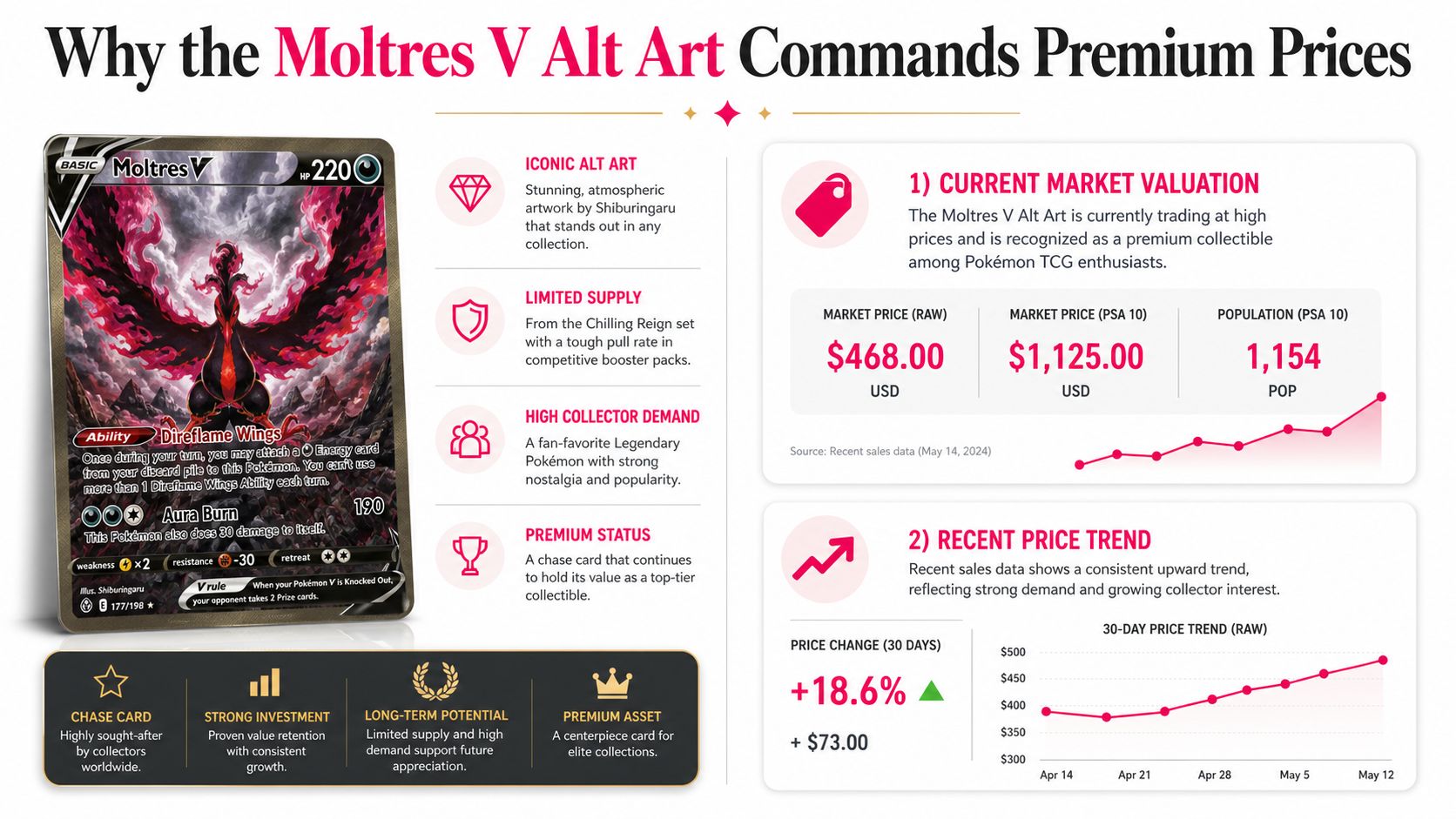
Recent market movement gives the clearest read on Moltres V Alt Art pricing. One market-data aggregator tracked the raw Near Mint card at about $205, with a $85 move over 30 days, or +41.5% on Double Holo. That kind of move is not being driven by play demand. It reflects collector competition for a limited pool of copies, and that is what creates the premium.
Scarcity does most of the work
177/198 is the key number. In Chilling Reign, that places the card in the Secret Rare-style tail of the set, directly after the regular full art at 176/198, which is the numbering pattern collectors usually associate with chase cards PokémonDB. That structure matters because the market reads tail-end numbering as a signal that supply is tighter than the rest of the set, even before condition and grading come into play.
The premium also looks stronger when you view the broader Moltres family as a whole. A market reference from a Facebook group noted 85 Moltres cards tracked, $4,128.01 in total market price, a $498.88 high card, and 47.1% year-to-date growth across the species family Facebook market reference. That does not mean every Moltres print moves in lockstep, but it does show the species keeps collector attention well beyond a single release.
Practical rule: when a card sits in the high-number chase slot and has an established species following, buyers stop treating it like a normal Ultra Rare and start treating it like a supply-constrained collectible.
Why the premium holds up
The visual appeal helps, but it does not explain the entire spread. The card holds its premium because the art, set position, and brand recognition all reinforce the same outcome. When those factors line up, even moderate demand can pull the asking price away from ordinary Moltres prints, especially when available copies are already thin.
Condition spreads matter too. A copy in clean Near Mint shape can trade very differently from one with edge wear, surface scratches, or centering issues, and that gap is where short-term volatility shows up most clearly. For a broader framework on how collectors judge realized value, see what a Pokémon card is worth. The core point is simple. Moltres V Alt Art has a mainstream collector base, a rare-numbering slot, and a species name that already carries weight, so its price is supported by scarcity mechanics as much as by artwork.
Identifying the Galarian Moltres V Alternate Full Art
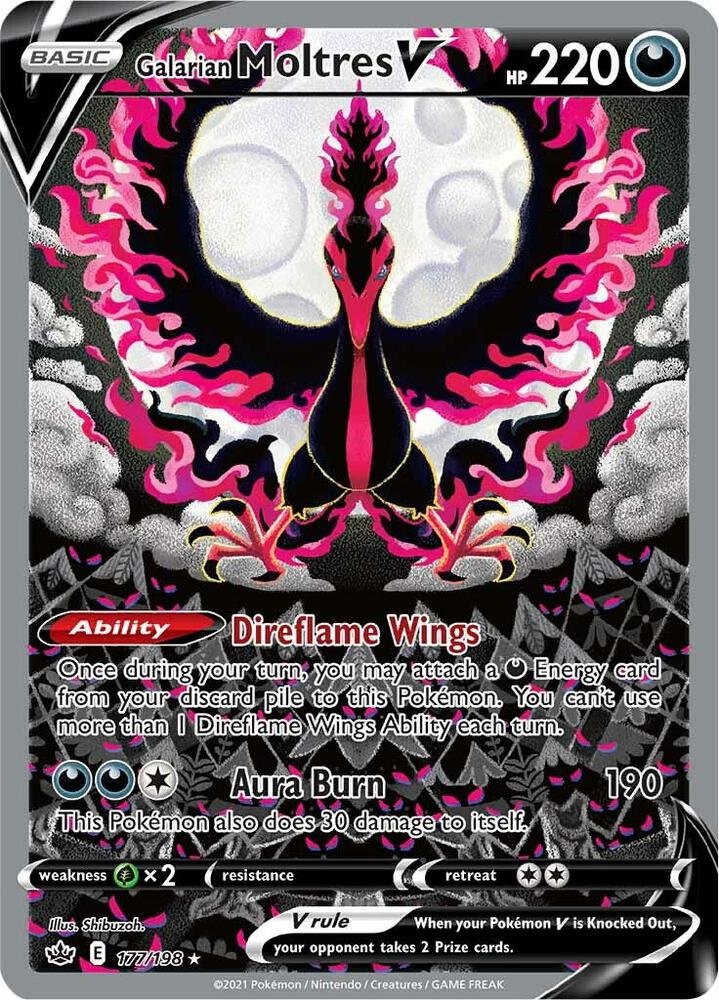
The card you want is Galarian Moltres V Alternate Full Art from Chilling Reign, numbered 177/198 PokémonDB. That number is the quickest authenticity check in a listing, because the regular full art sits at 176/198 and the alternate art occupies the next slot, which is the market’s standard way of signaling a chase version rather than a simple reprint.
What to verify before buying
The easiest mistake buyers make is relying on the name alone. Sellers often shorten titles, omit the set number, or mix the alternate art with the regular Moltres V print family, so the safest practice is to verify the numbering first and the art second. The alternate full art is the version with the premium scarcity profile, not any Moltres V from the set.
The underlying card data also matters. The card version tied to the special Chinese CSR listing shows 220 HP and the Direflame Wings ability, which attaches a Darkness Energy from the discard once per turn Pokémon Card China product page. That ability confirms you’re looking at the same playable Galarian Moltres V structure, even though the premium here is driven by the alternate illustration and scarcity rather than gameplay utility.
Reading the attack line
The trading-card version mirrors that prestige with Aura Burn, listed at 190 damage PokémonDB. That matters less as a play pattern than as a content check, because high-value chase cards are frequently misdescribed in marketplace titles, especially when sellers copy language from other Moltres prints.
The best listing filter is simple, if the number doesn’t say 177/198, you’re probably not looking at the premium card.
Use the image, the card number, and the named attack together. If a listing shows the correct species but the wrong numbering, it’s not the same asset. If it shows the right numbering but the wrong art treatment, it’s still the wrong card for collector-grade pricing.
Comparing Alt Art Value Against Regular Moltres V Prints
The premium only becomes obvious when you put the versions side by side. Moltres V Alt Art is not expensive because it’s Moltres. It’s expensive because it sits at the intersection of a scarce slot, collector preference, and a version hierarchy that pushes ordinary prints down-market.
| Moltres V Print Variants Comparison | Card Number | Scarcity Tier | Market Position |
|---|---|---|---|
| Galarian Moltres V Alternate Full Art | 177/198 | Secret Rare-style chase slot | Premium collector card |
| Regular Full Art Moltres V | 176/198 | Standard full art | Lower-priced comparison point |
| Standard Moltres V | Varies by print | Mainset playable version | Baseline utility card |
What the comparison really says
The regular full art and standard V serve as anchors, not rivals. They help define the alt art’s price ceiling because they occupy the same species family without the same scarcity signaling. Once collectors decide they want the alternate illustration, the baseline prints stop competing on aesthetics and start competing on affordability.
That’s why the alt art’s value is mostly outside the gameplay conversation. The card’s premium comes from the fact that buyers are chasing the artwork and the supply profile at the same time. The regular versions can be functionally close, but the market doesn’t price them like substitutes when the collector pool is active.
A side effect of that structure is that pricing can disconnect from playability fast. Standard Vs tend to behave like liquid inventory, while the alternate art behaves like a trophy asset. The result is a market where the same Pokémon can have multiple price identities depending on whether the buyer wants a binder copy, a play copy, or a display chase card.
If you’re comparing versions for purchase decisions, don’t ask which one is stronger. Ask which one the market is rewarding for scarcity and presentation. Those are separate questions, and for this card the answer isn’t close.
Understanding Short-Term Price Volatility in Alt Art Cards
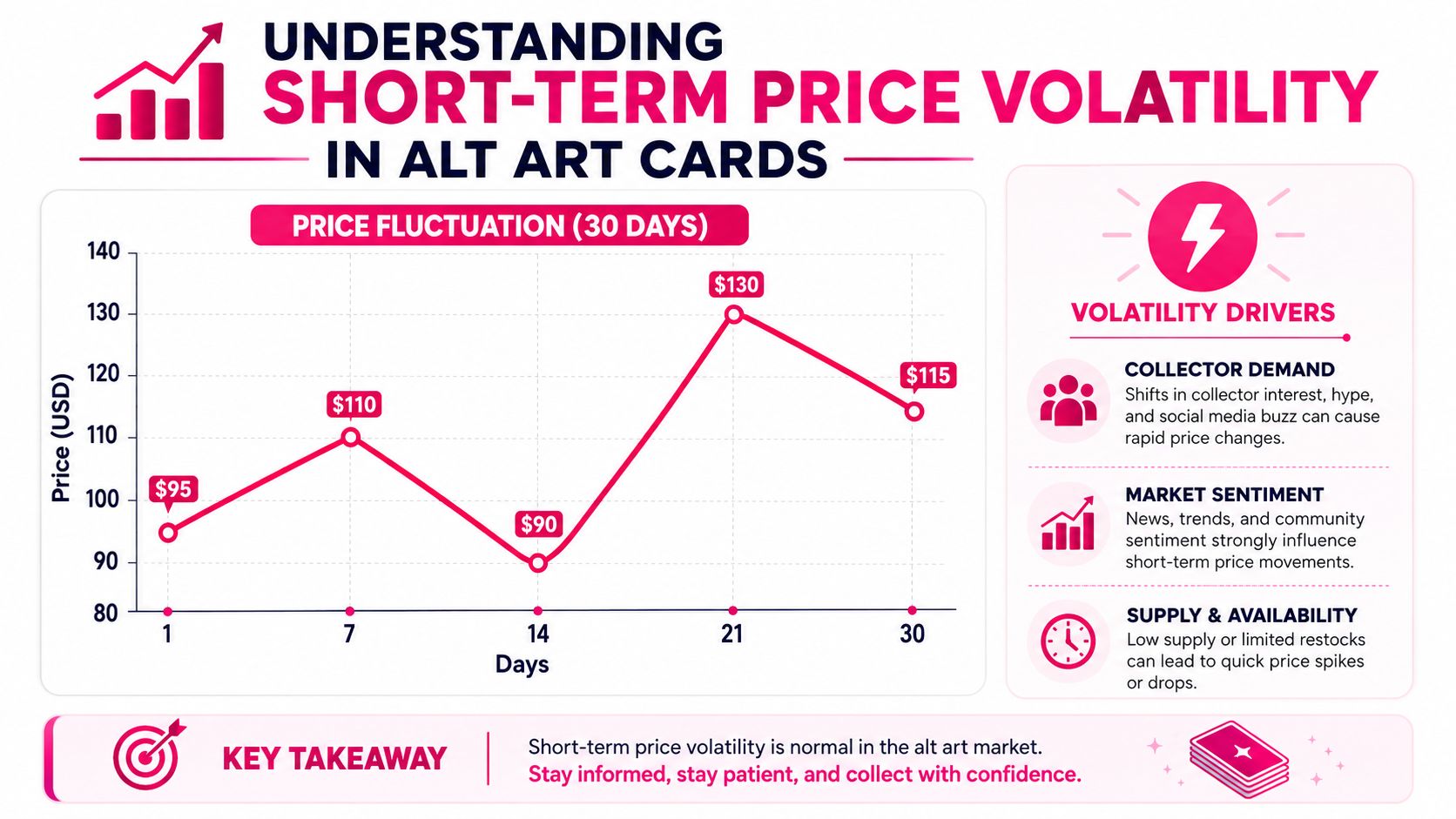
A raw Near Mint copy showing a $85 30-day move is the clearest warning sign in the current market. That kind of swing shows the card is trading on collector urgency, not on slow, fundamentals-only repricing. With thin supply, even small shifts in buyer attention can push the market up or down quickly.
Why the price moves fast
Alt art cards face supply shocks that regular Vs usually do not. Pack openings add fresh copies unevenly, grading submissions can put more inventory into public view at once, and collector demand often concentrates around a few chase cards instead of spreading evenly across the set. That mix makes price discovery unstable.
The market structure explains the speed. Because the premium is mostly aesthetic and scarcity-based, the floor does not get much support from gameplay demand. Value is therefore more exposed to sentiment shifts, visible inventory changes, and whether buyers are chasing graded or raw copies in the same week.
Trading rule: if a card’s appeal comes mainly from collector scarcity rather than play demand, expect sharper swings whenever new supply hits the market.
How to read the move without overreacting
A short-term rise does not automatically mean a lasting reprice. It can also reflect temporary tightening when a few lower-priced listings vanish and the visible market looks thinner than it really is. A spike in listings disappearing is a supply event first, a demand signal second.
For price monitoring, consistency matters more than prediction. Track raw, lightly played, and graded listings together, then watch whether the spread narrows or widens after a burst of sales. That tells you more than any single daily snapshot, especially for a card that can reprice on attention rather than on fundamentals.
A live workflow like the one described in a dedicated Pokémon card price tracker helps separate real trend shifts from a short squeeze of collector attention. The goal is not to guess the next tick. It is to avoid treating a temporary scarcity premium as a stable valuation floor.
How Grading and Condition Affect Realized Value
Condition is where Moltres V Alt Art stops behaving like a simple chase card and starts pricing like a graded asset. The same copy can clear very different realized values depending on centering, edge wear, surface quality, and whether the buyer wants raw cardboard or a slab with a grade attached. For this card, grading decisions need to be modeled separately from collector demand, because the condition premium is not uniform.
Raw versus slabbed value
The clearest market anchor is still the raw copy, with verified listings showing a near $205 level in Near Mint and $213.78 in Holofoil condition, as noted earlier. The spread is narrow enough to matter. It shows that raw condition still supports most of the tradeable value, while the slab premium remains tied to buyer confidence rather than a dramatic re-rating of the card itself.
That matters because grading changes the buyer’s risk calculation. A slab removes some uncertainty, but it also introduces submission cost, turnaround time, and the chance that a strong-looking raw card lands below the grade you expected. Sellers who treat every copy as a grading candidate usually miss the key split in the market, which is between clean raw inventory and copies that are strong enough to justify certification.
What to inspect before submitting
-
Centering: Check whether the borders look balanced on the front and back. A strong image does not offset poor centering.
-
Surface: Look for scratches, print lines, and holo wear under angled light. Alt art surfaces can conceal small flaws until the card is rotated.
-
Edges and corners: Whitening on the back edges lowers realized value even when the front looks clean.
-
Population context: If a grade becomes common, the slab premium can compress, which is why grading decisions should be considered alongside broader population data in grading population guidance.
When grading makes sense
Grade only when the raw card is strong enough that the slab is likely to improve liquidity or buyer confidence. If the card has visible defects, selling raw often preserves more value than paying for a grade that does not clear the submission cost. The better question is not whether the card is popular, but whether this specific copy is clean enough to sell at a premium after fees and risk.
That is the disciplined lens here. Condition converts collector demand into realized value, but only when the copy is good enough to support the grade and the market is willing to pay for certainty.
The Competitive Legacy Behind Moltres Collector Demand
Moltres already had a collector base before the modern alt-art market gave it a fresh pricing lens. The species has long carried legendary weight in the games, with a base Special stat of 125 and a base experience yield of 217 in Generations 1 through 4, then a later experience yield of 261 in subsequent releases, as listed in Bulbapedia). That kind of continuity matters because cards tied to familiar, historically strong Pokémon tend to attract steadier attention than cards built around short-lived hype.
Why the species still matters
The modern regional form keeps the same overall stat total of 580, with a spread of 90 HP / 100 Attack / 90 Defense / 125 Special Attack / 85 Special Defense / 90 Speed, which is part of why the name still carries weight with collectors across different eras, according to Bulbapedia). Those numbers do not set the card’s market price on their own. They do help explain why Moltres continues to feel like a top-tier legendary rather than a forgettable reprint target.
The release timeline adds another layer. Moltres appeared in Pokémon GO on July 31, 2017, and Dynamax Moltres came later on February 3, 2025, as documented in the official Pokémon GO news archives and game material from the wider franchise. That kind of recurring exposure keeps the species in circulation across multiple play environments, which supports recognition when a premium art version enters the market.
Why that legacy supports premium art
The alternate art does not manufacture Moltres demand from scratch. It monetizes a reputation that already exists. Collectors know the bird, know the legendary status, and tend to respond to special treatments of the species, so the artwork lands on a familiar audience instead of one that needs to be educated from zero.
Scarcity mechanics matter more here than casual fan sentiment. A chase card tied to a well-known legendary can trade with a wider buyer pool, but that same visibility also creates sharper reactions when clean raw copies get scarce or when graded copies cluster around the same tier. The spread between raw inventory, near-mint examples, and slabbed copies is where short-term volatility shows up first.
That is the practical read for buyers and sellers. The card’s value floor comes from species familiarity and franchise continuity, while the ceiling comes from presentation and scarcity. When those layers line up, Galarian Moltres V Alt Art behaves less like a routine modern print and more like a collectible asset that can move quickly when supply tightens and condition confidence improves.