


You just pulled the card. Maybe it’s a glittery hit from a booster box, maybe it’s the one holo you’ve been chasing for months, and now your phone is already open with a search tab asking what it’s worth. That urge is normal, but the first number you see usually isn’t the number that matters. Pokémon card worth is a process, not a sticker.
If you price the wrong variant, ignore condition, or choose the wrong selling venue, you can give away real money without noticing. The better move is to treat the card like inventory, label it correctly, judge it accurately, then decide whether it should be sold raw, graded, or moved through a channel that keeps more margin in your pocket.
Table of Contents
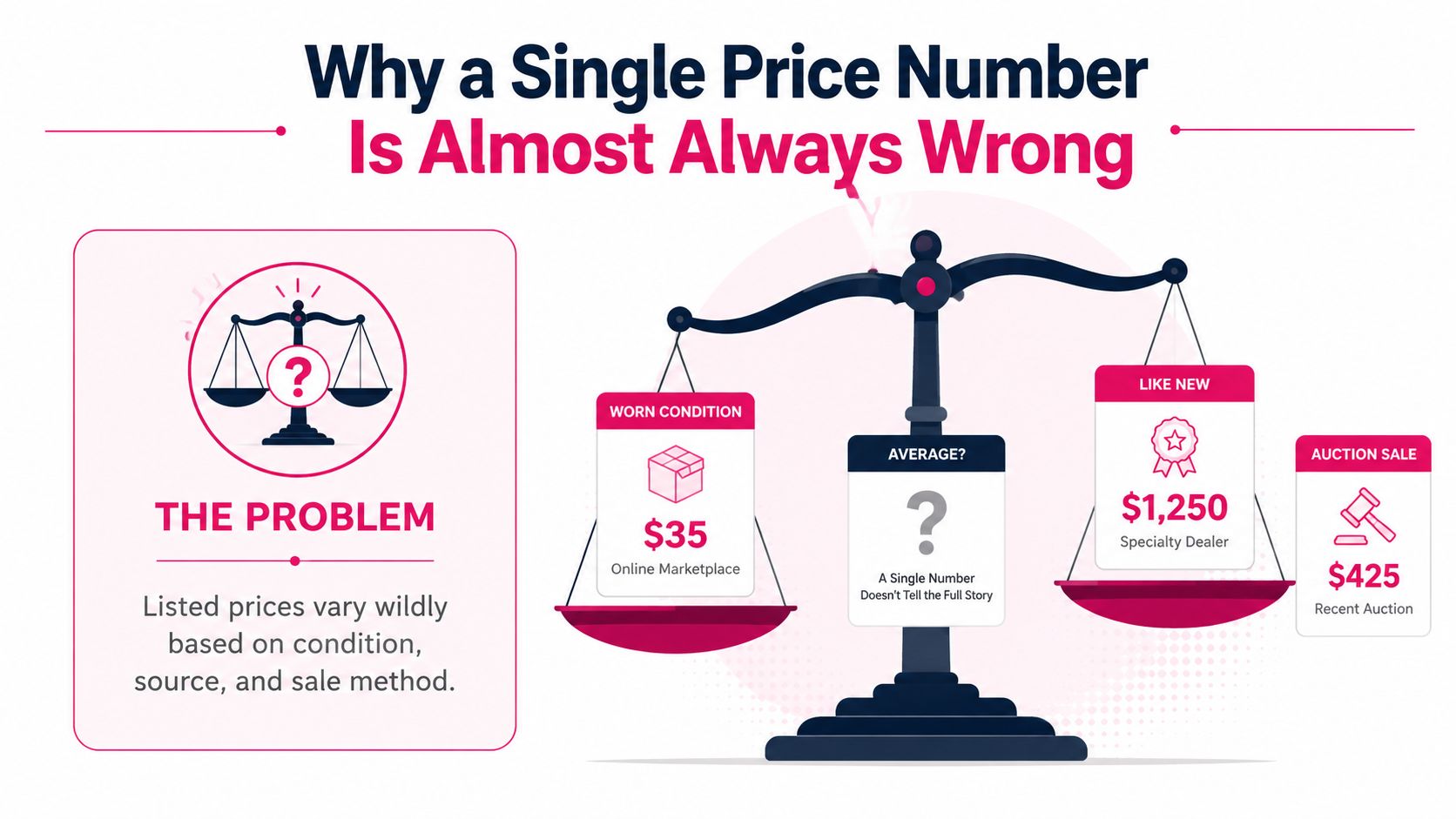
Why a Single Price Number Is Almost Always Wrong
You pull a chase card, tilt it under the light, and the first instinct is to ask, “What’s it worth?” That question sounds simple because people answer it badly. A card doesn’t have one clean value, it has a value depending on exact variant, condition, timing, and where it sells.
The market is also top-heavy. Only about 0.6% of priced cards are worth $1,000 or more ungraded, while 22% were worth less than $1. That’s why most cards are ordinary in resale terms, and why the few high-end cards pull attention away from the rest of the binder.
Identify the exact card first
If you search the wrong card, every comp after that is polluted. Start with the card name, then the set name and symbol, the collector number, the rarity, the edition stamp if it has one, the holo pattern, and the language.
Practical rule: never price a card until you can say exactly what it is in one sentence. If you can’t identify it cleanly, you’re not ready to compare it cleanly.
The market guide on valuing Pokémon cards recommends pricing against completed sales from the last 1 to 7 days, filtered by condition, because asking prices can drift far from what sold. That matters even more for cards with multiple printings, like Japanese promos, shadowless copies, reverse holos, and base set variants.
Search the right bucket, not a mixed pile
A Near Mint comp does not help much if your card is lightly played. Condition-adjusted pricing is the key game, and sealed product uses a different logic entirely, because you’re pricing expected value per pack, not just the box label. If you lump all versions together, you’ll overestimate the weak copy and underestimate the premium copy.
The safest workflow is simple. First, name the exact card. Then confirm the set symbol, number, language, and finish. After that, search only the sales that match those details closely enough to be useful. If the comps are fuzzy, the number is fuzzy too.
Reading Condition Without a Loupe
Condition decides whether a card is trade bait, grading bait, or a quick sale. You do not need a jeweler’s loupe to make a smart call, but you do need to stop guessing. The four axes that matter are centering, surface, corners, and edges.
A clean-looking card can still lose value fast if one of those axes is off. Industry valuation guides note that those four points are the main inspection targets, and expert resources say a PSA 10 can command roughly a 5x to 10x premium over a raw copy in some cases, while surface or centering flaws can cut value by 10% to 20% or more depending on severity. That’s the spread you’re really deciding on when you decide whether to grade.
Use your phone light like a field tool
Hold the card under a bright light and move it slowly. Centering is the easiest early filter, because if the borders are obviously off, the card is probably not sitting in top-grade territory. Surface problems, like scratches, print lines, and scuffs, often show up only when you tilt the card.
Corners and edges matter just as much. Whitening, dings, and tiny bends tend to kill the premium that people hope to get from a slab. A card with sharp corners and clean edges is usually the one worth sending in, while a card with obvious edge wear is often better sold raw and described.
Decide before you look up comps
You want your condition opinion before you search sold listings, not after. That keeps you from talking yourself into a grade the card doesn’t deserve. It also keeps you from underpricing a strong copy because you assumed all raw cards are basically the same.
A quick self-check helps:
-
Centering: look at border width on all sides and ask whether it would annoy a grader.
-
Surface: tilt the card for scratches, print lines, and gloss loss.
-
Corners: check for whitening, compression, or blunting.
-
Edges: scan for chipping, dents, and small nicks.

Grading Companies Compared for Value and Speed
Once a card looks strong, the grader you pick changes your net result. PSA still anchors most of the market for vintage and modern chase cards because buyers trust the label and the slabs move easily. BGS can command outsized interest when the label is extraordinary, CGC and TAG can make sense when you want different cost or turnaround tradeoffs.
The main question is not which slab is “best.” It’s which slab leaves you with the most money after the fee, the wait, and the resale haircut that comes from a slower or thinner market.
| Grader | Typical Premium | Value Tier Fee (US) | Turnaround | Resale Liquidity |
|---|---|---|---|---|
| PSA | Strong market anchor, often the easiest to sell | Tiered by declared value | Varies by service level | Highest for most vintage and modern chase cards |
| BGS | Can be outsized for top-label hits | Tiered by declared value | Varies by service level | Strong on elite label examples |
| CGC | Often used for cost-conscious submissions | Tiered by declared value | Varies by service level | Solid, but narrower buyer pool than PSA |
| TAG | Attractive for precision-minded collectors | Tiered by declared value | Varies by service level | Improving, but still developing relative to PSA |
Pick the grader for the buyer you want
If you’re holding a vintage grail or a modern chase card that serious buyers know by heart, PSA usually gives you the broadest exit. If you have a card that could land a pristine label and the market cares about that label, BGS deserves a look. If your submission is lower on the value ladder and you care about cost control, CGC or TAG can be sensible options.
The point is to match the grader to the exit. A slab that looks good in a binder but drags in the market is a bad choice. A slab that costs less to submit and still sells cleanly can be the smarter business move.
Seller rule: don’t choose a grader because you like the logo. Choose it because the resale market pays you enough extra to justify the fee and delay.
Calculating Grading ROI Before You Ship
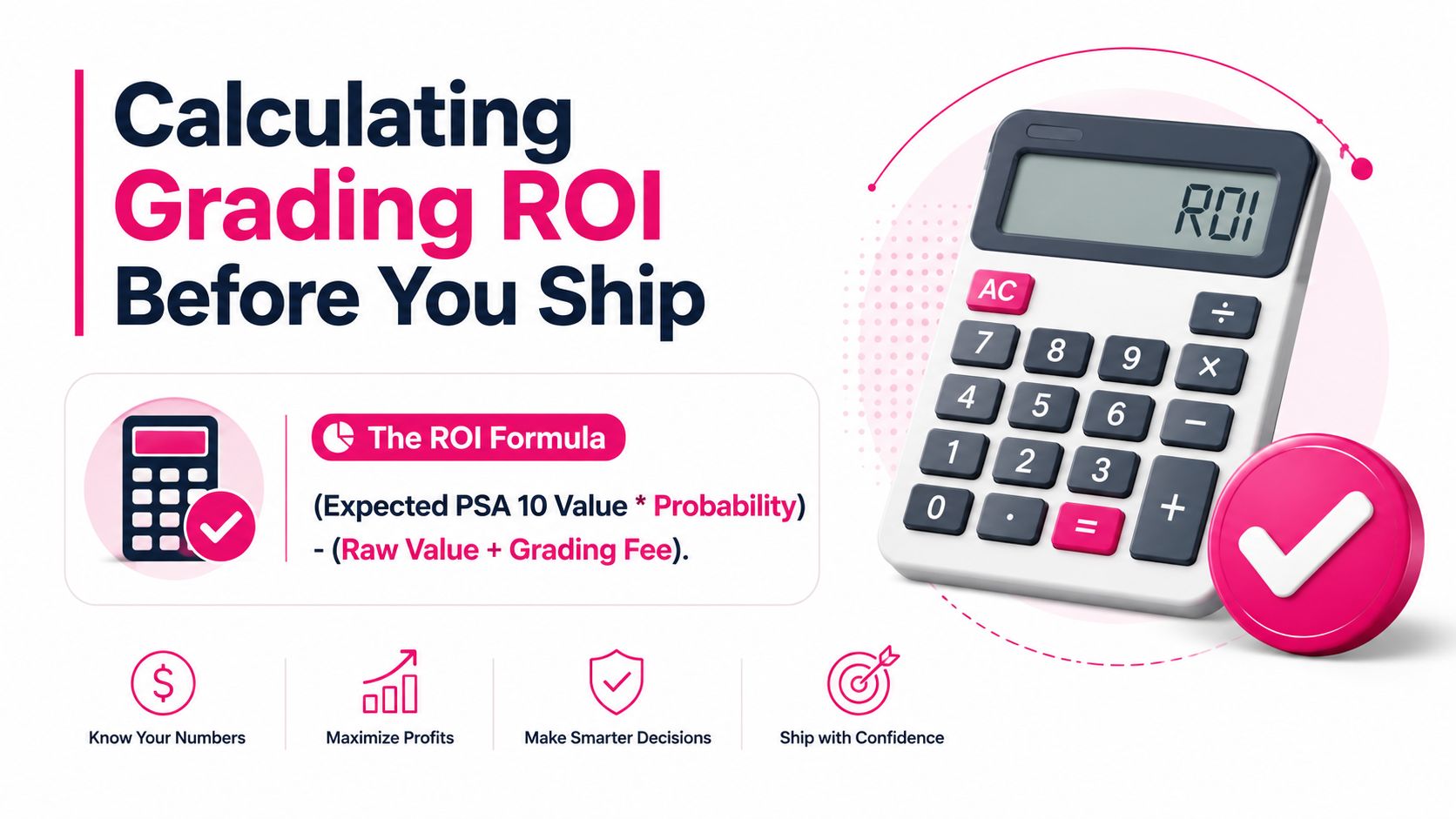
Most collectors ship first and do the math later. That’s how grading turns into a fee sink. The cleaner approach is to estimate the upside, then subtract the hard costs before you ever seal the sleeve.
The useful formula is straightforward. Start with the expected value of each grade outcome, multiply by the probability of that outcome, then subtract raw value, grading fee, return shipping, insurance, and any add-on charges. If the floor case still works, submit. If it doesn’t, keep it raw and move on.
Price the worst case, not just the dream case
People love to model the PSA 10 outcome. That’s the dangerous part. The core question is whether the card still makes sense if it lands one grade lower than you hoped.
A clean PSA 9 floor tells you whether the submission is rational. If the floor is weak, the card is probably better sold raw. If the floor is strong, the submission has room to breathe, and you can tolerate the grading risk without chasing the market every day.
The broader comparison also matters. Raw, PSA, BGS, CGC, and TAG don’t all create the same net result, even if the front-end number looks close. The good grading decision is the one that leaves you with more money after the entire cycle, not the one that looks exciting on social media.
Video reference for the grading decision math:
If you want a more structured way to compare grading paths, use the opportunity-cost framework in this grading comparison guide.
Use a cleaner ROI filter
A card should go in a grading submission only when three things line up. The card has a real premium if it hits. The floor outcome still protects you. And the fee, shipping, and wait time are not eating the spread.
For borderline cards, cross-grading can be worth considering when one company’s scale is likely to treat the card more generously than another’s. That’s not a hobbyist instinct, it’s a margin decision.
Researching Real Comparable Sales
Ask a seller what a card is worth and they’ll often point to whatever listing looks highest. That’s not how real pricing works. Asking price and realized sale price are different numbers, and the gap between them is where a lot of bad decisions start.
The best comps are the ones that closed in the last 1 to 7 days, for the exact variant and condition bucket you own. A price tracker that helps organize sold data can keep you from anchoring on stale listings, and the broader market commentary keeps pointing collectors back to sold comps, volume, and recent trend direction instead of list prices alone (CBC market pricing discussion). That’s the right instinct.
Read the sales pattern, not the loudest sale
A single high sale can be noise. A cluster of recent closes is information. When you’re checking comps, look at where most sales are landing and whether the spread is tightening or widening.
The other clue is momentum. If completed-listing volume is rising and the raw-versus-graded gap is narrowing, the card may be repricing faster than casual sellers notice. That’s especially useful for cards that look cheap until the market wakes up.
If you track cards regularly, a live price tracker can help you separate a one-off spike from a real change in demand.
Price the card you have, not the card you wish you had
Honest condition assessment pays off. A Near Mint comp does not help a Lightly Played copy, and a graded comp does not tell you what a raw card will sell for if it’s got surface wear. Match the sale data to the card in front of you.
Seller rule: if you can’t find three close comps for your exact version, stop pretending the market has given you a clean answer.
Choosing the Sales Channel That Protects Margin
The same card can net very different money depending on where you sell it. That’s the part most price checks ignore, and it’s why sellers feel like the market “moved against them” when the actual issue was fees. If you care about what lands in your hand, you need to look at the channel, not just the headline price.
eBay takes roughly 12.9% plus its shipping label rules, TCGPlayer is around 10.75%, and Double Holo’s marketplace uses a 4.9% standard seller fee (4.7% on premium) plus a 2.9% + $0.50 card processing fee. A direct local sale can cut the platform fee to zero, but then you’re giving up buyer pool, protection, and often pricing confidence. For a more detailed comparison, see this marketplace breakdown.
Match the venue to the card
High-end slabs want serious buyers and strong price discovery. Mid-tier raw cards usually do fine on mainstream marketplaces where volume is decent and the audience is broad. Quick-flip modern cards should go wherever they move fastest without forcing you into a weak net result.
The hidden costs are real. Shipping, insurance, and the time you spend waiting for the right buyer all chip away at the number you thought you were getting. A “higher listed price” is useless if the channel eats too much of it before payout.
Use bid, ask, and recent closes together
A clean pricing decision comes from three views. The bid tells you what buyers are willing to pay now. The ask shows what sellers hope to get. The recent sale history shows where those two meet.
That’s why serious sellers keep an eye on sales histograms and market signals instead of guessing from a single listing. If the recent sales cluster is healthy, you can price with more confidence. If the market is thin, you should expect more slippage and plan your channel accordingly.
A Reusable Valuation Checklist and Common Pitfalls
The smartest sellers use the same workflow every time, because emotion makes bad pricing decisions faster. Identify the card exactly, inspect condition, model grading ROI, pull real comps, set a list price, choose the channel, then ship tracked and insured. That sequence keeps you from jumping straight to a number that feels good but doesn’t hold up.
The mistakes that quietly cost money
The biggest mistake is trusting asking prices. The second is ignoring condition and grading deltas. The third is skipping the worst-case grade floor and acting like every submission will hit the dream outcome.
Another bad habit is selling on a venue that doesn’t match the card. A high-end slab dumped into the wrong buyer pool can sit too long or clear too cheap. A quick modern flip sold too slowly can lose its edge before you ever cash out.
Use scarcity and momentum together
A card can be scarce and still badly priced. It can also be supported by demand growth and still look cheap because the supply side hasn’t caught up yet. The useful question is whether completed volume is rising while the raw-versus-graded spread narrows.
That’s the setup you want to watch. It tells you the market may be repricing before the loudest sticker prices catch up. If you care about protecting margin, pay attention to that gap and not just the number on the listing page.
If you want a sharper way to price, grade, and sell without leaking margin into avoidable fees, use Double Holo to compare market data, track cards, and choose the right exit before you ship. It’s built for collectors and vendors who want cleaner decisions on raw cards, slabs, and sealed product, not guesswork after the fact.