Japanese Pokémon card prices look simple until you separate the market into slices.
The lazy story says Japanese is always cheaper than English. The data doesn’t support that as a blanket rule.
Table of Contents
Why Japanese Pokemon Cards Are a Distinct Market
Japanese Pokémon cards are priced as a segmented market, not a single pool. The useful question is not what “Japanese cards” are worth in general. It is which slice of the catalog you are pricing, because set averages, promo cards, and graded chase cards do not move together.
How Japanese Bid and Ask Prices Work
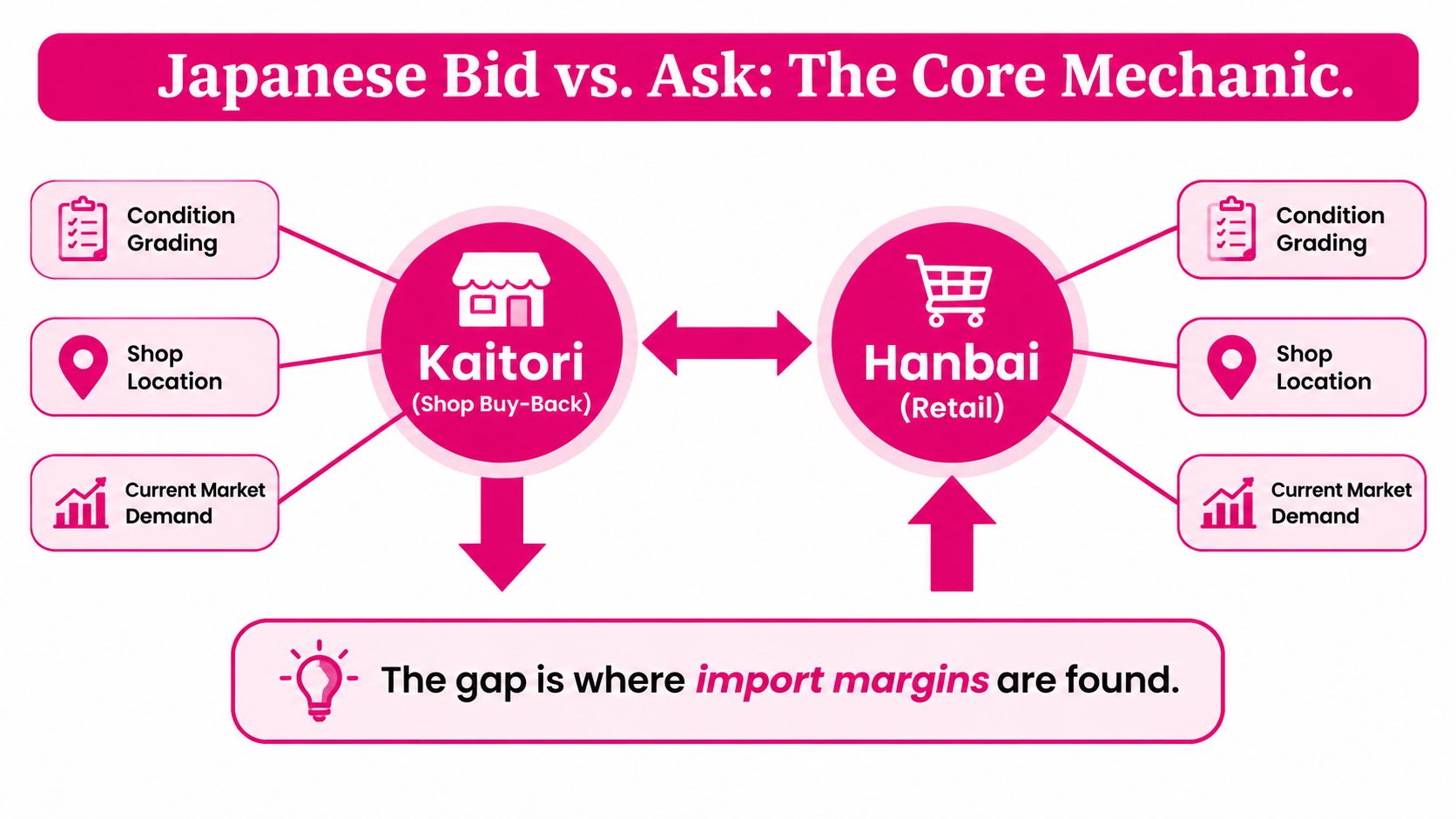
Japanese pricing gets misread because the market often shows two honest prices at once. One is the shop’s buy-back level, known as kaitori. The other is the retail tag, hanbai. JP Card Prices says its displayed price sits at the midpoint between the two, and that midpoint is the most defensible single reference when you are trying to value a card rather than admire a shelf tag.
Retail is not the same thing as cash value
A shop can price a card for inventory turnover, replacement cost, or collector traffic. That means a retail sticker can sit well above the cash a buyer would receive. In practice, the asking price is not a lie, it is a listing price that reflects what the shop wants to clear, not what it will hand over in cash.
The gap between kaitori and hanbai is where import margins are found.
That gap is also why one shelf tag is a weak benchmark by itself. A midpoint price gives a cleaner read, and a completed sale is better still. If you only look at hanbai, you are negotiating against a number that was never meant to represent the actual clearing price, especially in a market where shops protect margin by keeping the spread visible.
Grade spread makes Japanese chase cards look even wider
Japanese cards also show pronounced grade sensitivity. One market guide says the raw-to-PSA 10 gap is commonly 3x to 14x on Japanese cards, especially on modern chase cards and premium promos. That is not a rounding error. It means the same card can belong to two entirely different markets, one for raw copies and one for gem-mint slabs.
That split matters because the midpoint only tells part of the story. A raw card near the kaitori level may have very little overlap with the graded copy that clears at a much higher tier. The spread is widest on cards with strong eye appeal, low population in clean condition, or obvious collector demand, which is why a single sticker price can hide the import math.
Official Japanese MSRP and What It Means for Sealed Pricing
Sealed Japanese pricing starts from a lower official anchor than many collectors assume. As of July 2026, a standard Japanese Pokémon expansion pack carries an official retail price of ¥180 to ¥200 tax included, with newer sets at ¥200 and older ones at ¥180. High-class packs are listed at ¥550 (Honto Japan).
Pack math sets the floor
That MSRP structure explains why Japanese sealed product often starts from a cheaper retail baseline. The common pack economics work out to roughly $1.50 for 5 cards versus $4 for 10 English cards, or about $0.30 per Japanese card versus $0.40 per English card. That comparison comes from the pack-price breakdown in how much a Pokémon card pack costs, and it shows a real per-card gap without pretending the gap stays intact once import costs and local demand enter the picture.
The key insight is straightforward. Japanese sealed begins from a lower MSRP, so any later premium has to be judged against that lower base. A box that trades at a multiple of pack MSRP gives you a cleaner read than one priced only off hype, because the official price is the first check on whether the shelf tag still makes sense.
Use the floor before you use the market
A sealed listing only becomes interpretable after you tie it back to the official pack price. If a box sits far above implied pack value, the premium has to be explained by chase density, print constraints, or collector demand. If none of those pressures are visible, the markup is more likely to reflect retail friction than card economics.
That is why the floor matters before the resale market does. It separates the base product from the speculative layer on top of it, and it gives you a way to compare Japanese and English sealed without flattening the difference into a simple “cheaper” or “more expensive” label.
Set-Level Concentration and the Promo Premium
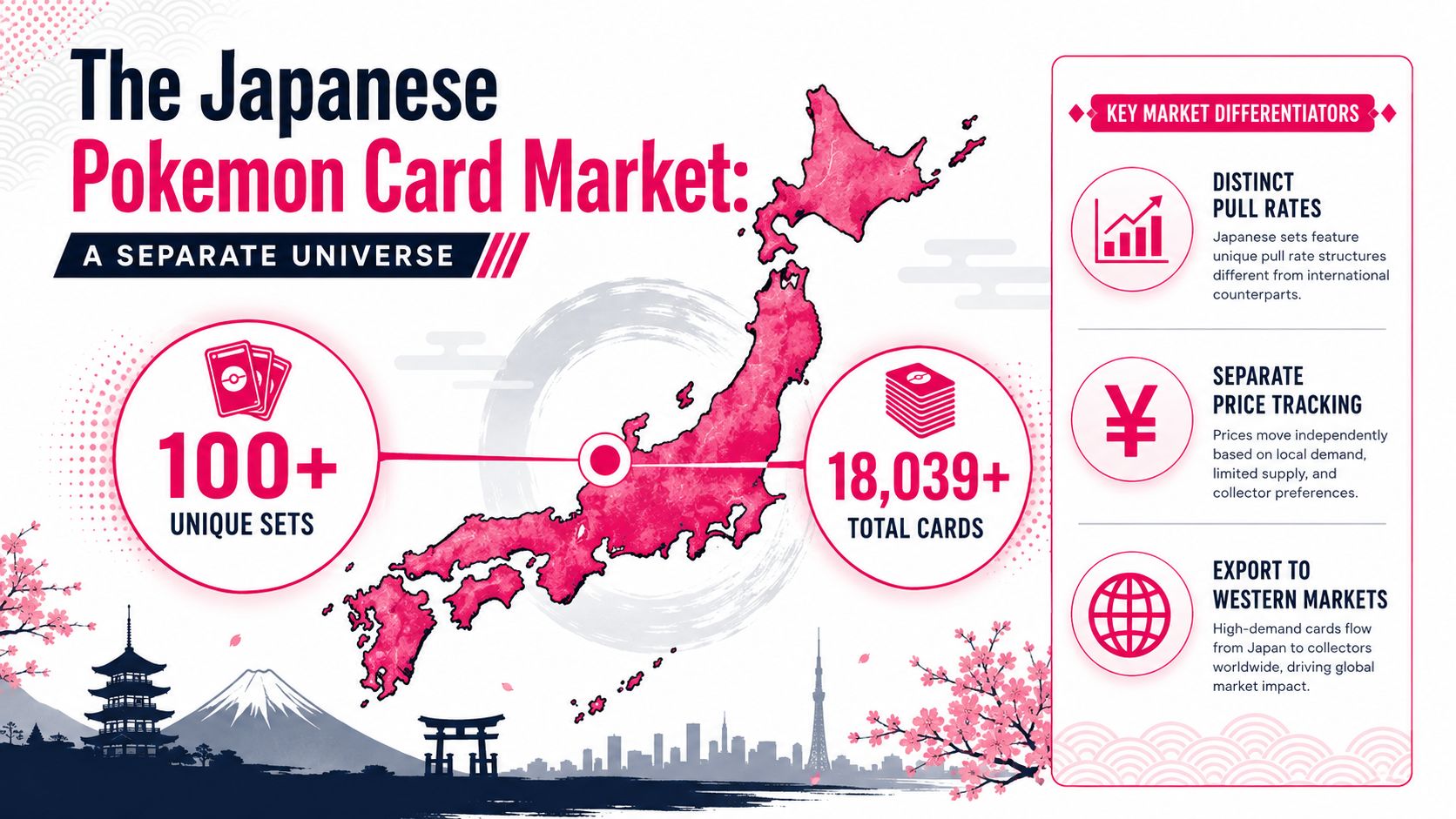
Japanese market value is concentrated, not evenly spread. As covered in Section 1, the Promo category carries $830,810.10 across 1,712 cards, with an average of $485.29. The key point is how quickly that average stops describing the typical card and starts reflecting a narrow group of high-end copies.
Set averages orient you to a category, but they do not price a specific card. A promo sheet can look expensive on paper while most of the population sits far below the mean, and a handful of chase pieces do the heavy lifting. In Japanese, that gap is especially visible because a small number of character promos, event cards, and graded grails can pull the average well above the market most buyers encounter.
A more useful question is where the card sits inside the tier structure. If it belongs to a population-sensitive segment, the right comparison is a graded-sale comp, not the category average. Condition, centering, and slab grade matter more in that tier than in ordinary bulk, and they can move the price sharply even when the underlying card type is the same.
A simple way to think about the promo tier
| Japanese Promo Category Snapshot (2026) | Value |
|---|---|
| Sets tracked | 100 |
| Cards tracked | 18,039 |
| Promo cards | 1,712 |
| Promo category value | $830,810.10 |
| Promo average price | $485.29 |
Valuation rule: price the card you own, not the category average that happens to include it.
That rule matters because promo pricing is rarely evenly distributed. One iconic release can distort the average for a broad catalog, especially when the top end is driven by a handful of graded copies rather than by steady raw-card demand. A category average helps you see the shape of the market, but it can still mislead if you use it as a substitute for direct comp work.
For sealed collectors who want to connect promo pricing back to product structure, Japanese booster box economics explains how box-level pricing interacts with the broader release cycle.
Key Japanese Sets and Cards That Carry Import Premiums
Some Japanese cards cross borders cleanly because Western collectors want the same character, artwork, or promo lineage. The highest import premiums usually appear where scarcity, nostalgia, and slab sensitivity all point in the same direction. The pricing pattern is uneven, and a single promo family can behave very differently from the broader catalog.
PriceCharting’s Japanese promo guide is useful because it shows how far values can spread within one card family, but it should be treated as a reference point rather than a summary of the entire market. For sealed collectors, Japanese booster box economics helps connect promo demand to product structure and release cycles.
Worked examples beat vague category talk
Poncho-Wearing Pikachu #231/XY-P is listed at $3,577.44 ungraded and $10,494 in PSA 10. Mario Pikachu shows $4,050 ungraded and $20,995 in PSA 10 in the same guide. Those two cards are useful because they show what import premium looks like when the card already has international recognition and a grading premium that widens the gap between raw and slabbed copies.
The read is straightforward. When a promo combines recognizable art, limited distribution, and strong slab sensitivity, it can support import pricing even after shipping and fees are added. When one of those pieces is missing, the Japanese copy may still be collectible, but the room for profit shrinks quickly once the card moves through import, authentication, and grading costs.
A small checklist before you bid
-
Identify the promo lineage: Japanese exclusives, event promos, and cross-market chase cards do not trade the same way.
-
Check the graded reference first: PSA 10 usually says more than a raw asking price on a premium card.
-
Compare Western demand, not just Japanese availability: a card can be common in Japan and still command a premium overseas.
-
Watch the exact printing: variant identity can matter more than character popularity.
That checklist is why a card like Carracosta GX - SM Promos #SM239 belongs in a careful import review rather than a casual buy. The card’s position in the promo ecosystem matters more than the fact that it is a Pokémon card.
Why Six-Figure Prices Are Possible in the Japanese Market
A six-figure Japanese price usually comes from a narrow part of the market, not from broad character demand. Exact printing, promo lineage, and grade matter more once a card becomes a true trophy piece, and the top end behaves very differently from the rest of the catalog.
Variant identity is the real pricing engine
PriceCharting lists Illustrator Pikachu at $550,000 ungraded. Those prices are not random spikes. They reflect extreme scarcity, cultural status, and the fact that exact versions of the same character can trade on completely different terms.
Collectors at this tier aren’t buying a character name. They’re buying an exact printing, a specific promo story, and often a specific grade. That is why one Pikachu can clear six figures while another Pikachu sits much lower.
The same family can live in a normal price band
Japanese pricing also has a middle tier that keeps the market anchored. Pikachu #227/S-P is listed at $1,371.12 ungraded and $2,310.85 in PSA 10. The card belongs to the same broad market as the trophy promos, but it does not carry the same cultural weight or ceiling.
High-end Japanese pricing is not driven by character popularity alone. It rises when exact version, grade scarcity, and overseas collector competition all line up on the same card.
That is the part many pricing guides miss. A trophy promo, a modern special art, and a standard character card can share a language and a brand, but they do not share the same pricing logic. Treating them as one market hides the spread between median value and top-end value, and that spread is the reason six-figure Japanese prices are possible at all.
Import Math From Japan to a US Sale
Importing Japanese cards only works if the landed cost still leaves room after shipping, grading, and resale friction. The path is straightforward in theory, but each step reduces margin. You buy near hanbai or kaitori levels, move the card through a domestic forwarding service, pay international shipping and handling, submit for grading if the card can justify it, then list into the US market.
A clean purchase price in yen can still turn into a weak deal in dollars. The import spread has to survive every fee between the shop counter and the buyer’s wallet.
The cost stack has to be modeled upfront
The first mistake is buying a card because the sticker looks low in yen. The second mistake is grading every card that looks clean. As noted earlier in Section 2, JP Card Prices shows that Japanese chase cards can run on a 3x to 14x raw-to-PSA 10 spread, so grading can make sense on the right card, but it does not rescue weak demand or poor centering.
The question is whether the card clears break-even after every cost is counted. If it does not, the import premium is gone before the card reaches your listing page. That pressure is highest in bulk modern singles, where the gap between Japanese and English often gets absorbed by freight, grading, and selling fees.
Where imports usually fail
-
Bulk modern singles: too little upside after fees.
-
Low-pop promos with weak Western demand: scarcity in Japan does not always translate abroad.
-
Cards whose Japanese premium is already baked in: if the market has priced the advantage, the edge is gone.
The line between a smart import and dead money is usually thinner than collectors expect. Disciplined sellers model the full landed cost before they buy, because the margin disappears quickly once the card leaves Japan.
How Japanese and English Prices Compare Over Time
Japanese and English prices often move in the same direction, but they do not move with the same intensity or at the same pace. The clearest way to see that is across a longer window, because short snapshots hide the gap between median cards and the top end. A classic example is Base Set Charizard, which price trackers show at about $50 in 1999, $120 in 2010, a $400 peak in 2020, and around $350 in 2025.
Long-term appreciation is real, but not linear
That path shows three separate forces. Iconic cards can build value over time, even with long pauses between advances. Sharp corrections still happen on blue-chip pieces. Holding works best when the copy is scarce, the grade is strong, and the market has room to re-rate it during a stronger cycle.
Card Ladder’s broader Pokémon guide shows how high the top tier can run in Japanese-adjacent markets, with a 2016 Japanese XY-P Mario Pikachu in PSA 10 at $13,951 and a 2003 Skyridge Charizard in PSA 10 at $30,880 (Card Ladder). Those figures matter because they show the spread between the ordinary run of cards and the handful that pull the market upward. A collector who only hears “Japanese is cheaper” misses that some Japanese promos and graded chase cards sit in a very different band from bulk modern singles.
What that means for cross-market thinking
Japanese and English markets are correlated, but they are not interchangeable. The English flagship can trail a Japanese promo if the Japanese card has tighter supply, stronger collector memory, or better grade performance. A Japanese card can also look inexpensive in raw form and then reprice quickly once slabs and export demand enter the equation.
Demand concentration matters more than national origin when comparing value across markets. A card with deep collector demand, a strong grade profile, and a believable story can move across language lines and still hold its price. That is the segment collectors should watch, especially when judging whether a card belongs in the middle of the market or in the small group that behaves like a true chase asset.
For a broader view of how those segments are tracked, Double Holo’s price tracker overview is useful for comparing raw, slabbed, and sealed references without flattening the market into one average.
Sourcing Reliable Japanese Pricing Data
Japanese pricing is easiest to misread when you start from a single list price. The better reference points separate buying and selling behavior, which is why midpoint-based tools are more useful than a lone asking figure. A set-level view helps for the same reason, because it shows where value concentrates instead of flattening the market into one average.
A disciplined verification workflow
-
Prefer midpoint over asking. Retail tags can sit above where cards clear, especially when turnover is slow or sellers are testing demand.
-
Cross-check graded comps against raw. High-end Japanese cards often trade on slab logic, not loose-card logic, so a raw copy and a graded copy can belong in different price bands.
-
Treat set averages as orientation. They help you place a card inside the market, but they do not price the exact copy in front of you.
-
Look for transaction clustering. A real market shows repeated trades across similar copies, not just one eye-catching listing.
That workflow becomes more important as the data gets thinner. If the only number available is a single seller’s price, you are looking at a request, not a market.
For collectors who want a broader toolset around price verification and inventory decisions, Double Holo’s price tracker article is a useful companion. It supports side-by-side comparison of raw, slabbed, and sealed references, which helps prevent the common mistake of pricing every Japanese card from one data point.
Quick Reference for High-Value Japanese Promos
| Card | Ungraded | PSA 10 |
|---|---|---|
| Kangaskhan-Holo | $150,000 | Not listed |
| University Magikarp | $66,100 | Not listed |
| Poliwrath-Holo | $25,015 | Not listed |
| Pikachu-Holo | $16,100.99 | Not listed |
| Illustrator Pikachu | $550,000 | Not listed |
| Poncho-Wearing Pikachu #231/XY-P | $3,577.44 | $10,494 |
| Mario Pikachu | $4,050 | $20,995 |
| Pikachu #227/S-P | $1,371.12 | $2,310.85 |
These cards show the shape of Japanese pricing. Some are trophy pieces, some are premium promos, and some sit in a more reachable band where grading can still matter, but the ceiling is lower. The key variable is always the same, exact printing plus population pressure plus collector demand.
If you want a cleaner way to price Japanese cards, sealed product, or graded promos without guessing from a single listing, visit Double Holo and compare the bid, ask, and grading context before you buy or sell. It’s the fastest way to turn Japanese Pokémon card prices from folklore into a usable decision framework.