

A modern loose Pokémon booster pack usually costs $3 to $6 at retail. The answer to how much does a Pokémon card pack cost changes fast once you move into sealed boxes, retail bundles, or vintage product, where the same pack can effectively cost around $7.56 in a booster box or $300 to $1,000+ if it’s a scarce old Base Set pack.
Table of Contents
Actual Price Range for Pokemon Card Packs
A pack’s price depends on which market is setting the rate. Modern retail packs usually sit around $3 to $6, hot modern packs on the secondary market can climb to $9 to $12, and vintage sealed packs can move from $30 into the $300 to $1,000+ range depending on set, edition, and condition. That spread explains why a search for how much does a Pokémon card pack cost can return answers that seem to conflict, even though each one is describing a different segment of the market.
Three pricing tiers that matter
Common modern product is the first tier, and it is where most shoppers expect a normal checkout price. Premium modern sealed product is the second tier, where demand, release timing, and scarcity can push a pack above the usual retail band. The third tier covers special edition and vintage, where the pack starts behaving like collectible inventory instead of a simple item to open.
Two questions sort almost every pack quickly. Is it still in circulation, and was it printed for current play or older collecting? If both answers are yes, the pack usually belongs in the modern retail tier. If one answer is no, the price may already be set by collectors, not by shelf pricing.
Practical rule: if the pack is sealed, old, and tied to an out-of-print era, do not compare it to current retail pricing. It belongs in a different market.
The price gap is visible in market history. Current sealed-product trackers show products around $26.69 for a three-pack blister and $232.90 for a booster box, while historical collector data shows an archived 2001 purchase of 36 booster packs for $39.24, or about $1.09 per pack. That swing explains why collectors treat pack cost as a market signal rather than a fixed number. For a broader look at how sealed product pricing behaves across formats, see the Double Holo booster box value analysis.
Per-Pack Cost Across Modern Sealed Formats
Most buyers never pay a standalone pack price in a vacuum. They buy blisters, ETBs, or booster boxes, then divide the total by the number of packs inside to see what they paid per pack. That math matters because sealed format often changes the unit cost more than the set itself.
What the math looks like in practice
A recent sealed-product tracker shows a 3-pack blister at $34.63 and a booster box at $232.90 (Double Holo’s Pokemon Price Tracker). If the blister contains 3 packs, the implied cost works out to about $11.54 per pack. If the booster box contains 30 packs, the implied cost is about $7.76 per pack. The exact format matters more than the label on the box.
Here’s the part many shoppers miss. Buying in bulk usually lowers the effective unit cost versus buying loose packs, and one market guide notes booster boxes are often 10 to 15% cheaper per pack than individual boosters (DX Collection). That doesn’t mean every box is a bargain, but it does mean the cheapest-looking shelf tag can hide the least efficient way to buy.
| Modern Pokemon Sealed Product Per-Pack Cost | Typical Price | Packs Included | Cost Per Pack |
|---|---|---|---|
| 3-pack blister | $26.69 to $34.63 | 3 | about $8.90 to $11.54 |
| Booster box | $232.90 | 30 | about $7.56 to $7.76 |
| Loose pack | varies by market | 1 | usually the highest unit cost |
The table shows why a loose pack is rarely the most efficient choice if your goal is pure pack count. The box absorbs less packaging overhead per pack, while a blister often sits in the middle because it bundles display appeal with convenience.
A booster box is usually the unit to compare against if you’re shopping for opening volume. A loose pack is the unit to compare against if you’re shopping for convenience or a single impulse buy.
This booster box value guide is useful if you want to compare sealed box pricing against other modern product types without guessing at the unit math yourself.
Why Big-Box Retail Prices Mislead Shoppers
Big-box shelves create one of the biggest misunderstandings in this hobby. Target listings often mix multi-pack bundles, boxed products, and premium collections instead of true single packs, with public listings at prices like $14.99, $24.99, $44.98, and $74.99 (Target Pokemon cards listings). The shelf price usually reflects a bundle structure, not a clean booster price.
The price tag is often not the pack price
A shopper sees a Pokémon product on a major retailer shelf and assumes it is a simple single-pack purchase. In practice, the store may be selling a multipack blister, a boxed accessory product, or a gift-ready collection that includes several items beyond the pack itself. The packaging makes the product feel close to a booster, but the economics are usually different.
That hidden layer matters. If the box includes extras, the pack inside is no longer the whole purchase, and the effective per-pack cost can look much higher than the number stamped on the sticker. The buyer is paying for presentation, bundle design, and retail convenience as much as for the cards.
Practical rule: if the shelf tag looks attractive but the package contains accessories, promos, or multiple packs, divide the full price by the pack count before deciding it is a deal.
Retail-platform third-party sellers can make the picture even noisier, because the listed price may reflect resale demand rather than a straightforward store price. That is why many collectors get better unit economics through hobby stores or sealed-box buys than through big-box impulse purchases. A useful reference point is this vintage booster box analysis if you want to see how boxed product pricing can diverge from shelf-level assumptions.
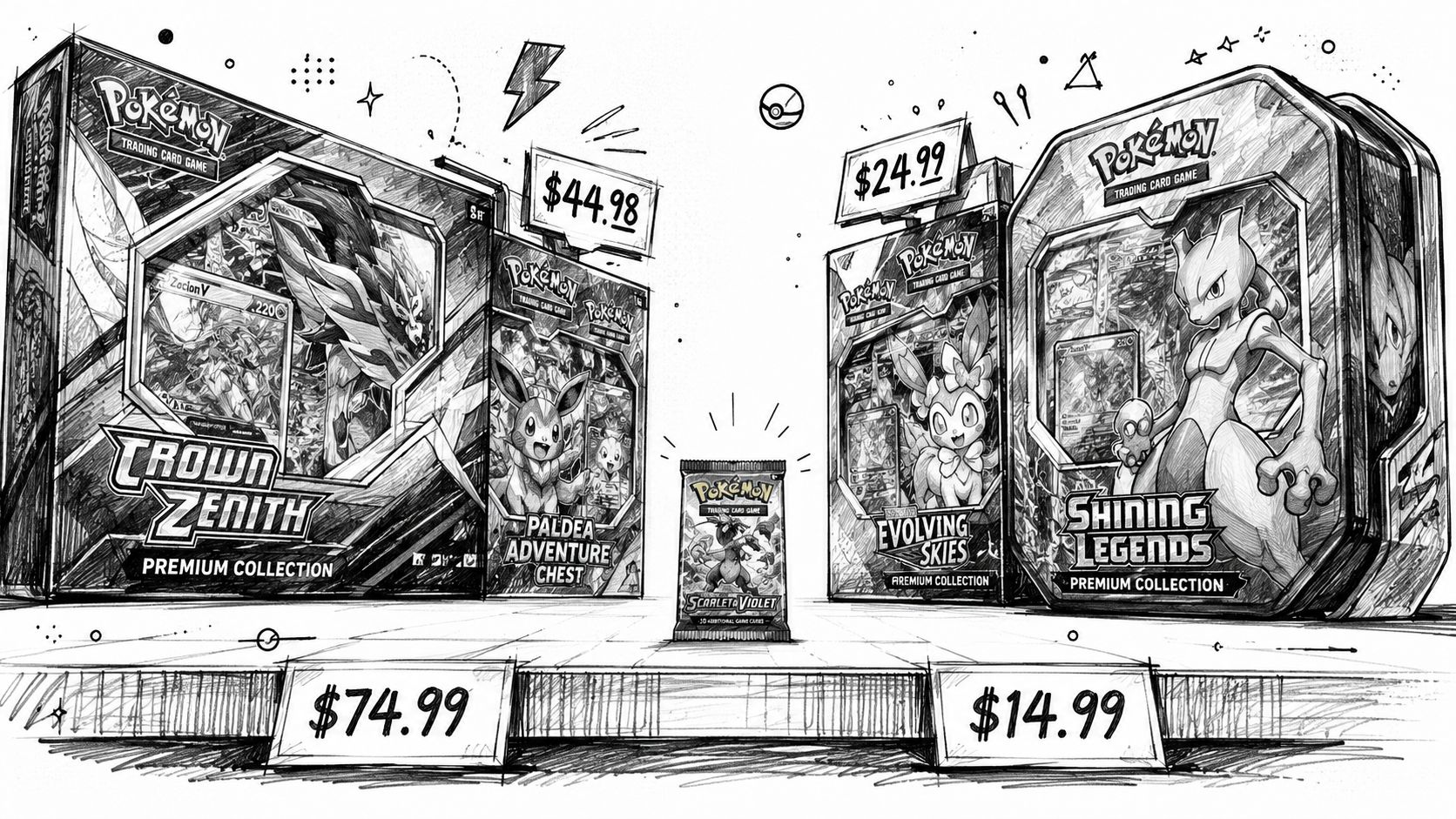
A serious buyer treats a retail shelf like a bundle menu, not a pack-price database. Once you start reading the store that way, the product at the endcap often stops looking cheap.
The Vintage Pack Premium Explained
Vintage sealed packs no longer behave like ordinary retail product. A pack that originally sat near about $1.09 in 2001 can now trade for $30 to $50+, and the most sought-after versions can go even higher depending on set and condition. That spread is not just nostalgia, it reflects a market where unopened supply has thinned while collector demand has stayed active.
From old retail to collector asset
The jump is easy to see in older sales records. In spring and summer 2019, some unlimited Fossil and Jungle packs were selling for about $30 each, while first-edition Fossil packs were reported around $40 to $50 each. Current market summaries also place Base Set packs around $300 to $1,000+ depending on variant and condition, which sits in a completely different buying range from modern retail.
The same pricing force shows up in individual cards. The Base Set Charizard is cited at $50 in its 1999 release era, $120 around 2010, $400 at a 2020 peak, and $350 in 2025, with 26-year growth of +600% (Double Holo’s Pokemon Price Tracker). That does not mean every sealed product follows the same curve, but it does show how collector demand can reprice a classic Pokémon asset long after it leaves print.
The practical change is simple. Vintage sealed product behaves less like a current game supply and more like a constrained collectible. Once the supply gets thin enough, every unopened pack carries two kinds of value at once, it is a nostalgic object and a scarcity asset. That is why old packs can look wildly overpriced to a player and entirely rational to a collector.
This vintage booster box guide is useful if you want to compare vintage sealed product across box-level pricing and see how the premium develops beyond single-pack assumptions.
A short market note explains the psychology. When a pack is old enough that opening it destroys a shrinking sealed item, buyers stop pricing it only for the cards inside. They pay for the unopened status itself, and that is where the premium gets anchored.
How to Decide What to Buy Based on Your Goals
The right purchase depends on what you’re trying to do, and that’s where many people waste money. If you want a specific card, opening random packs is usually the least controlled path. If you want the sealed experience, paying a little more for convenience may be acceptable. If you want long-term exposure to scarcity, the market starts favoring sealed product with collector demand.
Match the format to the goal
Chasing a specific card. Buy singles or targeted product instead of broad pack openings. Pack cost doesn’t matter much here, because the core question is whether the expected pull path is cheaper than just buying the card outright.
Opening for fun. Modern booster packs, blisters, and boxes make sense when the experience itself is the product. In that case, compare the per-pack cost and choose the format that gives you the opening volume you want.
Thinking like a collector-investor. Vintage sealed product and scarce modern runs sit in a different category. These are priced around scarcity, historical demand, and sealed-condition preservation, so the purchase is less about ripping and more about holding.
Good buying rule: if you already know the exact card you want, opening more packs rarely improves the math. The pack price is only attractive when the entertainment value matters as much as the card value.
The smartest buyers separate emotional value from expected value. A sealed box can be rational for a set builder even if it’s not the cheapest route to one chase card. A vintage pack can be rational for a collector even if it looks wildly overpriced compared with modern retail.
Here’s the simplest filter. If your goal is specific card ownership, buy the card. If your goal is opening experience, buy the format with the lowest per-pack cost that still feels fun. If your goal is sealed scarcity exposure, buy the product that has already moved into collector territory rather than consumable territory.
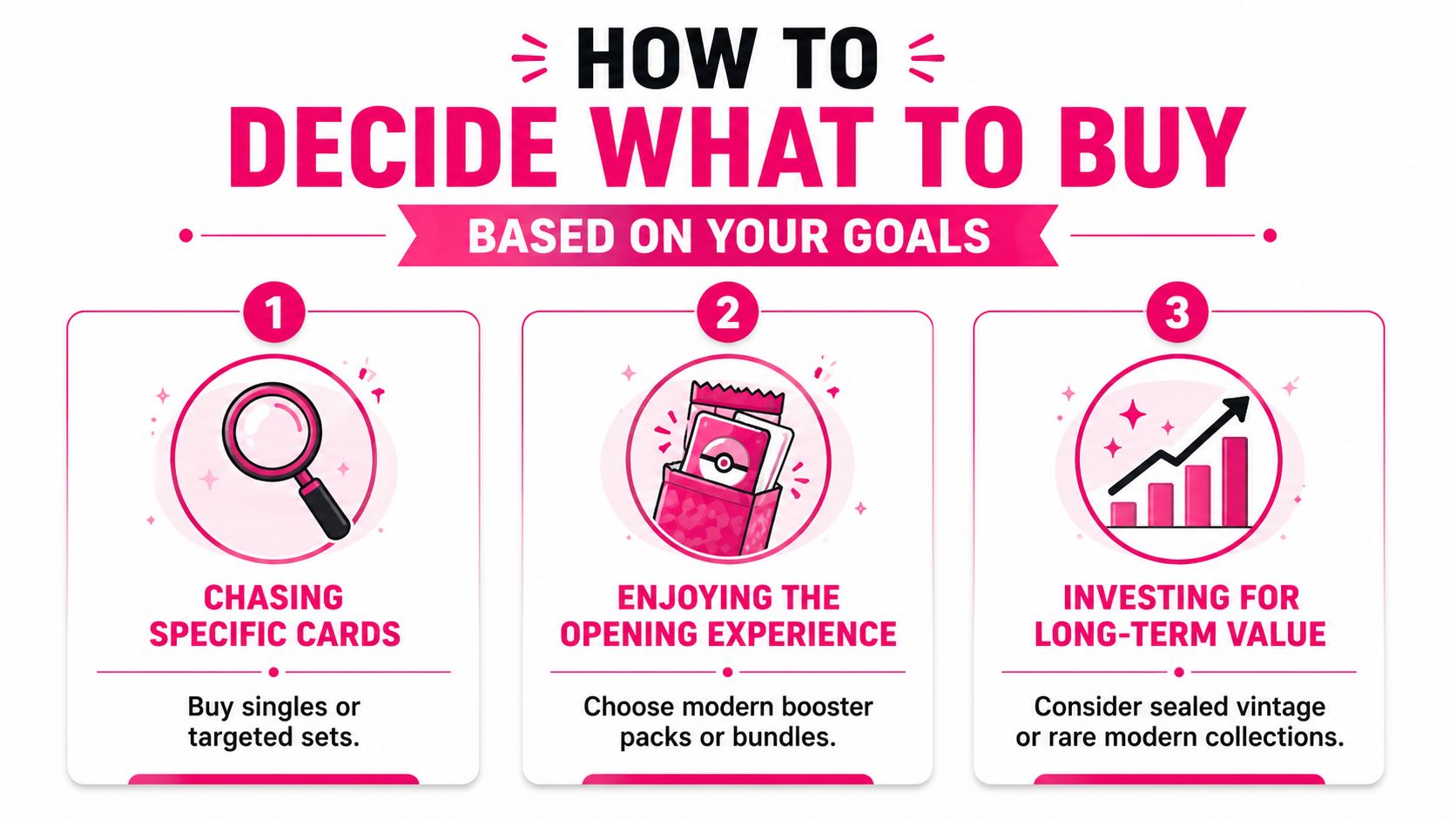
That decision tree keeps you from making the same mistake twice, paying collector prices for a player’s objective or player prices for a collector’s objective.
Track Pack Values with Real-Time Market Intelligence
Pokémon pack prices move with new releases, reprints, sealed scarcity, and hype cycles, so yesterday’s good deal can disappear fast. The modern way to keep up is to watch market data instead of relying on a static price guide. Tools that track daily price data across 50,000+ Pokémon cards make it easier to see whether a pack, box, or vintage lot is mispriced (Double Holo’s Pokemon Price Tracker).
What serious collectors watch
Expected value matters if you open packs regularly, because set composition and chase demand change the economics of opening. Real-time alerts also matter, because underpriced sealed product usually doesn’t stay underpriced for long. A market dashboard can flag pack listings, box swings, and broader sealed-product movement before the window closes.
Double Holo’s price tracker sits in that category, combining market monitoring with sealed-product context so collectors can compare a listing against broader pricing behavior instead of gut feel alone. That’s especially useful when the same pack type can mean very different things in modern retail, secondary-market modern, and vintage sealed contexts.
Market data doesn’t replace judgment, it keeps judgment honest.
The main advantage is discipline. Instead of asking whether a pack looks cheap, you ask whether it is cheap relative to the format, the era, and the channel. That’s the question that separates a casual buy from a good one.
If you want a tighter read on today’s Pokémon pack market, use Double Holo to check sealed-product pricing, compare market context, and watch for mispriced opportunities before they’re gone. It’s a practical way to turn pack buying from guesswork into a data-led decision, whether you’re shopping modern boxes or vintage sealed packs.