Crown Zenith’s market does not behave like a single price tag. Independent trackers place the set at roughly $234 to $252 across 160 to 179 tracked cards, yet the cheapest end of the market sits near $0.30 while a PSA 10 booster pack reaches $455. That gap is the whole story, because Crown Zenith price only makes sense when you separate singles, sealed product, and graded tiers instead of averaging them together.
Table of Contents
Understanding the Crown Zenith Market in 2026
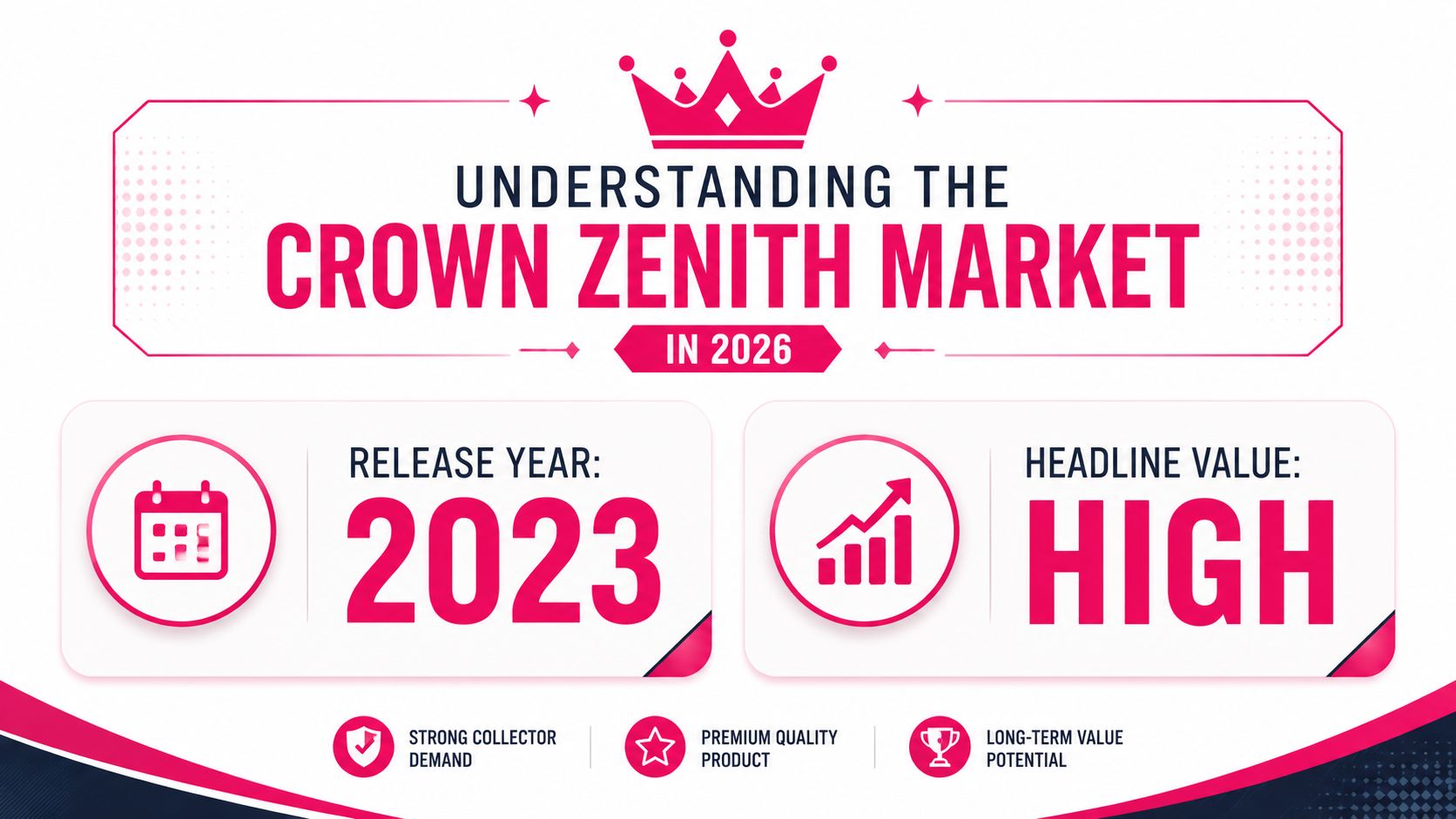
Crown Zenith released on 2023-01-20, and the set has matured into a real secondary market instead of a short-lived hype spike. Trackers now place it at roughly $234 to $252 overall, with TCGIndex reporting $234 across 160 tracked cards and Pokémon Wizard listing $252.06 with 179 cards priced and an average card price of $1.41. That spread matters, because it tells you the set is active, liquid, and broad, not just propped up by one or two cards. See the 2026 Crown Zenith market snapshot for the kind of market context collectors keep missing.
Three markets sit inside one set
The mistake most price pages make is treating Crown Zenith as one bucket. In practice, there are three different markets inside it. Singles trade on card-level demand, sealed product trades on scarcity and collector appetite, and graded items trade on condition plus the prestige premium of gem-mint copies.
Practical rule: if you’re asking whether Crown Zenith is cheap, first ask which version you’re buying. A bulk rare, a chase gallery card, and a sealed box all live in different pricing systems.
The set’s performance also shows a market that corrected, then recovered. TCGIndex shows -0.36% over 30 days but +18.07% over 90 days, while Pokémon Wizard reports a +6.6% 30-day trend and -28.1% all-time. Those two views don’t conflict, they describe the same reality from different time windows. Recent strength can coexist with a long-term drawdown, and that’s exactly what a post-release special set often looks like once the initial wave has passed.
What matters for readers is the structure behind the numbers. Crown Zenith is broad at the bottom, concentrated at the top, and volatile in the middle. Once you separate those layers, the set stops looking confusing and starts looking readable.
Singles Pricing and Where the Value Lives
Crown Zenith singles start with a very low floor, and that floor matters because it shows where casual demand ends. TCGplayer’s guide puts cards like Cherubi at $0.29, Bede at $0.33, and Absol at $0.50. That pricing pattern points to a set built on cheap commons, uncommons, and regular rares, not a broad middle tier that holds value evenly across the checklist. Bulk singles therefore anchor the market, but they do not drive collector demand.
The same set also contains cards with far more pull. A useful example is Switch - Sword & Shield #183, which sits in the low-value side of the set structure, while the chase end pulls attention and money toward a small number of cards. That split is the core of Crown Zenith pricing. The market is not flat, and the gap between filler cards and desirable hits is wide enough that the average price hides more than it reveals.
The top end is doing most of the work
The premium side of Crown Zenith is where the set starts to look like a collector product rather than a bulk singles pool. TCGIndex lists Pikachu (Secret) at $50.81, Elesa’s Sparkle (Full Art) at $14.88, and Radiant Charizard at $12.65, and says the top three cards make up 34% of total set value. That concentration shows a top-heavy market, even if the rest of the checklist looks inexpensive.
| Card | Ungraded Price | Set Share |
|---|---|---|
| Pikachu (Secret) | $50.81 | part of the top 3 that make up 34% |
| Elesa’s Sparkle (Full Art) | $14.88 | part of the top 3 that make up 34% |
| Radiant Charizard | $12.65 | part of the top 3 that make up 34% |
The table is useful because it exposes how little of the set carries meaningful value. Most Crown Zenith cards sit close to bulk territory, while a small group absorbs a large share of collector attention and pricing weight. CardTrack’s guide shows the same pattern from a different angle, listing Pikachu #160 at $49.66 ungraded and about $314 in PSA 10, while saying the complete raw set is about $295. That is the clearest sign that the “average Crown Zenith card” is not the card collectors are chasing.
The practical read is straightforward. Bulk singles are cheap because supply is wide and demand is thin. Chase singles hold value because collectors want specific art, rarity, and character appeal. If the goal is value, the low-end floor should not be confused with the cards that move the market.
For readers comparing raw cards, slabs, and submission costs, opportunity cost in Pokémon grading matters more than simple sticker price. A low-cost card can look attractive on a list and still make no sense once grading fees and resale spread are included.
Grading Economics on Chase Cards
Grading only works when the raw card already has enough baseline value to absorb the fees and still leave upside. Crown Zenith shows that clearly. PriceCharting lists Giratina VSTAR #GG69 at about $189.86 ungraded and $381.65 PSA 10, while Mewtwo VSTAR #GG44 is about $175.00 ungraded and $376.11 PSA 10. Those spreads are large enough to matter, and they’re concentrated on cards collectors already care about.
The multiplier is not the same across the set
A PSA 10 premium on a low-value card rarely changes the economics enough to justify grading costs. On a premium chase card, the same premium can create real margin because the starting point is already high. That’s the difference between a collectible that can support grading and a card that just looks more expensive in a slab.
Grading adds value only when the card already has enough demand to justify the trip to the grading company.
That rule is especially important in Crown Zenith because the set’s top end is skewed. The cards with the best raw-to-grade spread are the ones with strong name recognition, strong artwork demand, and enough scarcity in gem mint condition to create a real premium. The broader set, by contrast, doesn’t behave like a grading opportunity. It behaves like a low-value singles inventory pool.
For anyone weighing submissions, the question is not whether Crown Zenith has graded upside. It does. The question is which cards can support it after shipping, grading time, and potential condition risk. That’s why premium chase cards stand out while the rest of the set mostly doesn’t.
If you’re comparing grading paths, opportunity cost in Pokémon grading matters as much as the slab price itself.
Sealed Product Cycles from 2022 to 2026
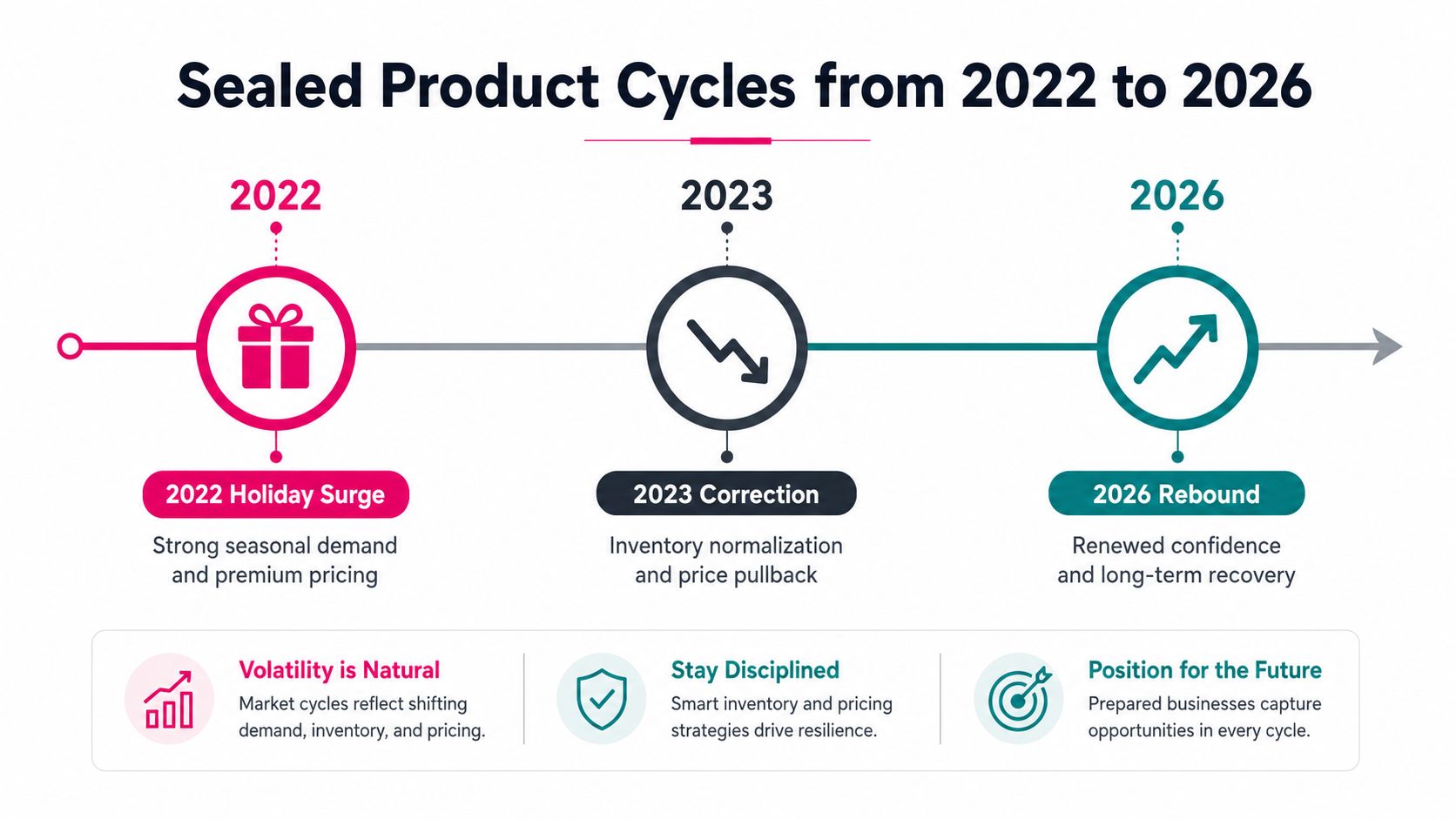
Crown Zenith sealed product has followed a classic boom, correction, and rebound pattern. During the holiday 2022 to Q1 2023 surge, the Elite Trainer Box climbed from $80 to $140, the Booster Box from $230 to $450, the Premium Collection from $60 to $90, and the Pikachu Promo from $30 to $180. That tells you the sealed market was already pricing in collector demand before the set fully settled.
The correction was steep, not subtle
After the reprint announcement, prices fell hard by mid-2023. The Elite Trainer Box dropped from $115 to $70, a -39% move. The Booster Box fell from $350 to $200, a -43% move. The Premium Collection moved from $80 to $45, which was -44%, and the Pikachu Promo slid from $140 to $90, or -36%. Those drops show how sensitive sealed Crown Zenith is to supply expectations.
By 2026, the picture looks different again. A collector guide places Crown Zenith ETBs around SGD 300 / US $224, notes a historical low of US $100 in January 2025, and a recent high of US $226. The important part is not the local currency detail, it’s the shape of the move. Even after volatility, sealed product more than doubled from its 2025 floor.
The booster box value discussion becomes relevant here because sealed Crown Zenith is not just about pack EV. It trades as a collectible object with its own supply curve, and the market has already shown it can reprice quickly when sentiment shifts. If you’re watching sealed, you’re watching scarcity expectations as much as pull rates.
Why Sealed Packs Trade Above Pack Value
A Crown Zenith booster pack is listed at $18.00 on PriceCharting, but the same item in PSA 10 reaches $69.88, BGS 10 reaches $91.00, and BGS 10 Black reaches $455.00. That is not a normal pack-value relationship. It’s a collector-grade scarcity ladder.
The spread says two things at once. First, buyers are not pricing sealed packs only by expected contents. Second, condition and third-party grading can turn a common sealed object into a premium collectible. That’s why pack pricing can be far above loose pack math even when the underlying set is accessible.
| Tier | Value |
|---|---|
| Raw Pack | $18.00 |
| PSA 10 | $69.88 |
| BGS 10 | $91.00 |
| BGS 10 Black Label | $455.00 |
PriceCharting’s booster pack page makes the same structural point with another tier spread, and it shows how grading rarity changes the market once a sealed item is treated as an asset rather than just an opener’s supply source. The collector who wants an untouched pack is bidding on preservation. The grader is bidding on condition scarcity. The Black label buyer is bidding on a very different kind of rarity altogether.
That’s why sealed packs can trade well above simple pack value. The packaging itself becomes part of the collectible. Once a market starts paying for the label, not just the contents, the price can detach from raw expected value in a way casual buyers often underestimate.
Is Crown Zenith Cheap?
Crown Zenith is cheap only at the bottom of the market. Bulk singles sit in one pricing lane, chase cards sit in another, and sealed product follows a third path. Cherubi at $0.29 belongs to the low end, while premium cards such as Pikachu (Secret) at $50.81 and Giratina VSTAR #GG69 at $189.86 ungraded sit in a very different bracket, so “cheap” depends on which part of the set you are measuring.
That split matters because price behavior changes by tier. If you want the lowest entry point, singles are still the easiest route. If you want scarcity, sealed product has shown the clearest premium. If you want condition-based upside, graded chase cards are the narrowest lane, since slab value concentrates around the cards collectors are already chasing.
TCGplayer’s low-end prices show that much of the set remains accessible. PriceCharting’s loose pack and graded-pack numbers show that some Crown Zenith products have moved into a more collectible pricing regime. Those findings sit side by side because they describe different segments of the same set, not one blended market.
Cheap set, expensive exceptions. That defines the Crown Zenith market.
That is why the right buying decision depends on the target. A collector filling a binder should not shop like a sealed investor. A sealed buyer should not price Crown Zenith like a bulk singles lot. A grader should not assume every card in the set deserves a submission slot.
What the 2025-2026 Rebound Means
A +6.6% 30-day trend alongside a -28.1% all-time trend points to a rebound from a lower base, while still leaving the set below its earlier peak. TCGIndex’s -0.36% over 30 days and +18.07% over 90 days show the same pattern from a second angle, a short recovery inside a longer correction.
Read the trend, then decide the action
Buyers need to decide whether the current move reflects sustained collector demand or a short-lived bounce. Sellers need to decide whether recent strength is strong enough to justify taking profit while the market still sits below prior highs. Graders need to decide whether the card in hand has enough raw value to support submission costs after fees and shipping.
The data supports a disciplined approach.
-
Buy singles when you want controlled entry. The low end of the set is still liquid and cheap enough for binder completion.
-
Hold sealed if you’re targeting scarcity. The sealed market has shown both downside and rebound capacity.
-
Grade only premium chase cards. The raw-to-slab spread is meaningful on the top end, not on everything.
-
Do not treat a bounce as a full recovery. The all-time trend is still negative, so the market has not erased the earlier drawdown.
Recent guides updated in mid-2026 reinforce that this is still an active market, not a dead one. The point is not that Crown Zenith is cheap or expensive in the abstract. The point is that the market is moving in layers, and each layer has its own trigger.
Where Crown Zenith Value Lives
Crown Zenith value lives in different places depending on the goal. Singles give collectors the lowest entry point, because the bottom end of the set is still anchored by cards around $0.29 to $0.52. Sealed product carries the scarcity premium, especially after the boom, correction, and rebound cycle. Graded chase cards offer the clearest raw-to-slab upside, but only on premium cards where the baseline already supports the fee structure.
The market breaks into three tiers, and each one behaves differently. A flat average hides that split. The cheapest cards handle binder filling and casual buying. Sealed boxes and ETBs reflect scarcity and collector demand. Graded cards concentrate value into the smallest group of chase hits, which is why the raw-to-slab spread matters most there.
That separation matters for price analysis. If you are buying for completion, the singles floor is the relevant number. If you are buying for long-term scarcity, sealed product deserves the focus. If you are grading, the question is not whether a card is from Crown Zenith, but whether the raw copy has enough upside to justify submission costs after fees and shipping.
Recent market data points in the same direction. Sealed ETBs can trade above MSRP, while PSA 10 booster packs have reached $455, which shows that the strongest value has shifted toward scarcity and condition-sensitive pieces rather than the set as a whole. That does not make every Crown Zenith card expensive. It shows that value concentrates at the top end while the bulk of the set remains cheap.
If you want market context, buying guidance, and grading decisions tied to real Pokémon data, visit Double Holo and use it to compare singles, sealed product, and graded slabs before you decide what to buy or submit next.