


What kind of seller to be · Sourcing your inventory · Pricing with real data · Your first card show · Selling online and a storefront · Inventory tracking from day one · Taxes and record keeping · The tools: one operating system · FAQ
To start a Pokemon card business, pick one lane to begin with (singles, slabs, sealed product, or bulk), sell cards you already own first, then source more through collection buyouts and card shows. Price every card from current sold data rather than memory, and track what you paid for each card from your very first purchase. Once you sell with any regularity, talk to a tax professional.
Start a Pokemon card business by picking a lane (singles, slabs, sealed, or bulk), pricing from current sold data, and tracking cost basis; as of September 2026, Double Holo's seller platform fee is 4.9%.
Steps reflect general vendor practice, not tax or legal advice. The fee is Double Holo's published seller platform fee as of September 2026, before payment processing.
Most Pokemon card businesses start the same way: a collector who already knows the hobby decides the cards moving through their hands could be moving through a business instead. The gap between those two things is not talent for spotting good cards. It is the operational side nobody warns you about, sourcing on purpose instead of by accident, pricing from data instead of memory, and keeping records clean enough that tax season is not a scramble.
This guide walks through that operational side in order: deciding what kind of seller you want to be, where inventory actually comes from, how to price it without guessing, what your first card show looks like, selling online, and the boring back-office parts that quietly decide whether this stays fun or turns into a mess. For strategies once you are already selling, our Pokemon card vendor tips guide picks up where this one leaves off.
What Kind of Seller Do You Want to Be?
Before sourcing a single card, it helps to know what you are actually trying to sell, because the four main categories reward different skills, capital, and time commitments. Most vendors end up doing some mix eventually, but starting with a clear lane makes the first few months far less overwhelming.
Singles. Individual raw cards are the most flexible starting point. They are easy to source in small quantities, easy to list one at a time, and forgiving if you make a pricing mistake on a single card rather than a whole case. This is where most vendors begin.
Slabs. Graded cards carry higher price points and fewer, larger transactions than singles, but buyers expect certainty: a clean cert lookup, an accurate description of the grade, and confidence the slab is authentic. Slabs suit vendors who already understand grading and want higher dollar amounts per sale rather than higher volume.
Sealed product. Booster packs, boxes, and cases tie up more capital per unit and need real storage space, and their resale value depends on expected value math (what is likely to be pulled versus what the box costs) more than card-by-card knowledge. It rewards patience and a willingness to hold inventory rather than turn it over quickly.
Bulk. Commons, uncommons, and lower-value cards sold by the lot are the easiest category to source, since most collections and buyouts include far more bulk than hits, and the fastest way to generate cash flow. Margin per card is low, but volume and low sourcing cost make up for it.
There is no wrong starting lane. The practical advice is to pick one based on the capital and time you actually have right now, get comfortable with sourcing and pricing it, and expand into the others as you learn what you enjoy and what the market in your area actually supports.
Sourcing Your Inventory
Every card business lives or dies on its ability to source inventory at a price that leaves room for a profit once it sells. A few channels cover most of what new vendors use to build a starting case.
Your own collection. The simplest first move costs nothing: sell what you already own and no longer want. It is the lowest-risk way to learn pricing, photography, and shipping before you have real capital on the line.
Collection buyouts. Buying someone else's collection outright, from a local seller, an estate sale, or a Facebook Marketplace post, is where serious vendors tend to make their best margins. The basic approach: ask for photos of the best cards before committing to meet in person, identify the handful of cards that carry most of the collection's real value, and make an offer well below retail since you have to resell everything at a profit and carry the risk in the meantime. Bring cash. It closes deals faster than a promise to pay later, and never buy a collection sight-unseen based on a verbal description of condition.
Card shows. Shows are as much a sourcing channel as a selling one. The deals cluster in bulk bins, priced for volume rather than precision, and in end-of-day discounts from dealers who would rather sell at a lower price than repack and haul product home. Our guide to whether card shows are worth it covers negotiating norms and what to bring in more detail.
Bulk and wholesale buys. Once you have some track record, buying larger unsorted lots or wholesale cases becomes an option. This trades a lower margin per card for lower time cost per card, since you are not negotiating a one-off deal for every purchase.
Whichever channel you use, the same rule applies everywhere: verify condition in person or with real photos before you commit, and know roughly what you are willing to pay before you start negotiating, not after.
Pricing With Real Market Data Instead of Guessing
Pricing off memory or a gut feeling is how new vendors lose money without noticing. Card values move, sometimes quickly around a set release or a spike in demand for an older card, and a price that felt right a month ago can be well off today. The fix is simple: price from current sold data every time, not from what a card used to go for.
Double Holo's value checker looks up current market pricing for both raw and graded cards, free and without an account, and is a fast way to sanity-check a price before you list. For a larger stack of inventory or a collection you are actively buying, the scanner built into Vendor Hub comps cards one after another from live market data, with your own buy and trade percentages already applied, so you are not looking up every card in the stack by hand.
On timing: a card priced right at the current market rate sells in a normal timeframe. A card priced noticeably below recent sold comps tends to move fast, at the cost of margin. A card priced well above comps can sit for a long time unless it is genuinely scarce and you are willing to wait for the right buyer. None of that requires guessing once you are checking real comps instead of an old memory of what a card was worth.
Your First Card Show
A card show is a temporary event, usually a hotel ballroom, convention center hall, or community center, where independent dealers rent tables for a day or a weekend. Working your own table is a meaningfully different job than listing cards online one at a time, closer to running a small pop-up shop for a day, and it is worth walking in prepared rather than figuring it out live.
Table costs. Renting a table costs money, and the rate varies by show, promoter, and location, so check directly with the show organizer before you commit rather than assuming a number. Factor the table fee into what you need to sell that day just to break even, before you count anything as profit.
What to bring. Cash in small bills speeds up transactions and helps with negotiating, since dealers and buyers both prefer not to make change or run a card reader for a small purchase. Bring toploaders, sleeves, or binder pages for anything you buy on the spot, a bag for bulk, and price labels already printed for what is already in your case rather than writing stickers by hand at the table. If you plan to buy from other dealers, having a way to comp a card quickly matters more than any other piece of gear, since a good deal at a show does not wait for you to research it later.
POS basics. At minimum you need a way to price a card on the spot, take payment, and log what came in and went out for the day. Vendor Hub's card show POS handles the pricing and the record keeping from a phone (you still take payment your usual way, cash or a card reader): scan a card or slab, get it comped from live market data with your buy and trade percentages already applied, review the whole deal before confirming, and every buy, sell, or trade rolls into a profit and loss number for that show automatically, including table fees, expenses, and cash in and out. No extra hardware is required, though a compatible label printer is a useful add-on once you are repricing and reprinting movers mid-show.

A show is one channel among several, not a requirement to run a business. It is genuinely useful for building relationships with other dealers, moving bulk and sealed product in person, and getting a feel for pricing across a whole room at once, but plenty of vendors never work a table and sell entirely online instead.
Selling Online and Building a Storefront
Once you have inventory priced correctly, selling online is where most vendors do the bulk of their volume. Listing on Double Holo is the simplest place to start: a low 4.9% seller platform fee (plus payment processing, as of September 2026), a focused Pokemon collector audience, and no need to build your own storefront before your first sale.
As you grow, a dedicated storefront gives you a place to send repeat buyers directly instead of routing every sale back through a marketplace listing. Vendor Hub syncs one inventory across the Double Holo marketplace, your own Shopify storefront, and the other online marketplaces you sell on, so a card that sells on one channel gets delisted everywhere else automatically. That sync matters more than it sounds: the fastest way to damage a new business's reputation is selling the same card twice because two channels were not talking to each other.
Inventory Tracking From Day One
The single habit that saves the most future pain is tracking inventory from your very first purchase, not once the shoebox gets too big to manage in your head. Every card should carry what you paid for it (cost basis) next to its current market value, so margin is a number you can check, not something you estimate later from a fuzzy memory of what a deal cost.
Vendor Hub's inventory system tracks raw cards, sealed product, and graded slabs together, with live market value shown next to what you paid for each item and each item's condition or grade recorded automatically for graded slabs. You can bring in an existing inventory from a CSV export, and most vendors import what they have and log their first deal the same day rather than re-entering everything by hand.
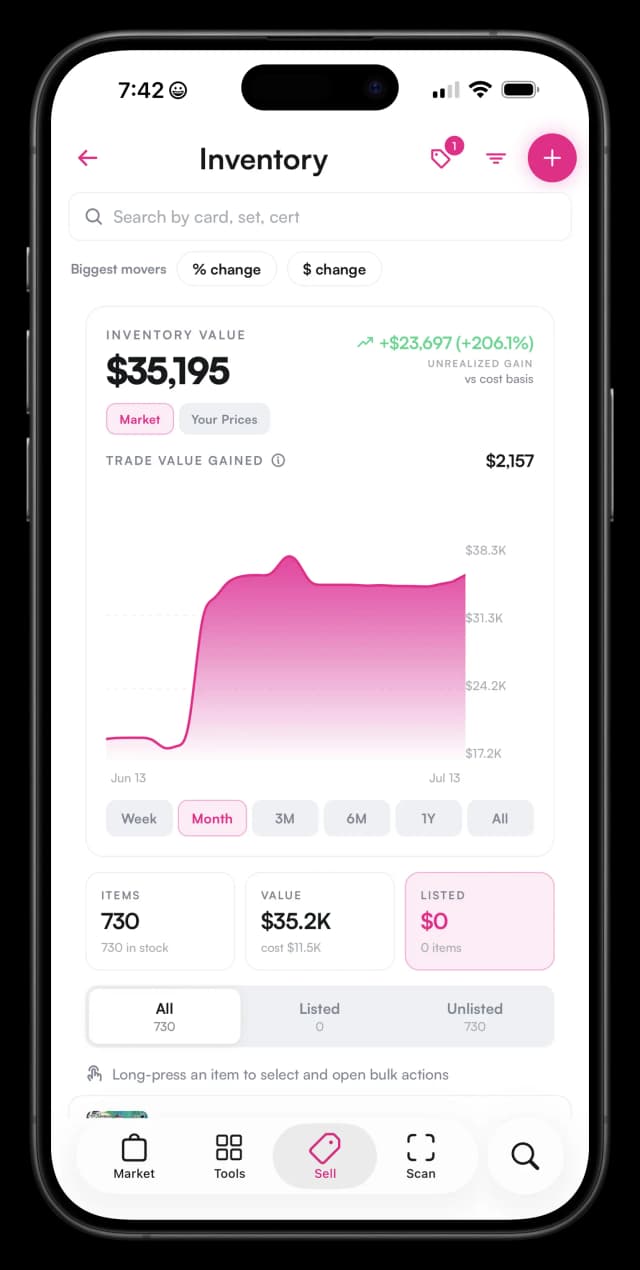
Starting this on day one, rather than retrofitting it after a hundred untracked purchases, is the difference between a business whose books make sense and one where a year of buying and selling has to be reconstructed from memory and old receipts.
The Boring Parts: Taxes and Record Keeping
This is general information, not tax advice, and it is worth saying plainly: talk to a tax professional once you are selling with any regularity. What follows are the considerations worth raising with one, not specific instructions for your situation.
Sales tax. Rules vary by state and by where your buyers are located, and they change. Some selling platforms handle collection automatically under the laws of certain states, others do not, and the details depend on your specific setup. Do not assume you know the answer; ask.
Cost basis and profit. The record keeping described in the inventory section above is not just an operational nicety, it is what makes an accurate tax return possible. Knowing what you actually paid for every card you sold, not a rough guess, is the foundation for reporting profit correctly.
When a hobby becomes a business. There is no single dollar amount or sale count that applies to everyone. Regular, intentional selling activity generally reads differently than occasionally clearing out extras, and that distinction can matter for how your activity is treated. Raise it with a tax professional before you assume the answer, rather than after a full year of sales has piled up untracked.
None of this needs to be intimidating if the habit starts early. A vendor who has tracked cost basis from the first purchase hands a tax professional clean numbers. A vendor who has not spends far more time and money reconstructing a year after the fact.
The Tools: One Operating System Instead of Several
Everything covered above, pricing, sourcing, card shows, online sales, and inventory records, tends to live in separate tools when a vendor starts out: a price guide here, a spreadsheet there, a notebook for deals, a label maker with no connection to any of it. That works for a handful of cards and breaks down fast once real volume shows up.
Double Holo's Vendor Hub is built to be the operating system for a card business instead, with everything reading from the same inventory:
Inventory. Raw cards, sealed product, and graded slabs in one place, each with live market value next to what you paid.
Deal tracking. A dedicated pipeline for B2B deals, collection buys, and trades, from first offer through completed financials, instead of scattered messages and memory. See our guide to price labels, deal tracking, and accounting for the full workflow.
Price labels. Labels print from live inventory prices and reprint when the market moves, so the sticker on a card and its online price never disagree.
Card show POS. Scan, comp, and log buys, sells, and trades from your phone, with per-show profit and loss tracked automatically.
Storefronts and sync. One inventory synced to the Double Holo marketplace, a Shopify storefront, and the other marketplaces you sell on, so nothing gets sold twice.
Vendor Hub is free to start, with no contract and no card needed for Vendor Free, as of September 2026.
None of these tools replace knowing your market or building real relationships with buyers and other dealers. What they remove is the operational drag, the hand-priced sticker, the deal that lives only in a text thread, the year of sales reconstructed from CSVs, that quietly wastes the time a growing business needs for sourcing and selling instead.
What's the difference between selling as a hobby and running a Pokemon card business?
A hobby seller occasionally clears out extras or funds an upgrade. A business sells with intent and regularity: sourcing inventory on purpose, tracking what you paid against what you sold for, and treating margin as something to manage rather than something you notice by accident. There is no single sale that flips the switch, but consistent, repeated selling activity is generally what matters, not any one transaction. Once you are past occasional sales, talk to a tax professional about what that means for you specifically.
How much money do I need to start a Pokemon card business?
Many vendors start with cards they already own and no extra capital, selling those first while they learn pricing, shipping, and listing. Building inventory beyond what you already have takes some capital, sourced through collection buyouts, card shows, or targeted purchases, and it is reasonable to put early sales back into inventory rather than trying to fund a large starting case up front.
Should I sell singles, slabs, sealed product, or bulk?
Most vendors end up doing some mix, but it helps to pick a starting lane. Singles are the most flexible and the easiest to source in small quantities. Slabs carry higher price points and fewer, larger transactions, and buyers expect certainty on centering, surface, and cert lookups. Sealed product ties up more capital and storage space, and its value depends on expected value math more than card-by-card knowledge. Bulk is high volume and low margin per card, but the easiest category to source and the fastest way to generate cash flow while you build toward higher-value inventory.
Do I need to work a card show table to build a Pokemon card business?
No. Plenty of vendors run entirely online, through a marketplace listing or their own storefront, and never work a table. A card show is one sourcing and selling channel among several, useful for building relationships and moving bulk or sealed product in person, but it is not a requirement. If you do work a show, a phone that can comp a card on the spot matters more than any other piece of gear.
What software do Pokemon card vendors actually need to get started?
At minimum, something that tracks what you paid for a card against what it is currently worth, so margin is not a guess. As you add sales channels, that same system should keep listings in sync so you never sell the same card twice, and it helps if it can also print price labels and log card show deals without a separate app for each. Double Holo's Vendor Hub handles inventory, pricing, deal tracking, price labels, and card show point of sale in one app, free to start as of September 2026, so a new vendor is not stitching four tools together on day one.
How do I start selling Pokemon cards?
Start with cards you already own and no longer want. Check each one against current sold prices, set aside anything with real single-card value, and list those first on a marketplace like Double Holo, while the commons and uncommons go out as a bulk lot. Selling your own extras first teaches you pricing, photos, and shipping before you spend money on new inventory.
List your first cards free on Double Holo, then bring your growing inventory into Vendor Hub when you are ready to run it like a business.
Top Pokemon Card Vendor Tips - strategies for pricing, sourcing, and customer service once you are already selling.
Are Pokemon Card Shows Worth It? - table costs, negotiating norms, and what to bring in more detail.
How to Sell Bulk Pokemon Cards - sorting, pricing, and moving the bulk pile that comes with most collection buyouts.
Pokemon TCG Inventory Management - cost basis, live values, and multichannel sync in Vendor Hub.
Card Show POS - the full walkthrough of running a table on Vendor Hub.