


You’ve got a stack of Pokémon cards on the table, a buyer asking for a price, and no interest in wasting a weekend listing the wrong cards in the wrong place. That’s the problem behind where can I sell Pokemon cards. The answer isn’t one platform, it’s a routing decision, because the card that pays on eBay is often the same card that drags on TCGplayer, and the bulk lot that looks annoying online might be exactly what a local shop wants today.
Table of Contents
Finding the Right Channel for Your Cards

A mixed collection looks simple until you try to sell it. One binder page has raw singles, another has a slab, a sealed box is sitting in the closet, and the rest is bulk, loose commons, or cards in languages you don’t usually list. If you dump all of that into one marketplace, you usually leave money on the table or waste time on cards that never should’ve been there in the first place.
Sort first, sell second
The cleanest route is to split your stack into raw singles, graded slabs, sealed product, bulk and low-value commons, and a fifth bucket that matters more than most guides admit, Japanese and other multilingual cards. Major marketplace advice for 2026 keeps coming back to the same pattern, eBay for high-value graded cards and raw singles, TCGplayer for playable singles and bulk, and Facebook Marketplace or groups for faster local sales with fewer shipping headaches. That pattern lines up with the market shift from local in-person selling toward multi-channel digital resale while keeping local shops in play for sellers who want cash quickly, as noted in recent guidance on Pokémon card resale venues and fee tradeoffs. The Penny Hoarder’s channel breakdown both points in that direction.
Practical rule: if a card is valuable enough that buyer trust matters, send it to the widest market. If it’s common enough that shipping hurts the deal, keep it local or bundle it.
That’s the whole play. Expensive slabs and rarities belong where there are the most buyers, while commons, binders, and cash-now lots go local or into hobby shop buyouts. The route matters because the “best place” is not a platform, it’s a fit between card type, speed, and fee tolerance.
This guide is built for three seller profiles. Casual sellers want to unload a childhood collection without turning it into a side hustle. Active flippers want a clean lane for moving singles without bleeding fees. Working vendors need a repeatable stack that handles volume without overselling inventory or getting trapped in returns.
The Six Major Online Marketplaces Compared
Online marketplaces are where serious Pokémon card sales happen now, but each one owns a different lane. The mistake is forcing one venue to do every job. That burns time on poor-fit listings and leaves sellers wondering why the same card moved fast somewhere else.
eBay, TCGplayer, and Mercari
eBay is the default for graded slabs, higher-value singles, sealed product, and niche items because auction dynamics and broad buyer reach can offset the fee drag. Independent 2026 guidance still places eBay as the top overall venue for high-value graded cards and raw singles. Its fee structure is not friendly, so sellers use it when reach matters more than squeezing every last point of margin.
TCGplayer is home field for raw singles, playable cards, and volume. It makes sense when your inventory is a steady stream of condition-sensitive cards that buyers compare by playability and price. Recent seller guidance keeps calling it the preferred route for singles and bulk, especially when you need a lot of small transactions to clear cleanly.
Mercari is the simpler fixed-price option. It works for sellers who want a lower-friction listing process and do not need auction mechanics to help slabs and chase cards stand out. It is less of a precision tool and more of a practical outlet for standard U.S. resale.
Whatnot, Cardmarket, and Double Holo
Whatnot is built for live selling. If you can stream, it can move sealed product and modern singles quickly because buyers show up for the live format, not just the listing. That setup favors sellers who are comfortable performing, talking inventory on camera, and running rapid-fire auctions.
Cardmarket is the obvious European lane. If you are shipping within the EU, it belongs in the same conversation as TCGplayer and eBay, but for a different region and buyer base. The right platform here is partly geographic, not just logistical.
Double Holo combines a real-time bid and ask market with vendor tools and a 4.9% standard seller fee (4.7% on premium listings) plus a 2.9% + $0.50 card processing fee. Its own comparison page also frames eBay at 12.9% and TCGplayer at 10.75%, which tells you why some sellers look for a lower-fee lane when margin is tight. The platform is especially relevant if you are moving graded cards, raw singles, sealed items, and multilingual releases in one place. The fee comparison page is the cleanest internal read if you are comparing those three directly.
| Marketplace | Best For | Standard Seller Fee | Payment Protection |
|---|---|---|---|
| eBay | Graded slabs, sealed, niche singles | 12.9% | Marketplace-backed buyer and seller systems |
| TCGplayer | Raw singles, playable cards, bulk | 10.75% | Marketplace payment flow |
| Mercari | Fixed-price U.S. resale | Not specified in verified data | Platform checkout protection |
| Whatnot | Live auctions, sealed, modern singles | Not specified in verified data | Live-sale platform protection |
| Cardmarket | EU singles and regional sales | Variable | Marketplace protection |
| Double Holo | Raw and graded cards, sealed, multilingual releases | 4.9%, or 4.7% on premium listings + 2.9% and $0.50 processing | Marketplace bid and ask structure |
eBay gives you reach. TCGplayer gives you volume. Local sales give you speed. Pick the one that matches the card, not the one that sounds familiar.
Calculating Net Proceeds Across Platforms
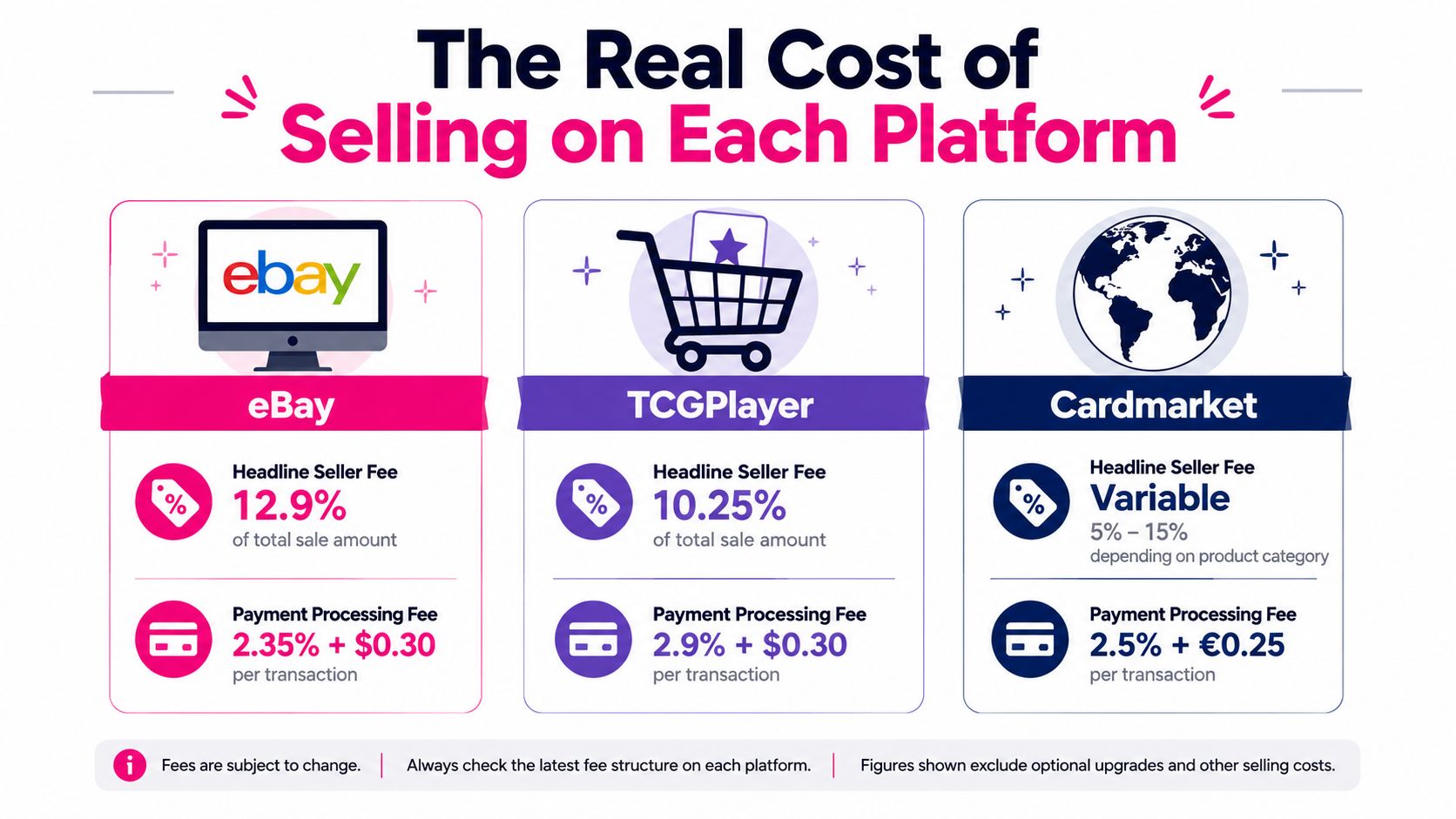
The sticker fee is only part of the bill. Sellers lose money in the gap between the headline rate, payment handling, shipping materials, and the ugly part, returns or disputes. If you only look at the listed fee, you are not calculating take-home.
A $100 sale does not stay $100
The cleanest fee comparison in the verified data is between eBay at 12.9%, TCGplayer at 10.75%, and Double Holo at 4.9% standard, or 4.7% on premium listings, plus 2.9% + $0.50 card processing (about 7.8% + $0.50 all in). A 2026 comparison also places TCGplayer at about 10.25% to 8.95% plus $0.30 per order and eBay at about 13.25% plus $0.30, with a $100 sale leaving roughly $85 to $87 on TCGplayer versus about $82 on eBay. That gap is the difference sellers feel when they move enough cards to care about every point.
For a $100 raw single, the cheaper lane usually wins unless eBay’s broader buyer pool pushes the sale price higher. For a $400 graded slab, the math changes less on paper and more in practice, because the wrong platform can leave the item sitting for weeks while the right one surfaces the buyer who wants that grade, that card, and that presentation. The point is not that one fee is magically bad. The point is that the same fee bites harder on low-value cards than on premium inventory.
Returns, chargebacks, and the real loss
The hidden cost is risk. A marketplace with strong buyer protection helps until a buyer claims the card arrived misdescribed or opens a chargeback, because then the seller loses time, shipping, and sometimes the item itself. Clean photos, tight condition notes, and careful packaging matter more than people want to admit.
Practical rule: if the card can be disputed easily, treat the shipping box like part of the contract. The listing does not end at checkout.
Sellers chasing net proceeds need to think in layers. The seller fee is the first layer, payment handling is the second, shipping is the third, and returns are the fourth. A cheap platform with sloppy disputes can cost more than a pricier one that closes cleanly. That is why platform choice should follow card value and buyer risk, not just a headline percentage.
Local Card Shops, Cash Buyouts, and Consignment
A seller walks into a local shop with a box of mixed cards, wants fast cash, and learns quickly that the shop is not paying full retail for inventory it still has to sort, price, list, and protect. That gap is the whole business model. It is the cost of convenience, and for the wrong stack of cards, it is the right trade.
Cash now beats perfect price for the wrong inventory
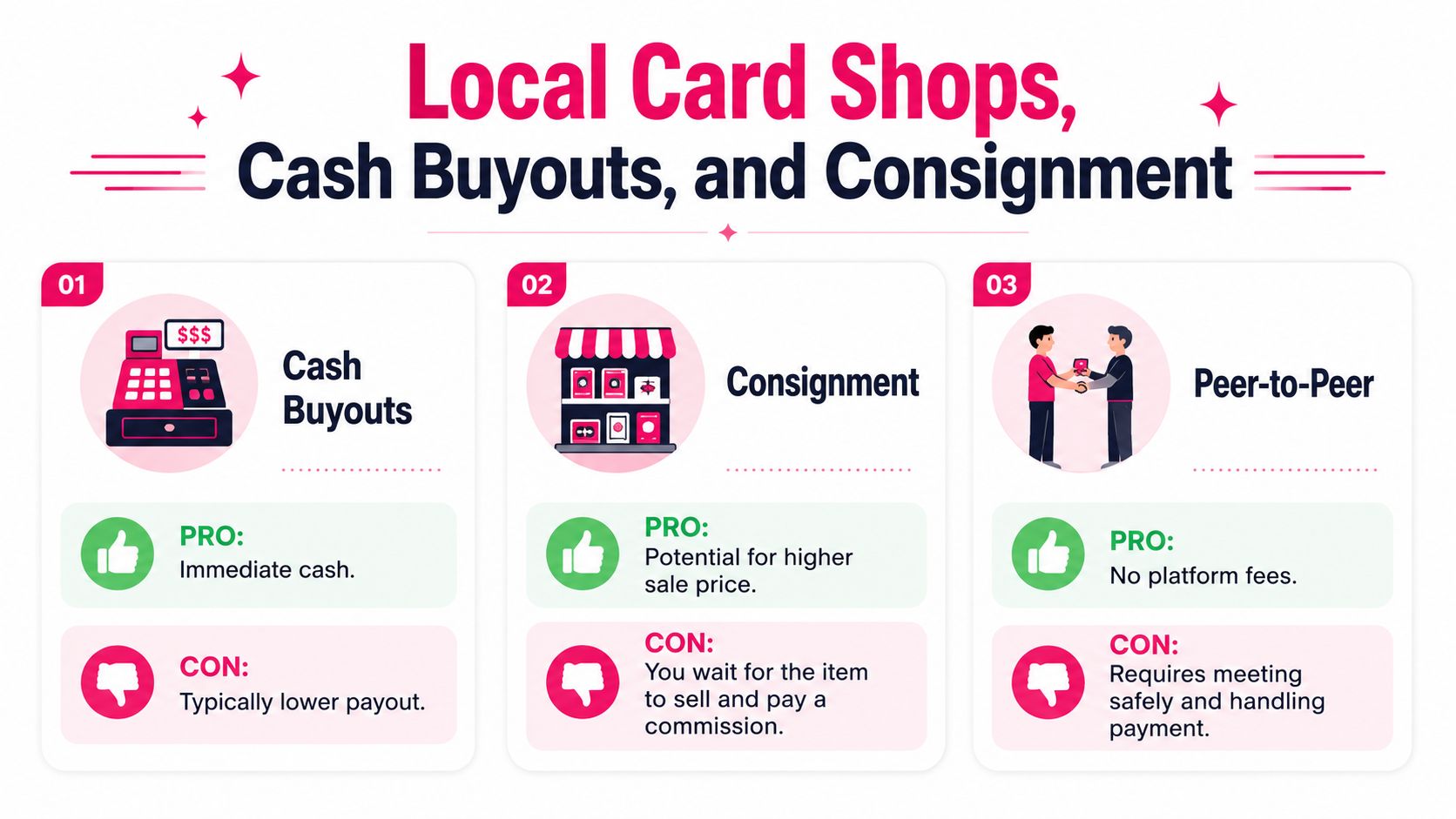
Local card, comic, and hobby shops usually make buyout offers well below market value because they are buying speed, convenience, and resale risk at the same time. That haircut is real. It still makes sense for bulk, mixed-condition lots, and low-value cards that would eat hours if you tried to list each one separately. For that kind of inventory, cash now is the clean exit.
CardCodex’s resale guide makes the same basic point, and it is the right call for sellers who want the box gone without turning the week into a listing project.
Consignment sits in the middle. The store or vendor lists the card, you wait for it to sell, and they take a cut. Use that route for cards with enough value to justify patience, but not so much urgency that you need immediate money. It works better for sellers who want more than a buyout and less hassle than running a marketplace operation themselves.
Peer-to-peer works when you can control the meeting
Card shows, tabletop events, Facebook groups, and meetups can produce fast, fair-price cash for slabs when you show up with a price list and a little patience. You skip a lot of platform friction, and buyers can inspect the card in person. The tradeoff is clear. You handle the meeting, the payment, and the trust gap yourself.
Use local routes for these cases.
-
Bulk and junk drawers: Too much low-value inventory to list one by one.
-
Mixed collections: Good cards, bad cards, and uncertain condition in one pile.
-
Time-sensitive exits: You need cash now and do not want a shipping queue.
-
Slabs at events: Buyers who can inspect the card in person often move faster than online browsers.
Local sales are the fast-route, low-friction route. They are not the top-price route, and they should not be treated like one. For bulk, mixed lots, and cards you do not want to babysit through a marketplace, they make sense. For high-end singles with a bigger online audience, they usually leave money on the table.
Prep, Photography, and Shipping for Maximum Net Proceeds
A clean listing is not cosmetic. It reduces disputes, speeds up buyer confidence, and keeps the package from becoming the problem. If you’re trying to protect margin, the way you prep the card matters almost as much as where you list it.
Card type should determine the package
Raw singles need a penny sleeve and top loader. That’s the baseline, not the premium option. If the card is valuable enough that you’d hate to replace it, move it into a rigid card saver or magnetic case inside a bubble mailer instead of trying to save pennies on packing.
Sealed product needs team bags and bubble wrap so the edges don’t get crushed in transit. Slabs need the standard sandwich, sleeve, top loader, painter’s tape on the case, then a box with no room to shift. If a slab rattles in an oversized box, you’ve already made the buyer nervous before they open the package.
Practical rule: the box should protect the card, not audition as a percussion instrument.
Photos and shipping details do more work than most sellers think
Use natural light and a black background for singles. Shoot front and back of every card. For slabs, include in-case shots so buyers can see the actual holder and label, not just a cropped glamour photo. This isn’t about making the listing pretty. It’s about reducing the space for an INAD claim to breathe.
Shipping should match the card’s risk. For higher-value items, use the kind of service that lets you sleep after the label prints, not the cheapest envelope you can find. If you’re shipping a card that would hurt to lose, the package should be built to survive a bad sort, not a gentle one.
The biggest margin killers are predictable. Bare cards in a flat envelope, sealed product in a soft mailer, and slabs that can bounce around all invite damage or disputes. Sellers usually blame the platform after the fact, but the problem started at the desk.
When Grading Actually Pays for Itself
Grading is not a hobby tax, and it’s not a magic fee multiplier either. It’s a channel choice disguised as a condition decision. A raw card and a graded card are not competing in the same market, so you need to know which version earns more after the cost to grade, the wait, and the shipping back.
Grade the card, or move it raw
A raw card often sells fastest on TCGplayer when it’s a playable single or a high-turn card. A graded version of the same card often belongs on eBay, where the broader audience and auction format can support the premium. That premium only matters if the card clears enough value to cover the grading bill and the waiting time.
Double Holo’s grading ROI calculator covers PSA, BGS, CGC, and TAG, which is useful because not every card should go to the same grader. If you’re comparing graders, the question is not which slab looks prettier. It’s which holder gets you the best net outcome once you factor in cost and eventual sale price. The grading opportunity-cost guide is the relevant read if you’re deciding whether a card should stay raw or go out.
Don’t grade the cards that will waste your money
Modern low-value holos usually don’t deserve grading. Cards with obvious centering or surface issues usually don’t either. Sealed product is a different problem entirely, because once the graded population gets crowded, the premium gets compressed and the upside fades.
If you’re unsure, use a blunt test. Would the graded version plausibly move you into a different buyer class, or would you just pay to delay the same sale? If the answer is no, ship it raw and save the grading cost for cards that can absorb it.
Choosing the Best Stack for Your Seller Profile
The worst advice sellers get is to “list everywhere.” That sounds efficient until you’re reconciling inventory across tabs, answering the same question three times, and trying to remember which card was already sold on another channel. Pick a stack that fits your actual volume.
Casual sellers should stay narrow
A one-time collection cleanout should not turn into a marketplace business. Route graded cards to eBay auctions, bulk to a local buyout, and the playable middle to TCGplayer if you have enough clean singles to justify it. That keeps the work focused where the value is, instead of dumping everything into one channel and hoping for the best.
Serious sellers need a three-channel lane
Active flippers should run TCGplayer for raw playable volume, eBay for slabs, and a fast-turn outlet like Whatnot or a direct community channel for hot modern inventory. That stack keeps the inventory moving without forcing every card through the same funnel. If you use software, keep it simple and synced, because inventory mistakes are what turn a good month into a mess. Double Holo’s vendor software overview is one of the few public examples that treats inventory, repricing, and cross-channel sync as one problem instead of three.
Working vendors need a tighter operating system. They’re not trying to pick the perfect platform for each card. They’re trying to keep labels printed, cases priced, and stock from being sold twice. For that kind of seller, the platform stack matters less than the process stack.
If you sell a few cards a month, don’t build a warehouse process. If you sell hundreds, don’t rely on memory.
Your Decision Tree to the Best Channel
If you want the shortest possible answer to where can I sell Pokemon cards, use this filter.
What’s in the stack
-
Raw playable singles: Start with TCGplayer. If the card is more collectible than playable, move it to eBay.
-
Graded slabs: Start with eBay. That’s where the broad buyer pool and auction behavior usually make sense.
-
Sealed product: Use eBay if the item is collectible, or Whatnot if you can sell live and keep momentum.
-
Bulk and low-value commons: Take the local shop buyout or bundle for a local sale.
-
Japanese and multilingual cards: Use the marketplace or venue that already has buyers for that language set, and don’t force it into a lane built for English-only inventory.
How fast do you need cash
-
Today: Local shop, card show, or a direct peer-to-peer sale.
-
This week: eBay, TCGplayer, or Whatnot depending on card type.
-
This quarter: Grade selectively, then list the cards that can justify the wait.
How much time will you spend listing
-
An afternoon: Sell the best cards individually, bundle the rest.
-
A standing operation: Build a three-channel stack and keep your inventory synchronized.
-
No time at all: Accept the buyout and move on.
The hard truth is simple. There is no single best place to sell Pokémon cards. There’s only the right route for the card in your hand, the cash speed you need, and the amount of work you’re willing to put in.
Double Holo gives sellers a real marketplace, grading ROI tools, and vendor software in one place, which matters when you’re deciding what to list, what to grade, and what to move elsewhere. If you’re trying to stop guessing and start routing your cards by net proceeds, visit Double Holo and compare your stack against the channels that fit it.