

Raw Near Mint copies of Arcanine ex 032/198 trade around $0.99 to $1.86, while PSA 9 sits near $15.29 and PSA 10 clusters around $34.00 to $38.22. That’s a roughly 34x to 38x jump from raw to gem-mint pricing, and that spread matters more than the card’s low sticker price.
If you’re holding this card, you’re probably looking at the same question every modern singles buyer asks, whether the raw copy is just a cheap binder piece or whether it has enough grading upside to justify a submission. The answer depends less on the card’s floor price and more on how the market treats condition, supply, and thin liquidity.
Table of Contents
Why Arcanine ex 032/198 Still Gets Talked About in 2026
Arcanine ex 032/198 keeps showing up in pricing conversations because the market doesn’t treat it like a normal sub-$2 modern rare. Raw Near Mint copies sit around $0.99 to $1.86, but the same card in PSA 10 moves into the $34.00 to $38.22 range, which is where the valuation story lives. That spread tells you the card has a meaningful grading premium even though the raw entry point is cheap.
Why the raw price is the wrong starting point
A lot of guides stop at the floor listing and leave it there. That misses the part that matters to collectors and vendors, which is whether the card rewards strict condition discipline. When a card’s raw market is this low, small mistakes in centering or surface quality can wipe out the only margin that exists.
The better lens is to treat Arcanine ex 032/198 as a grading case study. It’s inexpensive enough that buyers can be casual, but the spread into PSA 10 is wide enough that grading judgment matters. That’s why the card keeps showing up in market chatter long after its release cycle cooled.
Practical rule: if a modern card’s raw price is low but the PSA 10 gap is wide, the market is telling you to inspect condition first and sentiment second.
The card also matters because it sits in a part of the modern market where collectors often confuse “cheap” with “irrelevant.” Those aren’t the same thing. Cheap cards can still have strong grading economics, and Arcanine ex 032/198 is a clean example of that.
The Card Itself and Where It Sits in Scarlet & Violet
Arcanine ex 032/198 is a Fire-type Stage 1 Pokémon ex in the Scarlet & Violet expansion, and the official Pokémon TCG database gives it 280 HP and Double Rare status (official Pokémon card database). Its rules text matters because it isn’t just decorative collector copy, it shapes how the card plays and how players value it.
What the attacks actually tell you
Raging Claws starts at 30+ damage and adds more damage for each damage counter already on Arcanine ex, which means the card scales with prior chip damage. Bright Flame hits for 250 but asks you to discard 2 Fire Energy, so it’s an efficient finisher with a real resource cost. The same official listing also notes the Terastal protection that prevents bench damage from attacks, which gives the card a specific defensive angle in play.
The key point is that this is not a low-impact utility ex. Its attack profile points to a higher-damage main attacker, which is why the printed card feels more substantial than many modern double rares that mostly exist to fill set slots.
Why gameplay text still matters to collectors
Collectors sometimes ignore attack text unless the card is a chase alt art. That’s a mistake with modern ex cards, because competitive-looking text can support demand even when raw prices stay low. Arcanine ex 032/198 has enough presence on the page to attract both players and collectors, and that broadens the buyer pool slightly without making the card scarce.
It also explains why the market keeps the card in a “worth watching” bucket instead of treating it like bulk. The card’s ex rule gives the opponent 2 Prize cards when it’s Knocked Out, so it behaves like a real ex attacker rather than a novelty print. That matters for play, and playability matters for the bottom of the market.
Raw vs PSA 9 vs PSA 10 vs BGS 10 Price Comparison

| Grade | Typical Price (USD) | Premium vs Raw |
|---|---|---|
| Raw Near Mint | $0.99 to $1.86 | Baseline |
| PSA 9 | $15.29 to $16.27 | Roughly 8x to 16x |
| PSA 10 | $34.00 to $38.22 | Roughly 18x to 39x |
| BGS 10 | Near $50.00 | Highest listed tier |
The spread matters more than the headline price. Arcanine ex 032/198 is not a card that becomes interesting because the raw copy is expensive, it becomes interesting because the grading ladder creates a wide gap between low-cost inventory and higher-tier slab demand, as reflected in the market data for the card.
What the ladder means in practice
Raw copies show how easy the card is to enter. PSA 9 and PSA 10 prices show where buyers are willing to pay for condition, centering, and cleaner surfaces.
That changes the decision tree. If you buy raw, the upside is limited unless the broader modern market re-prices the card. If you buy with grading in mind, the question is whether the copy has the condition profile to clear gem-mint standards.
Vendors should read that as a quality filter, not an inventory game. The market rewards copies that can grade cleanly, not just copies that can be stacked in quantity.
A useful comparison point is Captain Pikachu - Chinese Gem Pack #709, a separate product listing that shows how quickly modern singles can separate by grade sensitivity rather than by set fame. Arcanine ex 032/198 fits the same broad pattern, even though its demand profile is different.
How to read the premium
The premium does not mean the card is scarce in a strict collectible sense. It means gem-mint copies are pricing far above raw copies, and that gap is large enough to matter for grading decisions.
That distinction is where a lot of modern-card analysis goes wrong. A cheap raw card can still make sense as a grading target if the condition spread supports it, while a wide premium can also coexist with thin liquidity at the top end. For a broader look at why population matters, see this explanation of graded Pokémon card population data.
In this case, the ladder is wide enough that grading is the only part of the market where the card starts to look like a meaningful asset instead of a small purchase.
Population and Supply Growth Since Release
Arcanine ex 032/198 is still being absorbed by grading channels, and that’s the part collectors should watch. Double Holo reports 1,096 PSA 10 examples tracked for the set listing, a 45.7% gem rate, 63 more PSA 10s over one year, and 173 more total tracked copies over the same period.
What rising population does to the premium
More gem copies don’t automatically crush a card, but they do put pressure on the ceiling if demand doesn’t keep up. That’s especially true for a low-cost modern ex, because the raw pool stays easy to access while submissions continue to feed the slab market. If supply keeps growing faster than collector demand, the PSA 10 premium can narrow even if the raw price stays stable.
The 45.7% gem rate also tells you something useful about submission behavior. This isn’t a brutally difficult card to grade, which means more copies can plausibly hit premium tiers if they start clean. For graders, that lowers the mystery. For vendors, it means the card can keep appearing in high-grade form instead of drying up.
Population data only matters when you use it correctly
Population numbers can mislead people who read them as a direct scarcity score. They’re better used as a supply trend indicator. Rising PSA 10 counts tell you the market is still making fresh supply, and that supply matters most when the card’s raw floor is already low.
Bottom line: when a modern card still adds graded copies years after release, the premium is vulnerable to slow compression unless demand broadens faster than submissions.
For a deeper framework on why this matters, read the population guide on Double Holo. The right takeaway here isn’t that the card is overpopulated, it’s that the grading premium can’t be evaluated without watching new supply.
Short-Term Price Swings and the Liquidity Problem
Why low-cost modern cards fake momentum
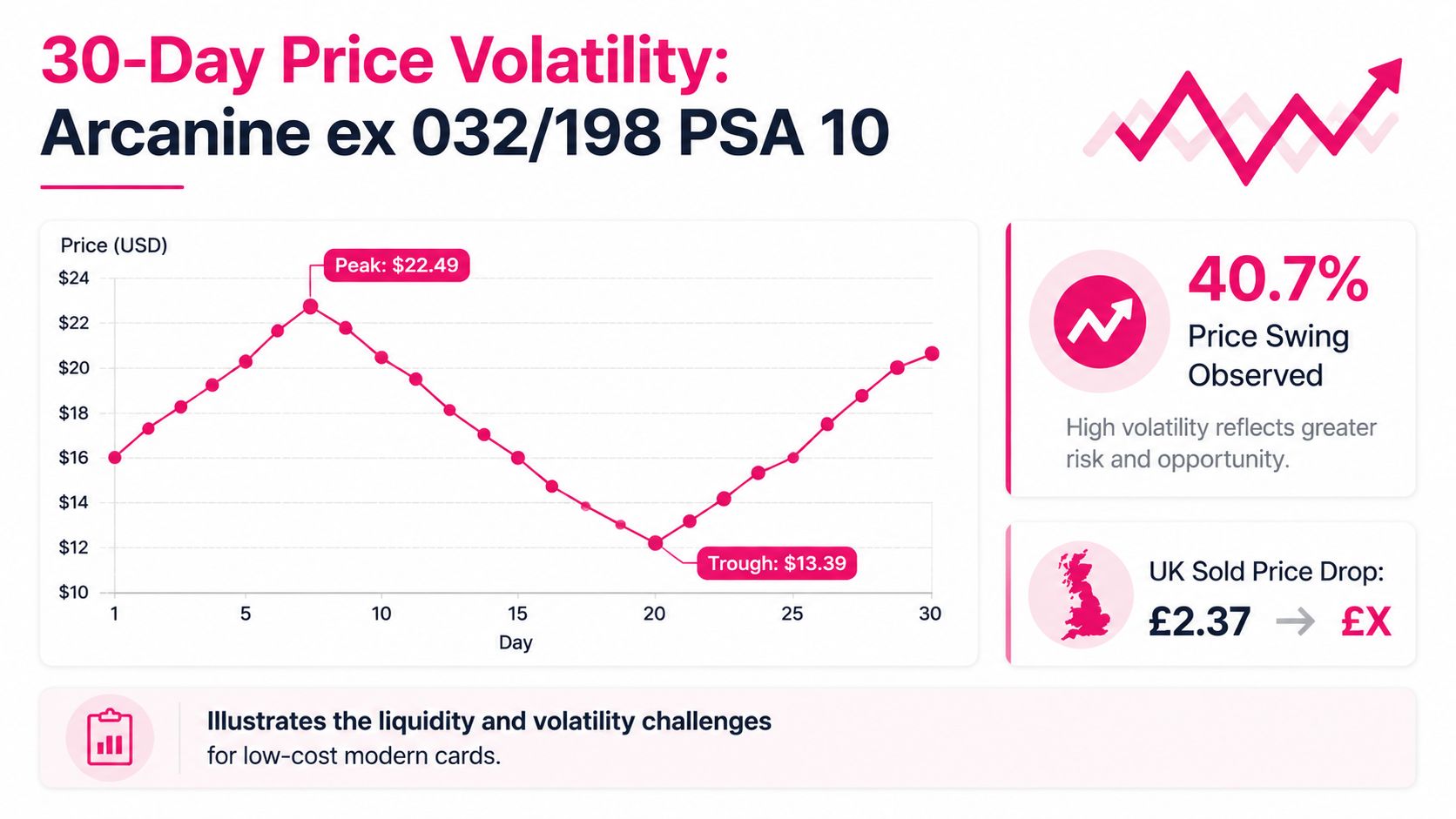
Low entry price changes the way charts behave. A small number of sales, a change in listing depth, or one outlier transaction can move the visible price far more than real collector demand would justify. That’s why the same card can look busy on one tracker and flat on another.
The chart tells you something important about execution. A card can show movement without showing conviction. If the trade base is thin, the signal gets noisy fast, and the most dramatic percentage moves can be the least useful.
Treat the spread as a liquidity warning
The European and UK snapshots are useful because they show the card trading in a narrow absolute band, even while percentages look dramatic. That’s exactly the environment where sellers misread momentum and buyers overpay for what turns out to be a temporary floor shift. The card’s low price makes it sensitive to fees, shipping, and marketplace friction, which can distort the price you think you’re seeing.
For market monitoring, Double Holo’s price tracker article is a better way to think about these signals than a single headline number. The right question isn’t whether the card moved, it’s whether the move was executable at size.
Market read: on thinly traded modern slabs, volatility often says more about supply depth than about real demand.
Pre-Grading Checklist That Actually Matters
The grading premium only helps if your copy has a real shot at gem status. With Arcanine ex 032/198, the market already shows that premium clearly, so the only rational reason to submit is strong visual quality and clean handling history. Anything less and you’re paying to convert a cheap raw card into a still-ordinary slab.
What to check before you spend grading money
-
Centering: Check the front and back alignment first. If the borders already look obviously off, the card probably doesn’t belong in a gem chase.
-
Surface: Look for print lines, scratches, or factory defects under direct light. Modern cards can look clean at arm’s length and still fail under inspection.
-
Edges and corners: Watch for whitening, small dings, and soft corners. Those tiny flaws matter because the card’s premium sits at the top end, not in mid-grade filler.
-
Economics: Compare your raw cost to the grading fee and the likely grade outcome. If the card only makes sense as a PSA 10, then anything that weakens the gem case makes the submission bad math.
The 45.7% gem rate shows that clean copies can make it, but it doesn’t mean your copy will. Population data is a background clue, not a promise. The card still needs to clear the visual bar in front of you, not the average bar in a population database.
Simple rule: submit when the card looks like a gem in your hand, not when you hope the grader will be generous.
For a more structured approach, Double Holo’s grading finder guide fits this card well because the economics only work when the candidate is already strong. Bulk submissions on low-cost moderns usually create fees, not margin.
Buy, Sell, or Hold Framework for 2026
Arcanine ex 032/198 is the kind of modern low-cost card that can look active on a chart while still being hard to trade cleanly. SportsCardInvestor showed it among 7-day movers at +6.0% with a 30-day change of -0.2%, which says more about short bursts of attention than any durable trend. For a card in this price tier, that is usually the more useful read. Narrow spreads and thin buyer depth can make a small print look meaningful even when the executable market has barely moved.
Buy raw when the entry is cheap and the copy is clean
Raw copies make sense if the goal is a binder slot, a set hold, or a grading attempt with limited downside. The math works only when the card is already inexpensive and the copy is structurally sound. Raw is not the setup for chasing a big price move. It is the entry point for optionality.
Grade only when the gem case is obvious
This card belongs in the submit-or-skip bucket. If centering, edges, and surface all look strong in hand, the raw-to-PSA 10 spread can justify grading. If even one of those areas is off, the economics weaken fast and the submission starts leaning on hope instead of evidence.
The raw market matters here because a weak copy can erase the spread you were trying to capture. On a low-cost modern card, the grading fee and the chance of missing the top grade can turn a modest resale gap into dead capital. That is why the best candidates are the ones that already look like gems before they ever leave your desk.
Sell when local demand gets noisy
A temporary burst of attention is usually the cleanest exit. Thin-liquidity cards can register sharp but brief interest, and that kind of move often fades before a seller gets another better print. The safest sale is usually the one that captures the spread before it compresses. Waiting for a bigger pop can leave you holding the card after the buyers have moved on.
Collectors who want a cleaner view across raw and slab tiers can use Double Holo alongside market tracking and grading ROI checks. It is a practical reference point for cards like Arcanine ex 032/198, where the difference between floor listings and executable sales matters more than the headline chart.