

You’re staring at a listing that looks close enough to buy. The photos are decent, the card is one you’ve wanted, and the price feels reasonable until you check sold comps and realize the seller is padding the ask. That’s the trap many new collectors fall into when learning how to buy Pokemon cards, and it’s why smart buying comes down to three things, sold-data discipline, seller vetting, and timing.
Table of Contents
What Every First-Time Buyer Gets Wrong
A new collector sees a Charizard VMAX listed for $65. They do not check eBay’s sold filter. They pay $65, then learn the market paid $48 yesterday. That $17 overpay is the cost of skipping sold-data discipline.
The mistake is not bad luck. It is a sloppy buying process.
The first bad habit is trusting asking prices
Asking price is what a seller wants. Sold data is what buyers paid. Start there, then compare the same card, the same condition, and the same format across recent sales before you move a dollar. A quick reference like how to check Pokémon card prices the right way gives you a clean way to separate real market value from wishful pricing.
If you buy off the ask, you are paying the seller’s optimism tax. If you buy off sold listings, you are paying the market.
Practical rule: if recent sold comps sit well below the asking price, the listing is for someone who did not check the market.
The second bad habit is treating every listing the same
Low-ticket cards and higher-priced cards get handled differently by sellers. Cheap cards are often padded hard because buyers are lazy and the absolute dollar overpay feels small. Higher-priced cards can sit closer to market, but only if the seller wants a faster sale. A collector buying a Charizard VMAX from Shining Fates should look at the sold cluster first. If recent sales are sitting around the high 40s and the listing is sitting at $65, that gap is the seller’s optimism tax, and it is not worth paying.
That means your margin for error changes with the card. A small overpay on several cheap cards turns into real money fast.
Do the boring part first. Check recent sold data, compare the exact version you want, and look at timing before you commit. A clean listing is not a fair listing. A fair listing is one that lines up with what the market already paid, not with what the seller hopes to get.
How to Verify a Fair Price Before You Pay
Open eBay, filter by Sold, then sort by Sold Date. That gives you the market, not the seller’s wishful number. Search the exact card name, set, and version you want, then look at the last handful of sales and ignore the outliers. If the recent sold cluster sits in a tight range, that range is the price that matters. If the listings are all over the place, the median sold price is the number you anchor to before you spend a dollar.
For a cleaner walkthrough of price research, use this guide to check Pokémon card prices the right way.
Do the comp check the hard way
Pull the exact card, exact set, and exact condition. Then compare recent sold comps from more than one source, because one marketplace alone can lie to you with thin data or a weird spike. Raw cards should be compared against raw cards. Graded slabs should be matched by the same grade, not just the same card.
A practical example makes this simple. Open eBay, filter by Sold, search for Charizard VMAX Shining Fates, and sort by Sold Date. If the last 10 sales land between $45 and $52, the median sits at $48, and that is your market price. Use that number, not the asking prices floating around right now.
Good buying habit: if the comps disagree, trust the recent cluster of sales, not the one outlier that flatters the seller’s price.
That is where negotiation starts. A common buying benchmark is about 85% of market value for individual purchases, and 75% to 80% when you are buying multiple cards from the same seller buying guide. Those numbers are a starting point, not a commandment, but they keep you from throwing out random offers with no grounding. Use sold data first, then decide how aggressive your offer should be.
Spot the red flags fast
A listing turns suspect when the photos are generic, the price sits far above recent comps, or the seller uses stock images instead of the actual card. Those are signs the listing is anchored above market and hoping you will skip the research. On collectible cards, that is the moment to walk.
Use the comp data to decide. Use the listing only to confirm condition and authenticity. Everything else is noise.
Choosing Between Singles, Sealed Product, and Graded Slabs
Buy the format that matches your goal. People waste money when they buy sealed product thinking it’s the cheapest way to get one specific chase card, or when they buy graded slabs because they think certification automatically means better value. It doesn’t. Each format serves a different buyer, and the smartest purchase is the one that fits your purpose instead of your impulse.
For sealed product context, see whether booster box value makes sense for your goal.
Singles vs Sealed vs Graded Slabs
| Format | Best For | Typical Premium | Skill Needed |
|---|---|---|---|
| Singles | Players, set completers, buyers who want one exact card | Lowest | Low to moderate |
| Sealed Product | Set collectors, long-term holders, people who want opening value | Higher variance | Moderate |
| Graded Slabs | Buyers who want certification, liquidity, and easier resale | Premium for grade and holder | Moderate to high |
Singles are the default answer for many collectors. If you want a playset, a binder slot, or one chase card, buy the single and stop burning money on sealed packs. That’s the cleanest route and the easiest one to comp correctly.
Sealed product is different. You’re not buying certainty, you’re buying optionality, which is fine if that’s your plan and not a self-deception. Graded slabs sit in the middle, because you’re paying for condition certification and easier comparison, not just cardboard in a plastic shell.
Match the format to the buyer
If you’re a player, buy singles. If you’re trying to complete a set without the lottery ticket feel, singles still win most of the time. If you want certified condition and easier resale later, graded slabs make sense, but only if the premium still leaves room for a rational exit.
The problem is simple. Most new buyers don’t buy the format they need. They buy the format that feels exciting.
Vetting Sellers So You Don’t Get Burned
A cheap card from the wrong seller gets expensive fast. Disputes, bad returns, and counterfeit risk wipe out any savings. Start with seller history, not the asking price. Look for sellers with more than 10,000 sales, a 5-star rating, and platform verification when it is available buying guide.
Stock photos are a red flag on anything you care about. If the listing does not show the exact card, skip it unless the seller can prove what you will receive. For higher-value cards, you want front, back, corners, and surface detail, especially anything that shows holo wear or print lines.
A seller with 15,000 sales and a 99.8% positive rating on eBay is a safer bet than a seller with 50 sales and 100% positive. Volume tells you the person has handled enough orders to know how to pack, ship, and answer problems without drama.
The checklist that actually reduces risk
- High transaction volume: A seller with a long track record has already handled enough buyer issues to show how they operate.
- Strong feedback: Recent positive reviews matter more than an old perfect score buried in a profile.
- Real photos: Actual card images beat polished stock art every time.
- Protected payment: Use PayPal Goods and Services, which offers buyer protection for collectibles, or use a platform like Double Holo that holds funds in escrow until the buyer confirms receipt Double Holo’s buyer protection details.
- Clear condition photos: Ask for the corners, edges, surface, and back, especially on expensive cards.
If a seller stalls on photos or pushes you to move the deal into DMs, walk away. Off-platform deals from strangers in Discord or direct messages are where buyers get careless, and the payment method decides who eats the loss.
Don’t trade buyer protection for a tiny discount.
For marketplace-level buyer safety, review Double Holo’s buyer protection details before you move money on a higher-value purchase.
When to Buy to Get the Lowest Price
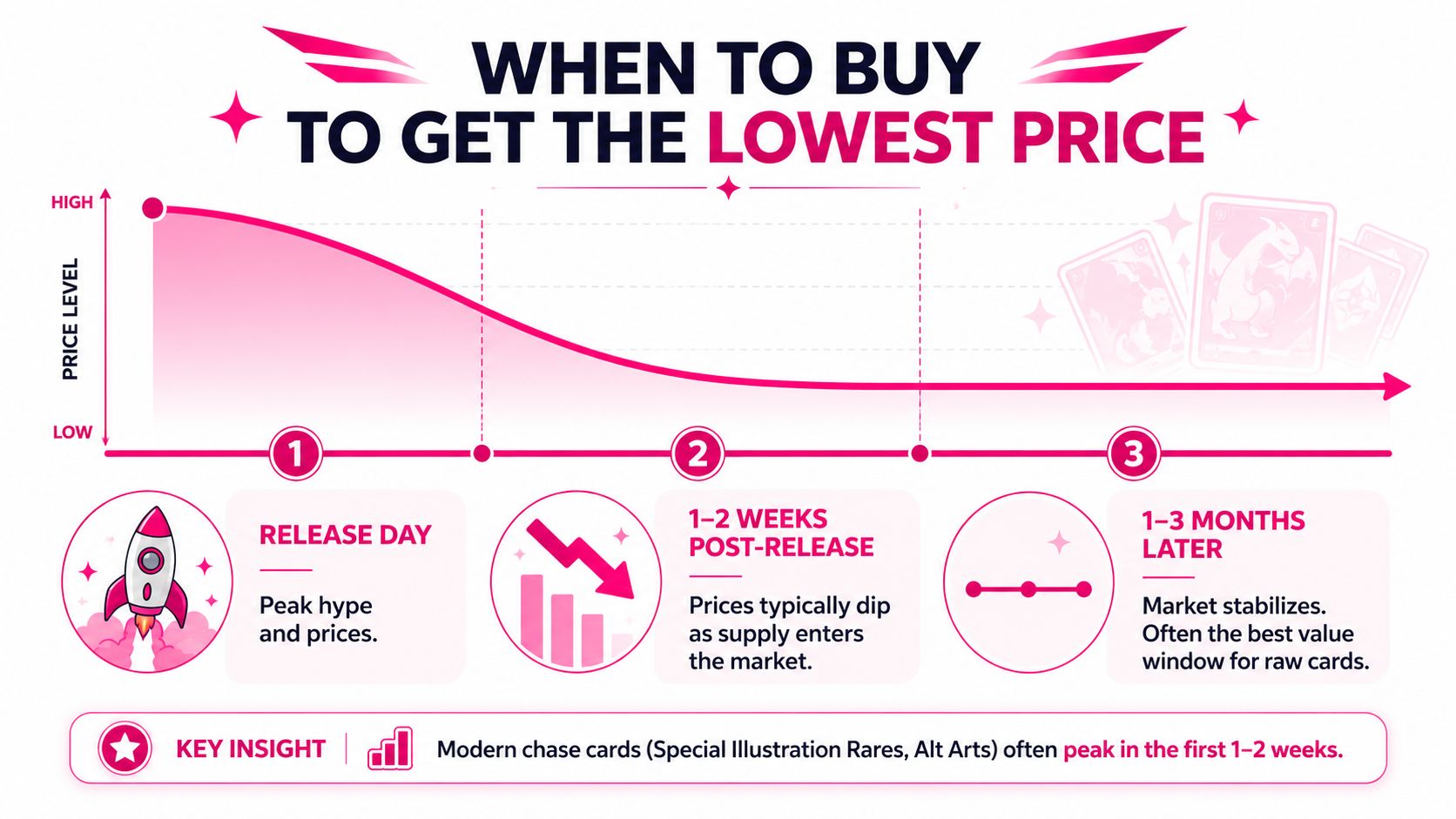
The best time to buy a modern chase card is not launch day. It is 6 to 8 weeks later, when the hype fades and supply floods in. Early release prices are driven by hype and thin inventory, then they cool once more copies hit the market. A YouTube investing guide points out that modern Special Illustration Rares and Alt Arts often peak right after release and then drop hard as supply opens up.
The timing rule that saves the most
Check the card at launch if you want. Do not buy it at launch unless you have a very specific reason. Revisit the price in 6 to 8 weeks, after the first wave of demand has cooled and the launch markup has had time to break.
That window matters because sellers still test the market early, while buyers are still chasing the newest pull. Once the rush passes, prices usually stop reflecting pure excitement and start reflecting actual sold data. That is the number you should trust.
A buying guide also recommends waiting a few months after set release before buying singles, because release-week pricing is usually inflated. That advice lines up with what serious collectors already know, if you are watching sold listings instead of asking prices.
For example, a Charizard ex Special Art Rare from Obsidian Flames can spike hard during the first wave of demand, then settle much lower once supply catches up. Waiting turns a bad buy into a normal one, and the savings are real.
When early buying still makes sense
Buy early only when supply is likely to stay tight for a clear reason. That includes promo-driven cards, allocation-limited releases, or cards you need immediately because the window matters more than the savings. In those cases, waiting can cost you the card itself, not just a better price.
For everything else, early buyers pay for excitement. Later buyers pay closer to what the market clears at.
Inspecting Condition So You Know What You Are Buying
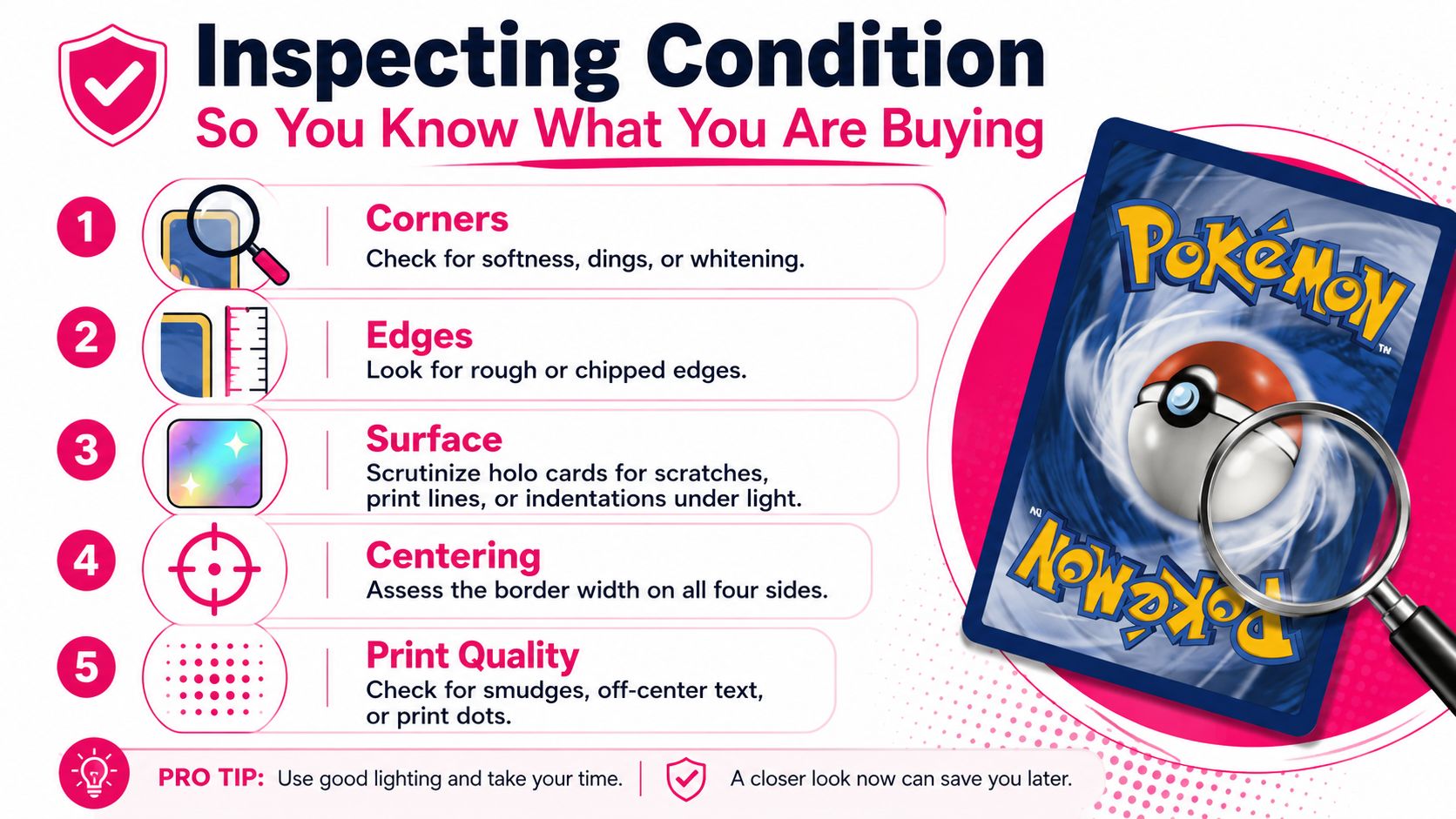
A glossy holo can hide whitening on the edges. A single scratch on the surface can drop a card from PSA 10 to PSA 9 and cut its value in half. Start with the card in your hand, not the seller’s headline. Check edges, corners, holographic scratches, centering, and surface before you pay, because condition and authenticity drive what a Pokémon card is worth. The Ozzie Collectables buying guide also points buyers toward careful inspection before purchase.
What to inspect on raw cards
- Corners: Check for softness, dings, and whitening.
- Edges: Look for rough spots or chipping.
- Surface: Put holo cards under bright light and look for scratches, print lines, and indentations.
- Centering: Compare border width on all four sides.
- Print quality: Watch for smudges, off-center text, and print dots.
Do that every time, because a raw card that looks clean in one photo can fall apart in person. When you inspect a raw Charizard VMAX, hold it under a bright light and sweep the card slowly so the holo surface catches every scratch. One scratch can push a card from PSA 10 to PSA 9, and the value drop is enough to wipe out the margin on a bad buy. If you are buying remotely, make the seller show the card under light and from multiple angles. If they refuse, assume they are hiding something.
Understand what grading changes
Graded cards are commonly evaluated on a 1–10 scale, with 10 representing mint condition and usually bringing the strongest premium. That premium makes sense only when the card is strong enough to justify the submission costs and the risk of getting a lower grade. For example, a PSA 10 Charizard VMAX from Shining Fates commands a 200% premium over a raw copy in near-mint condition, but the grading fee and shipping cost $50, so only grade if the raw card is worth at least $100.
A clean card is not automatically a grading candidate, and a rare card is not automatically worth submitting.
Use grading on cards with real upside, especially stronger modern chases or older holos in excellent shape. Skip it when fees and risk eat the gain. Compare graded and raw comps before you send anything off, and only submit cards that can clear the gap after costs.
Your First Purchase Checklist
Keep the first buy boring. That’s how you learn without donating money to somebody else’s margin. The goal isn’t to find the cheapest card on the internet, it’s to avoid the most common overpaying mistakes and protect yourself while you learn the market.
Use this exact order
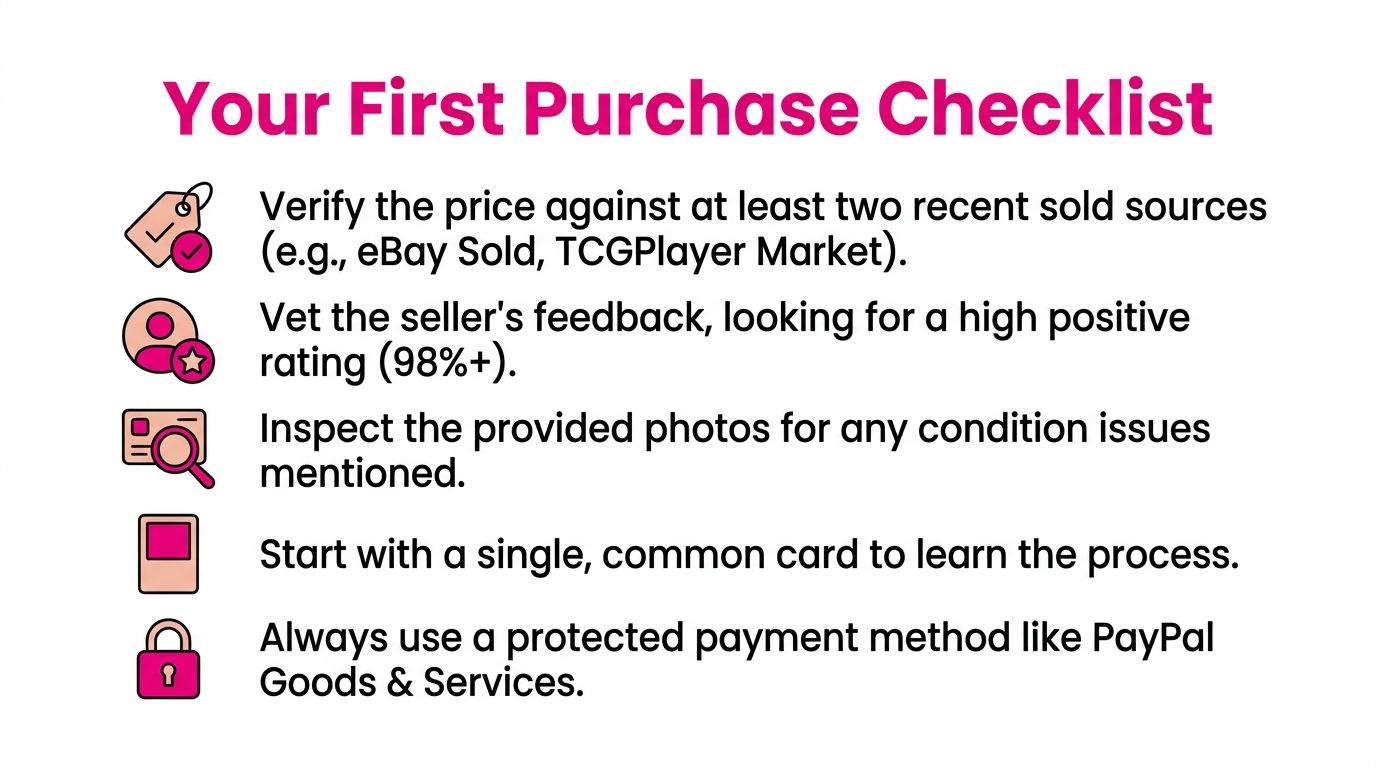
- Verify the price against at least two recent sold sources, such as eBay Sold and TCGPlayer market data.
- Vet the seller by checking feedback, sales history, and whether the listing uses real photos.
- Inspect the photos for visible condition issues before you pay.
- Start small with a single common card so you can learn the process without much risk.
- Use protected payment every time, especially on remote purchases.
That sequence keeps you from making the three expensive mistakes that hit most new buyers. You won’t overpay because you checked sold comps. You won’t get burned because you checked the seller. You won’t buy too early because you’ll wait for a saner price window.
When you follow that order, buying cards stops feeling like gambling and starts looking like a process.
If you want a place to compare cards, track the market, and make better buy decisions without juggling a dozen tabs, visit Double Holo. It’s built for collectors and sellers who want cleaner price discovery, buyer protection, and tools that make card purchases less guesswork and more discipline.