Misty’s Determination 80/108 sits around $0.27 as the regular print and $0.57 as the reverse holo. The Full Art #108/108 is a different market entirely, with a raw price of $37.76 and a PSA 10 value of $56.11.
Table of Contents
What Misty’s Determination 80/108 Is and Why the Print Matters
The first thing the market shows is a gap, not a mystery. Misty’s Determination 80/108 and the famous Full Art #108/108 share a name, but they do not trade the same way. One behaves like ordinary set stock. The other attracts grading attention and higher-end buyers.
Know the exact print before you price it
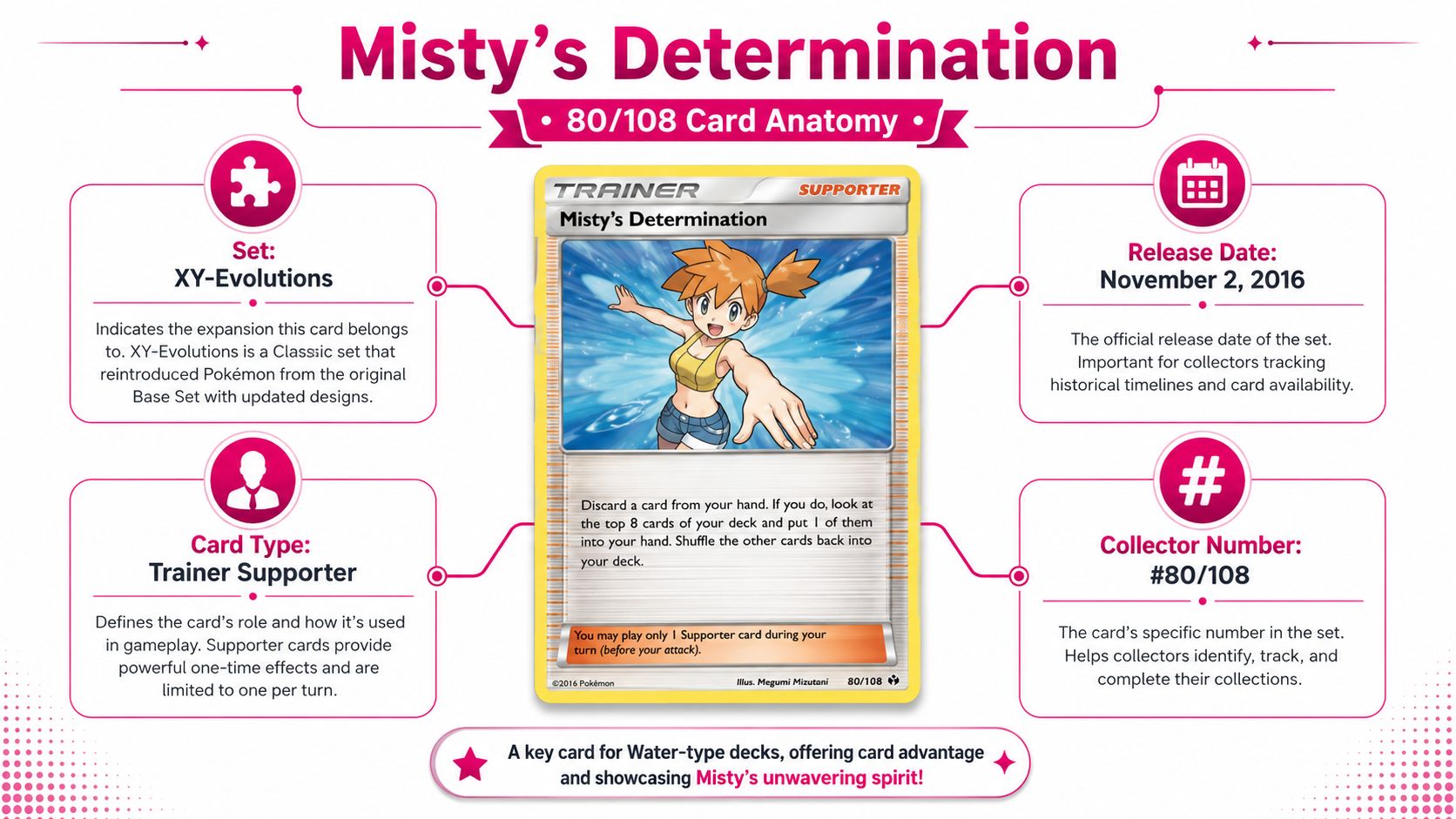
Misty’s Determination #80/108 is a Trainer Supporter from XY-Evolutions, released on November 2, 2016, illustrated by Ken Sugimori, and listed as an Uncommon in set indexes, according to the set record at Ripdex. Those details matter because collectors usually start with the name, while the market prices the exact printing.
The card also sits inside a broader XY Evolutions set spotlight context where minor print differences change demand more than the effect text does. The ordinary #80/108 is the version most buyers treat as a low-value pull, while the Full Art #108/108 is the copy that carries the stronger grading profile and the higher sale ceiling. If you confuse the two, your pricing model breaks immediately.
The easiest way to avoid the common mistake
Check the collector number first, then the finish, then the set symbol. If the card says 80/108, it is the standard Supporter. If it says 108/108, it is the higher-value full-art slot.
Practical rule: the collector number tells you more than the card name here, because the name alone hides the price gap.
That is why search traffic around Misty’s Determination 80/108 stays messy. Buyers type one name, but they may be looking at a different printing, and the market treats those as separate products. The useful habit is simple, identify the number first, then decide whether the card is binder filler, playable bulk, or a grading candidate.
How the Card Works in the XY Evolutions Era
Misty’s Determination isn’t flashy, and that’s exactly why it’s useful to analyze. It trades raw card count for selection, which makes it a timing card rather than a brute-force draw card.
What the Supporter actually does
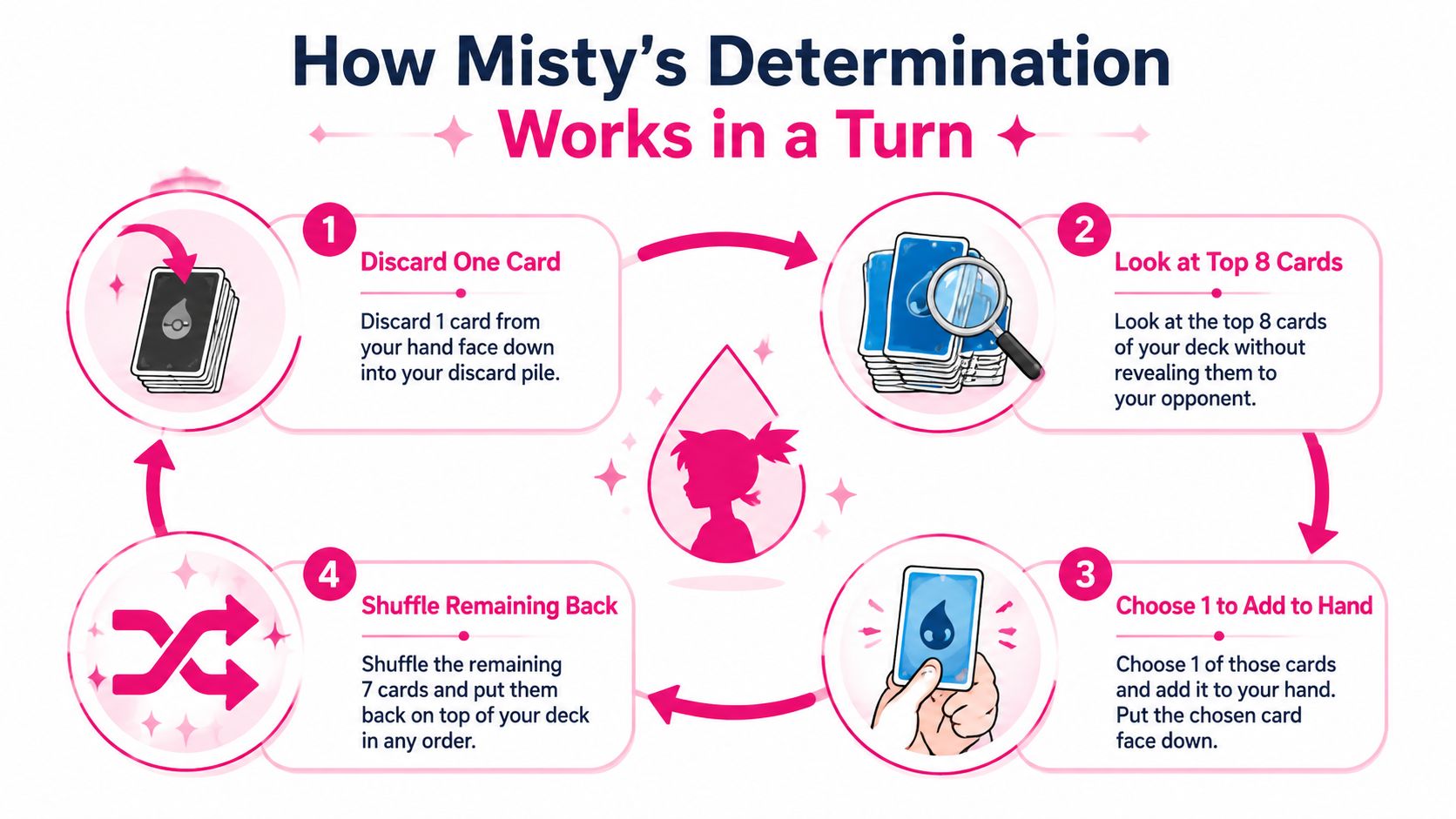
The card is a Trainer-Supporter whose effect is to discard 1 card, look at the top 8 cards of your deck, and put 1 into your hand, all under the one-Supporter-per-turn rule. That means it doesn’t function like a simple draw spell. It functions like a controlled dig effect with a built-in discard.
That discard isn’t always a cost in deck-building terms. If your list wants specific cards in the discard pile, the opening cost can be useful instead of awkward. The eight-card look is also deep enough to find combo pieces more reliably than shallow single-card draw effects, but only if your list is built to convert that access into a strong next turn.
Why tempo matters more than card count
A card like this is strongest when the fetched card changes your next action, not when it replaces itself. If you discard a dead card and pick up a piece that lets you attack, evolve, or recover, the Supporter has done real work. If you spend your Supporter on a card that doesn’t improve the board, you’ve used your turn for very little.
The cleanest way to think about it is this, Misty’s Determination is a selection tool, not a volume tool.
That distinction matters in casual play too. In a loose deck, the card can feel smooth because it digs eight deep. In a tight competitive list, the same effect is only as good as the density of useful hits. A Supporter that looks modest on paper can still be the right call when your deck wants exact pieces at exact times.
Regular vs Reverse Holo vs Full Art 108/108
The pricing ladder is where misty’s determination 80 108 becomes easy to misread. The regular copy is bulk. The reverse holo carries a small premium. The Full Art version is the primary collectible.
| Raw Price | PSA 10 Price | Liquidity | |
|---|---|---|---|
| Regular #80/108 | About $0.34 | Not typically the focus at this tier | High, bulk-style |
| Reverse Holo #80/108 | About $0.57 | Not typically the focus at this tier | High, slight premium |
| Full Art #108/108 | $37.76 raw | $56.11 PSA 10 | Lower, collector-driven |
The regular and reverse holo prices come from the market data in Double Holo’s pricing, while the full-art graded price ladder is the part that changes the conversation. The spread between raw and graded value is where condition starts to matter more than card text.
Why the reverse holo is the quiet middle tier
The reverse holo usually trades at a modest premium over the normal print because it is scarcer in presentation, not because it changes the card’s role. That makes it a binder upgrade, not a speculative target. If you’re sorting a stack and you want the nicer finish for display, the reverse holo is the version most keep.
Reading the Recent Market Movement
The regular print has not been frozen in place. Even a sub-dollar Supporter can move when supply tightens or casual demand changes.
What the 90-day numbers say
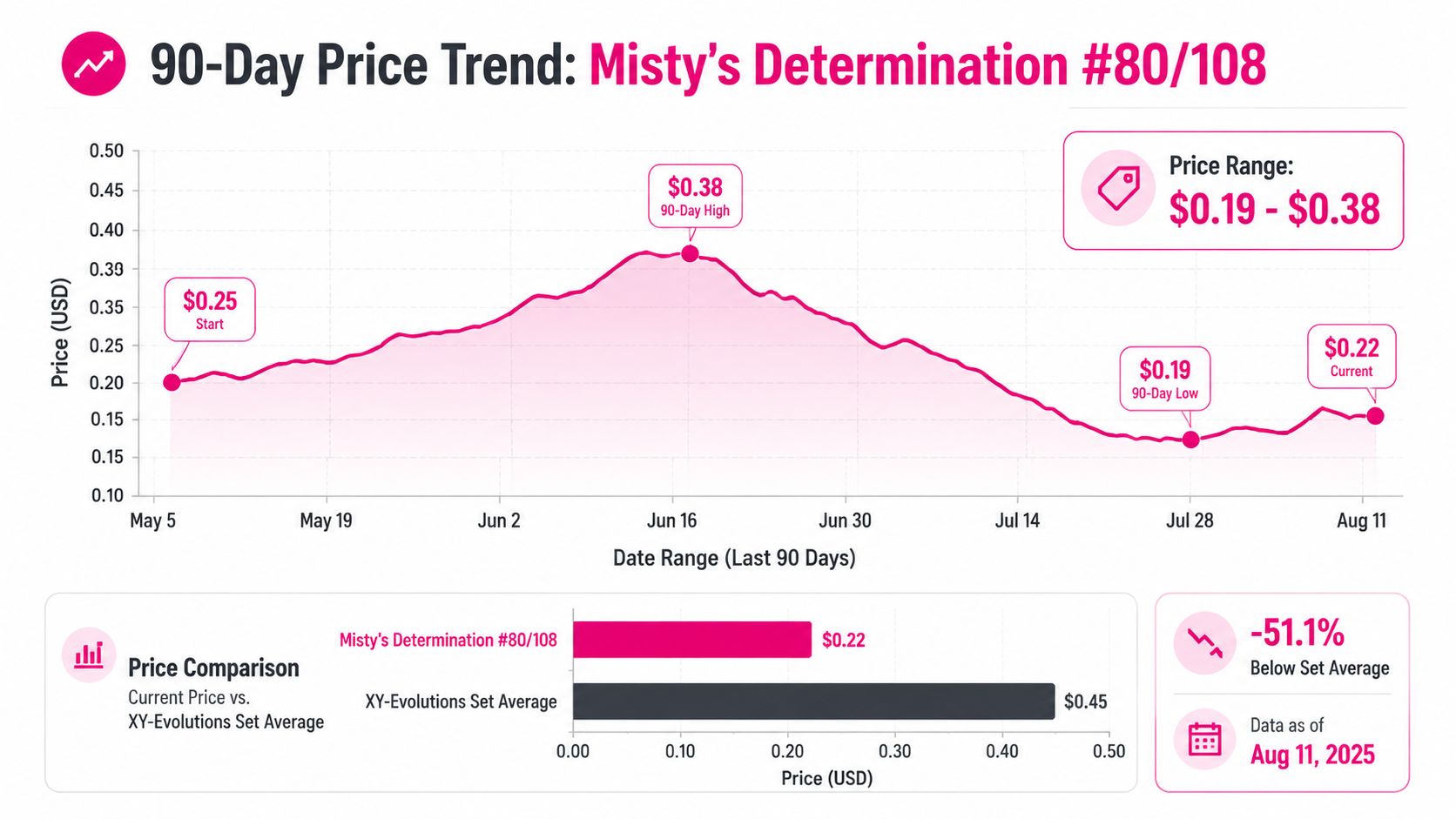
Double Holo records a 90-day price range of $0.12 to $0.32 for the regular #80/108, a 50% increase over the last 30 days, and 90-day volatility of 19.1%. Those are small absolute prices, but they still matter if you are buying multiples or trying to clear low-end inventory without giving up margin.
The movement is easy to miss if you only follow chase cards. A card like this can tighten when binders absorb copies, when bulk boxes stop circulating them, or when attention shifts toward a reprint-era set that collectors have ignored for a while.
What that movement means in practice
One copy is mostly a reference point. A stack changes the math, because every small move hits the full position at once. Low-dollar cards become difficult to manage at that point, since the spread is thin and can disappear quickly.
That is where opportunity cost in Pokémon grading matters. A cheap card can look active on paper and still be a poor use of grading budget, storage space, or time.
Collector logic: when a cheap card shows real movement, the question is not whether it is “investable,” it is whether the spread is large enough to justify the effort.
For casual collectors, patience is usually the right call. For traders, discipline matters more. The card remains bulk in most contexts, but the recent price action shows that bulk does not always sit still.
Grading the Card and When It Actually Pays
The grading question splits cleanly between the standard print and the full art. One is usually not worth the submission cost. The other can be.
When the standard print stays in the binder
For the regular #80/108, the ungraded baseline is too low for most grading workflows to make sense. Price sensitivity dominates. Unless a copy is unusually clean, the economics lean toward keeping it raw, storing it well, and moving on.
That’s the core decision rule for a card like this. The card text doesn’t create the value. The condition spread does, and only at the higher print level. If you’re looking at a standard copy, submit only if the card is exceptionally centered, clean, and likely to score extremely well.
Why the Full Art is the grading target
The higher-value full-art print is the one that justifies serious grading math. On the pricing ladder summarized by Double Holo, the card rises from $1.39 ungraded to $10.76 in PSA 9, $12.00 in PSA 9.5, and $56.11 in PSA 10, with BGS 10 examples around $73. That is a clear premium structure, not a marginal bump.
The same source also notes that a PSA 10 is worth 572% more than raw. That is the kind of spread that makes grading worth evaluating, but only for strong copies. Middling full arts don’t create enough upside to absorb fees, shipping, and turnaround risk.
A simple submission test
Ask three questions before you grade:
-
Is it the full-art #108/108, not the standard #80/108?
-
Does the card look like a top-grade candidate from the front and back?
-
Would I still want it graded if the result came back one grade lower than expected?
If the answer to any of those is no, the safer move is usually to keep it raw. For the standard print, that answer is even easier. It’s a deck card or a bulk card, not a grading project.
What Collectors Actually Do With the Card
Most collectors don’t treat every Misty printing the same way, because the use cases aren’t the same. One copy goes into a master set binder, one gets tossed into playable extras, and one becomes a grading target.
The three real buyer profiles
The first buyer is building XY Evolutions and wants the numbered slot filled correctly. That buyer cares about whether the card is #80/108 or #108/108, not just whether it says Misty’s Determination. The second buyer wants a playable Supporter for casual use and will usually accept the regular print because the effect is identical.
The third buyer is hunting the full art. That person cares about condition, not just ownership. The full-art card is the version that can justify slabbed storage, while the standard print usually can’t.
How to identify each version in hand
The easiest sorting cue is the finish. The standard copy is plain and inexpensive, while the reverse holo catches light differently and usually sits a little above the normal print in value. The full art is the one that immediately looks like the premium product.
If you find a copy in a stack, the back of the card should be checked for edge wear before you decide whether it stays raw. With a cheap Supporter, tiny flaws usually don’t matter. With the full art, they do.
If you’re unsure, assume the card is the cheaper version until the collector number and finish prove otherwise.
That mindset saves time and avoids overpricing errors. It also keeps binder decisions honest, because the market is already telling you which printing deserves attention.
Tracking the Card and Making Smart Decisions Going Forward
For Misty’s Determination #80/108, the right process starts with the collector number and ends with condition. That order matters because the card’s market behavior is driven more by printing tier and surface quality than by the Supporter text itself. Most copies are straightforward binder cards, while cleaner copies, especially the premium version, deserve a closer grading decision.
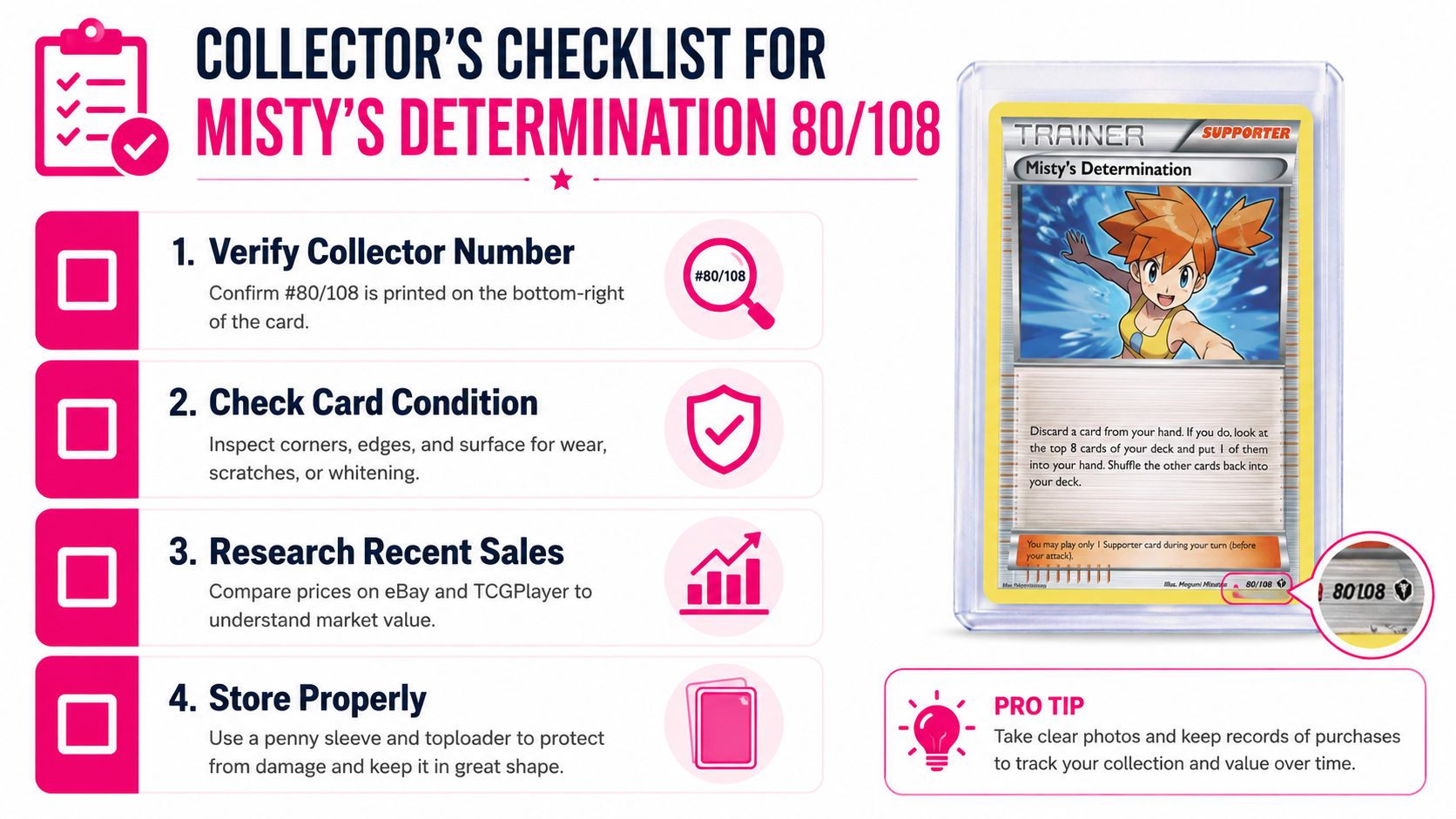
A practical checklist for the next copy you see
-
Verify the collector number first: If it says #80/108, you are looking at the standard print. If it says #108/108, treat it as the premium full-art version.
-
Inspect condition before pricing: Corners, edges, and surface defects matter more than the card text suggests, especially on the full-art copy.
-
Compare the finish, not just the name: The reverse holo is a modest step up, while the full art is the version that can justify grading.
-
Store it according to its value: A penny sleeve and top-loader are enough for most copies, provided the card stays flat and protected.
For live tracking, the useful habit is checking recent sales before you trade or list. A card like this can sit in bulk for long stretches, then move enough to matter once you are handling several copies at once. If you want a tighter read on those changes, use a pokemon card price tracker instead of relying on a single old listing. The goal is not to chase every small change. It is to avoid treating a low-headline card as fixed when the market still prices the better examples differently.
If you are sorting an XY Evolutions binder, keep the regular copy when you need the slot filled and the reverse holo when you want the cleaner presentation. Hold the full art to a higher standard, and only grade the copies that show strong centering, clean edges, and a surface worth submitting. That separates a binder filler from a card that can justify grading costs. It also keeps the decision tied to market reality, not just the name on the front.
For collectors who want a quick visual check before they buy or store a copy, this collector checklist infographic is a practical reference, and Double Holo remains the place to compare what is worth keeping, what is worth grading, and what is still bulk.
