

You’re staring at a booster box listing right now, and the decision feels simple until the small print starts to matter. The set is either live, scarce, or already drifting into the secondary market, and each path changes what “good price” means. For sealed Pokémon product, the best place to buy Pokémon booster boxes depends less on brand loyalty and more on supply condition, authenticity risk, and how much buyer protection you need.
| Buying channel | Best when | Main trade-off |
|---|---|---|
| Pokémon Center / official retail | A current set is in stock | Stock limits and geography |
| Authorized retailers | You want trusted retail access | Prices may not be the lowest |
| Verified marketplace sellers | A set is harder to find | More work to verify seller quality |
| Established card shops | You want hobby-store support | Inventory can be inconsistent |
| eBay, highly rated sellers only | You need older or out-of-print stock | Scam risk and return disputes |
The official path is the cleanest starting point, but it’s not always the cheapest or even available. The job is choosing the right channel for the set you want, then checking whether the price still makes sense once fees, condition risk, and seller trust are factored in.
Table of Contents
The Hierarchy of Buying Pokemon Booster Boxes
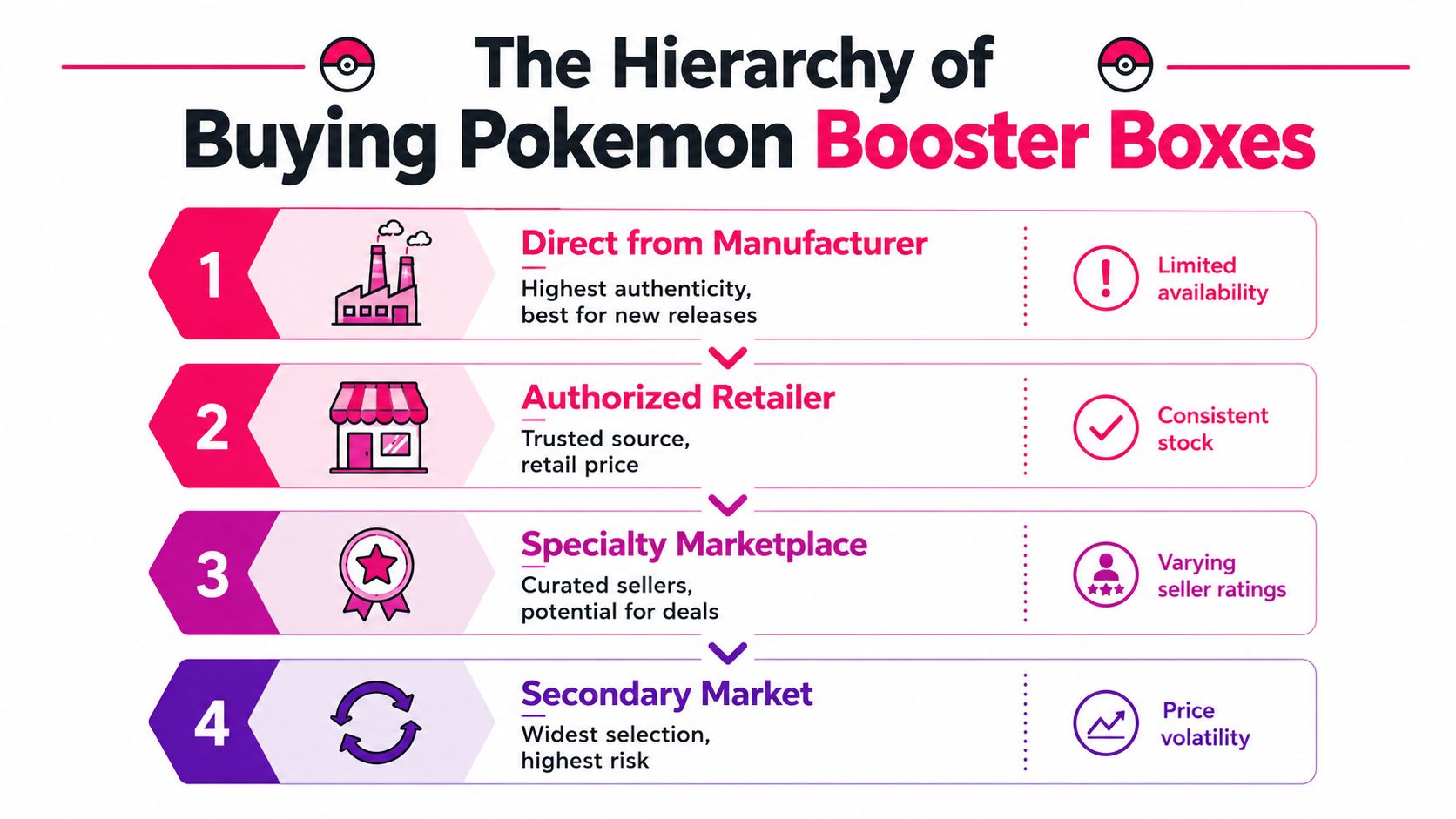
A collector asking for a single “best place” usually ends up with the wrong answer. The right source depends on whether the set is still in print, how much protection you want from seller risk, and how much premium you are willing to pay to avoid a bad box.
Start with print status, not store loyalty
If the set is in print, direct retail usually gives the cleanest mix of authenticity and entry price. That is where official channels matter most, because they reduce markup and remove a lot of uncertainty around sealed condition. Once a set is out of print, the question changes. The job becomes finding supply, not just finding a storefront.
That is why the same seller can be the right answer one month and a poor fit the next. Current releases are a retail problem. Out-of-print boxes become a sourcing problem.
Practical rule: buy current sets as close to official retail as possible, then move outward only when stock is gone or the set has clearly shifted into collector territory.
Think in tiers, not favorites
Pokémon Center is the safest source when it has stock because it buys directly from The Pokémon Company and sells at MSRP. That does not make it the cheapest option in every case, but it does make it the cleanest authenticity-first option. Once official stock dries up, trusted shops and verified marketplace sellers become useful because they fill the gap without forcing you straight into the riskiest end of the market.
The practical hierarchy is straightforward. Direct retail comes first for active sets. Trusted secondary sellers matter most once the set leaves normal circulation. If you treat those as different buying jobs, you stop paying extra for convenience and you avoid chasing “cheap” listings that hide fees, weak return terms, or scam risk.
Buying Direct From Official Sources
A direct buy works best when the box is still in normal circulation and the main priority is authenticity and unopened condition. The official Pokémon TCG “Where to buy” page points buyers toward Pokémon Center and retailer or store directories, which gives collectors a clean way to verify authorized channels before they rely on a marketplace (official where-to-buy page). That matters because sealed booster boxes carry value through the channel itself, not just the cardboard in the box.
Why official sources build trust
Pokémon Center is widely treated as the safest place for current sealed product because it sells at MSRP and buys directly from The Pokémon Company. For a collector who wants a current release with minimal authenticity doubt, that is a meaningful advantage. It also removes a lot of the guesswork around seller photos, relisted inventory, and whether the box has been handled by multiple middlemen.
Availability is the trade-off. Community guidance notes that Pokémon Center access is limited to the US, Japan, Canada, and the UK (collector discussion on where to buy booster boxes). That limited reach is one reason no single official storefront works for everyone, even if the trust profile is excellent.
Where official sources stop being efficient
For collectors focused on value, MSRP is not always the number that matters most. The same collector discussion shows that booster-box pricing in the hobby is often discussed around the $100ish level rather than as a default MSRP buy, which explains why official retail can feel expensive once the broader market softens (collector discussion on where to buy booster boxes). If stock is easy to find elsewhere and the spread is wide, a direct purchase can prioritize convenience over value.
A direct buy still has a place. Use official sources when stock is live, the set is current, and the buyer protection is worth more to you than chasing a lower price. For a useful comparison of how official retail fits against marketplace buying, see the TCGPlayer vs eBay vs Double Holo breakdown. Shop elsewhere once the box has moved out of normal retail circulation and the market has already priced in scarcity.
Navigating TCGPlayer, eBay, and Amazon
Secondary marketplaces each solve a different buying problem, and they each add different costs through fees, seller quality, and dispute handling. TCGPlayer fits hobby buyers who want a card-focused marketplace. eBay gives access to broader inventory, especially when a set is older or harder to find. Amazon can be convenient, but the convenience can hide weak listing control. If you are serious about sealed booster boxes, you need to judge seller trust mechanics, not just whether the product is available.
The collector problem here is straightforward. Buyers keep asking where to buy, but the harder job is avoiding fake, resealed, or risky inventory online. Community advice keeps pointing back to the same practical filter, use marketplaces like TCGPlayer and eBay only when you are comfortable checking seller history, and treat Amazon with more caution for sealed product (community discussion on buying booster boxes).
TCGPlayer and eBay reward attention, not laziness
TCGPlayer is a dedicated card marketplace, so the buyer starts inside a hobby-specific environment. That helps, but it does not remove the need to inspect seller profiles, listing language, and sealed-condition wording. eBay is broader and often better for older inventory, but the buyer has to work harder to separate a legitimate sealed listing from a risky one.
The safest pattern on either platform is plain. Use sellers with strong histories, clear sealed-box photos, and straightforward return terms. If the listing copy looks thin or the box photos are generic, move on. Marketplace fees and seller protections matter too, because the final price is not just the sticker price. For a practical side-by-side look at those trade-offs, see the TCGPlayer vs eBay vs Double Holo breakdown.
Amazon is the least forgiving of the three
Amazon can be convenient, but convenience is not the same as sealed-product confidence. For booster boxes, the main issue is that the listing environment can make condition verification harder than it should be. Community advice is blunt on this point, Amazon can be problematic, and that is enough reason to treat it as a last-mile convenience source rather than a default collector channel.
A clean rule works here.
-
Use TCGPlayer when you want a hobby-specific marketplace and can verify the seller.
-
Use eBay when you need broader inventory and can handle more scam filtering.
-
Use Amazon only when you have confirmed the exact seller and trust the listing enough to accept the downside.
How to Verify Sealed Product Authenticity
Buying from the right place matters, but sealed-product verification matters just as much. A legitimate storefront can still host a sloppy listing, and a strong marketplace seller can still use weak photos. The easiest way to lose money is to assume that “sealed” means “safe.”
Independent collector guidance keeps coming back to the same mechanics, check seller ratings and reviews, confirm the listing is for a sealed original box, and use alerts to catch deals or restocks. That advice is basic, but the value is in how you apply it.
Read the listing like a seller would
A good sealed-box listing should answer three questions fast. What exact product is this? Is it still sealed as issued? Who is standing behind the sale? If any of those answers are vague, you’re taking on more risk than you need.
That’s why I look for item-specific wording rather than generic “Japanese Pokémon box” language. The box name, language version, and condition notes should be visible without guessing. If the seller can’t describe the product precisely, they probably can’t support a dispute precisely either.
A high-value sealed box isn’t a mystery item. If the listing forces you to guess, the seller is shifting risk onto you.
Treat seller trust as a measurable filter
For sealed products, a strong profile is more than a high star rating. You want consistent feedback, a history that matches the kind of product being sold, and a return path that doesn’t look hostile. That’s especially important on eBay and other marketplaces where the platform may be decent but the individual seller can still be the problem.
I’d also check photo quality before I check price. Clear edges, intact seals, consistent shrink, and box corners shown from multiple angles tell you more than a cheap headline. If the product is older, compare the seller’s wording against the box itself instead of trusting category labels alone.
For a broader product-browse and verification workflow, the internal checklist in this booster-boxes-for-sale resource is the kind of page buyers should use before they click buy.
Understanding Market Value and Return Rates
A box price only tells you what it costs to enter. It does not tell you whether the set still has enough demand behind it to justify that entry, and that balance shifts with print status, collector interest, and the point in the market cycle. In sealed Pokémon, the lowest sticker price can still be the weaker buy if the set is cooling or if supply is already moving past the easy money phase.
Price-tracker data for Japanese booster boxes makes that trade-off visible. One box showed an EV of $90.03 against a box price of $134.29, which implies a return rate of 67.04%. Another came in at EV $57.10 against box price $112.93, or 50.56%. The same tracker also lists return profiles of 47.08%, 61.03%, and 41.94%, which makes the point plain, box value can vary sharply by set and pricing environment.
Price and value don’t move together
A set can look expensive at retail and still be the stronger buy if demand stays firm after release. A different set can look affordable and still disappoint once you open it or try to resell it. Experienced buyers focus on value capture, not just the checkout total.
The historical example in the tracker shows that clearly. Evolving Skies booster boxes were bought at retail for $130 to $145 and later sold for about $2,500 to $2,700 by early 2026, which shows how release timing can overwhelm the starting price. The key takeaway is that the strongest entry point is often early, while the set is still a retail object.
The market changes the buying channel
Fresh sets usually reward direct retail or a trusted shop with minimal markup. Once a set starts tightening up, the secondary market can become the only practical source of inventory, even if the listed price is higher. That shift is why a one-store answer does not hold up.
Serious buyers treat the market as a ladder. Start at official retail while a set is current. Move to trusted shops and verified sellers when stock tightens. Use the secondary market when scarcity, not convenience, is setting the price. That is where comparison tools matter, including the Double Holo marketplace, because they help separate active pricing from wishful listing.
Why Double Holo Is the Smart Collector’s Choice
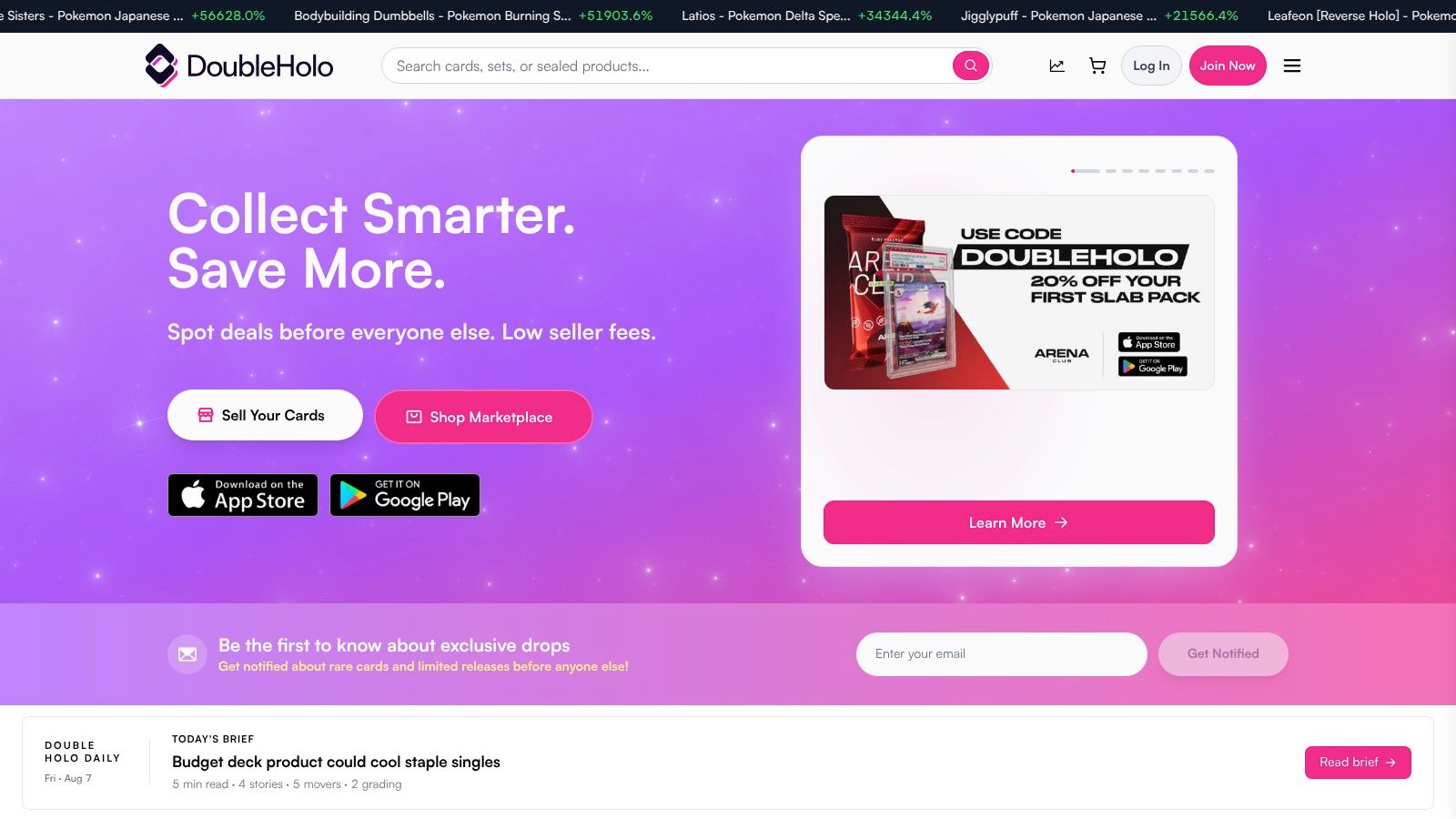
If you’re comparing channels, the problem isn’t just where to buy. It’s how to avoid overpaying, buying the wrong box, or trusting a listing that looks better than it is. Double Holo operates as a live marketplace plus a market intelligence layer, so collectors can compare sealed product, raw cards, and multilingual releases with more context than a flat listings page gives them.
Fees and pricing matter before you click buy
The platform states a 4.9% seller fee, reduced to 4.7% on premium, compared with eBay at 12.9% and TCGPlayer at 10.75%. That fee spread matters for sealed product because margin disappears quickly once marketplace costs stack on top of shipping and payment friction. Lower fees don’t make a box cheaper by magic, but they do make resale and buy-side comparison less distorted (Double Holo pricing and platform overview).
The more useful part is the market structure. A live bid/ask marketplace gives buyers a clearer sense of what inventory is clearing for, instead of relying only on static listings. That helps when you’re trying to decide whether a booster box is fairly priced or just listed aggressively.
Use tools when a box is more than a box
Double Holo also packages market intelligence around buy, sell, or grade decisions, which is useful when sealed product is part of a wider collection strategy. For serious collectors, that matters because the purchase isn’t just a one-off transaction, it’s part of a bigger buying rhythm.
If your goal is to buy smarter, not just buy faster, you need a view of the market that shows more than a shelf price.
For sealed-product buyers, that means better context before you commit. For sellers, it means less guesswork about where a box sits in the current market. For collectors tracking Japanese releases, it means one place to compare options without treating every listing as equal.
Final Decision Framework for Buying Booster Boxes
Use the decision tree, not the hype. If the set is current and in stock, start with Pokémon Center or another authorized retail path, because that’s where authenticity risk is lowest and pricing is closest to official retail. If the set is current but sold out, move to reputable card shops and verified marketplace sellers, then check seller history and sealed-condition photos before paying.
If the box is out of print, stop searching for a perfect retail answer. You’re in the secondary market now, so the job becomes finding the cleanest seller, the clearest condition, and the lowest total landed cost. That’s where highly rated eBay sellers, trusted hobby stores, and strong marketplace protection start to matter more than a theoretical MSRP.
For collectors chasing older, rarer, or higher-volatility boxes, market data matters before checkout. Compare the current box price against the likely value environment, then decide whether the spread is worth the risk. A box that looks cheap can still be a bad buy if the market has already priced in the downside.
If you want the shortest version, use this rule. New set, buy direct. Sold-out set, buy from trusted secondary sellers. Out-of-print set, verify the seller twice and compare landed cost before you commit.
If you’re trying to buy booster boxes with less guesswork, use Double Holo to compare live market context before you commit to a listing. Visit Double Holo to check the marketplace, review pricing signals, and make sharper decisions on sealed Pokémon product.