

You can find a booster box listing in minutes, but buying the right one can still feel messy. One tab shows a deal that looks cheap, another shows the same set at a much higher price, and a third seller has perfect photos but a return policy that disappears when you zoom in. That’s the current state of booster boxes for sale, especially if you’re chasing sealed product you might later resell, hold, or grade.
The sealed market has moved past simple shelf inventory. Booster boxes are now tracked with live market prices, release dates, and ROI data, and that changes how serious buyers should think about them. The cheapest box isn’t always the safest buy, and the safest buy isn’t always the one with the lowest sticker price.
Table of Contents
Why Buying Booster Boxes Is More Complex Than It Looks
A collector starts with a simple search for a set like Evolving Skies or Journey Together. The first listing looks like a bargain, the second is slightly higher, and the third comes from a seller with strong feedback but a weaker return policy. By the time shipping, tax, seller fees, and platform trust enter the picture, the cheap option usually stops looking cheap.
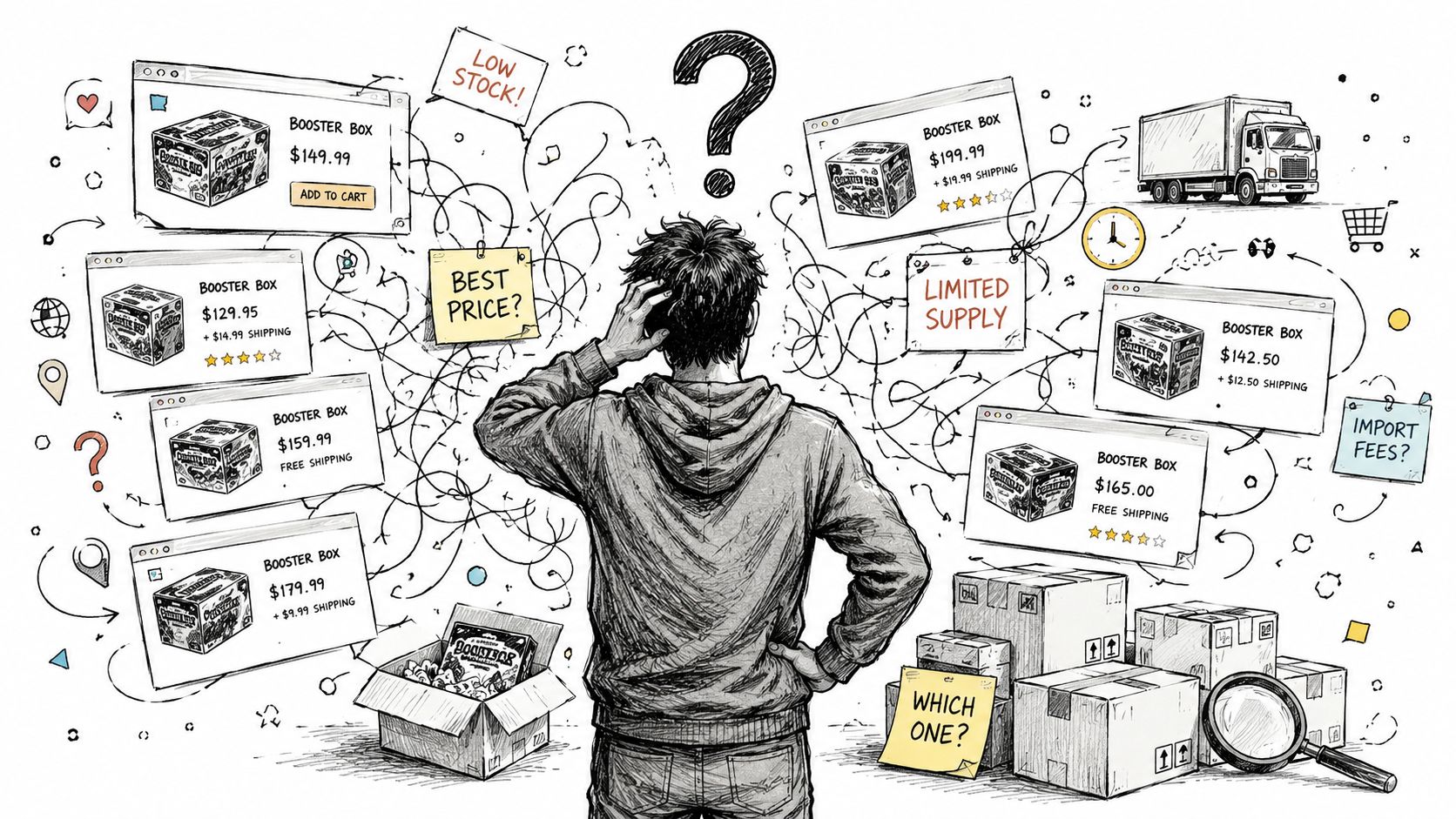
The sealed market now behaves more like a priced asset class than a casual hobby shelf. A live market list shows current booster box pricing across eras, including Mega Evolution at $212.16 and $280.52, Phantasmal Flames at $394.95, Perfect Order at $202.51, and Destined Rivals at $547.54 Double Holo’s pricing. That same database shows meaningful month-to-month moves, with Phantasmal Flames up 11.79% over 30 days while Mega Evolution down 13.79% in the same period.
Why the obvious bargain can be the wrong box
A low sticker price can hide a messy exit later. If a box has shaky provenance, sealed buyers may question it when you try to resell, and that friction shows up in lower offers, slower sales, or requests for extra proof. Clear chain of custody, solid photos, and a seller history that makes sense matter more in sealed product than many buyers expect.
I treat every listing as a mix of product and market risk. The box itself is only part of the purchase, because you are also buying future resale flexibility, fewer questions from buyers, and a lower chance of getting stuck with a listing nobody trusts. If a deal saves a little money but creates doubt, the savings can disappear fast.
Practical rule: If a listing feels cheap because the seller is vague, the box may be priced correctly for the risk, not for the product.
For a broader primer on evaluating cards and sealed product together, see this guide to buying Pokémon cards.
The True Cost of Buying a Booster Box
Sticker price is only the first line in the spreadsheet. The actual ownership cost includes shipping, tax, platform fees, the cost of a return if the seller is difficult, and the resale penalty if the market doesn’t trust where the box came from. Buyers who ignore those costs end up comparing listings that aren’t really comparable.
A useful example is the kind of pricing gap seen in live marketplaces. One buyer may spot a Journey Together box around $200 and assume the deal is obvious, but shipping, tax, and platform friction can quickly change the math. Even before you think about resale, the landed cost can look very different from the number on the listing page. That’s why serious buyers compare landed cost, not sticker price.
What landed cost really means
Landed cost is the full amount you’ll have tied up in the box. It includes the listing price, shipping, sales tax where applicable, and any platform-specific fees that affect your total spend. If the listing has no return protection or forces you to pay return shipping on a dispute, that risk belongs in the number too.
A slightly higher listing can still be the better purchase if it comes from a seller with stronger protections or lower overall friction. That’s especially true when the box is expensive enough that a bad experience becomes a serious capital lockup. A buyer trying to save a small amount upfront can easily spend more later to fix the mistake.
Practical rule: Buy the listing that gives you the best total exit, not just the lowest entry.
Many collectors miss the hidden cost of liquidity. A box bought from a random account with no history may be harder to unload later than a cleaner listing from a more established seller, even if both boxes are genuine. Resale buyers ask different questions than first-time buyers, and they often pay more for confidence.
If you want a broader framework for judging sealed product value before you click buy, this booster box value guide is a useful companion.
A simple buying filter
Before purchasing, run every listing through the same filter.
-
Base price: Start here, but don’t stop here.
-
Shipping and tax: Add both before you compare.
-
Return friction: If the seller makes returns painful, assign that risk real weight.
-
Future liquidity: Ask whether another buyer would trust the box later.
The point is not to overcomplicate the purchase. The point is to stop calling a box “cheap” until you’ve counted everything that comes with owning it.
Comparing Marketplaces for Sealed Product
Different marketplaces solve different parts of the buying problem. Some are built for volume, some for protection, and some for price discovery. If you shop sealed product long enough, you learn that the marketplace itself is part of the product.
| Marketplace | Seller Fee | Buyer Protection | Authenticity Verification | Resale Liquidity |
|---|---|---|---|---|
| eBay | Higher than specialist TCG platforms | Established buyer protection programs | Mostly seller-driven, platform checks vary by listing | High, because of traffic and broad buyer reach |
| TCGPlayer | Marketplace-based fee structure | Structured buyer support for many transactions | Seller reputation matters, verification is not uniform across all listings | Good for some sealed product, especially in the US |
| Cardmarket | Regional marketplace dynamics | Buyer protection depends on transaction type and seller history | Listing quality varies, so due diligence still matters | Strong in Europe, with solid regional price discovery |
| Specialized retailers | Built into retail operations | Often clearer policies and cleaner support | Usually better controlled inventory and direct handling | Good if the box is familiar and the brand is trusted |
| Double Holo | Standard 4.9% seller fee (4.7% on premium) + 2.9% and $0.50 processing Double Holo | Marketplace structure plus market tools | Live bid/ask marketplace with sealed product support Double Holo | Strong if the box needs transparent pricing and easier follow-on sale |
The important trade-off is simple. A platform with lower fees doesn’t always protect you better, and a platform with higher fees doesn’t automatically make the deal safer. Buyers should weigh protection, seller quality, and the ease of later resale as one decision, not three separate ones.
Where buyers usually get better outcomes
eBay gives access to broad inventory, which is why so many sealed product searches start there. That same scale also means you need to inspect each seller hard, because one listing can be clean while the next one is thin on details. TCGPlayer and Cardmarket often feel more specialized, which helps with comparison shopping, especially when you already know the set and want to benchmark the market.
Specialized retailers can be easier when you care more about condition control than bargain hunting. The inventory is usually less chaotic, and the purchase path can feel cleaner when the seller handles sealed product as a core business. That doesn’t make every listing perfect, but it does reduce some of the guesswork.
Good buying habit: use the platform that matches your risk tolerance, not the one that merely looks cheapest on the first screen.
The last category is where market intelligence starts to matter. A live marketplace paired with price tools lets you see whether a listing is underpriced or just stale. For anyone buying boxes to hold, trade, or resell, that visibility is often worth more than a slightly lower sticker price.
How to Authenticate Sealed Booster Boxes Before You Buy
A tempting listing is where mistakes happen. The photos look sharp, the seller sounds confident, and the description claims the box came from someone they trust. That is the point to slow down, because counterfeit and tampered sealed product often hides behind a good price and polished copy.
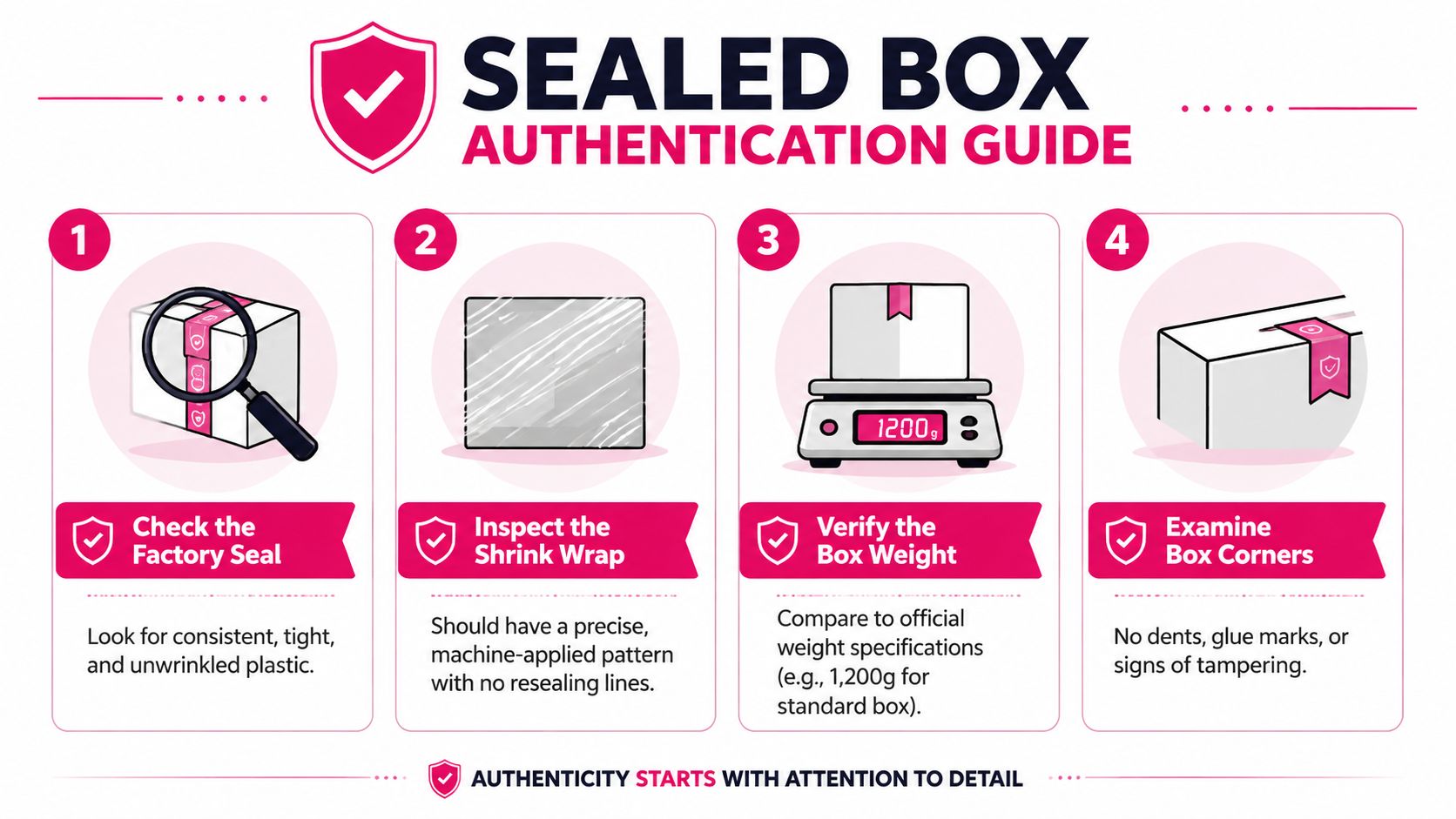
For Japanese standard boxes, the checks are physical and specific. Authentic factory-sealed units are typically sold as 30 packs of 5 cards each, and practical screening often starts with weight, since standard boxes usually sit around 350 to 400 g and High Class Pack boxes around 200 to 250 g. Any meaningful deviation deserves attention. English boxes use a different retail format, usually 36 booster packs per box, with each pack containing 10 cards plus 1 Basic Energy card and 1 code card.
What to inspect before money changes hands
Shrink wrap comes first. English boxes should show a T-shape protrusion in the wrap, along with the Pokémon Company logo and small air holes. If the folds look uneven, the seal looks reheated, or the wrap sits loosely in a way that doesn’t match a factory finish, walk away. Japanese boxes should also feel factory-tight, with clean heat seals and uniform wrap.
Weight is the next filter. Tampering often changes the expected range, and that matters whether the seller swapped packs, resealed the box, or altered the contents another way. A box that comes in too light can point to missing material, while an oddly heavy box can be stuffed or manipulated. Weight alone does not prove authenticity, but it is one of the fastest ways to screen a listing before you commit cash.
Seller photos matter more than polished listing text. Real photos show the exact box in hand, the corners, the wrap, the seal lines, and any dents or label issues a stock image will hide. Feedback history matters too, especially if the account has little or no record with sealed product. A seller who avoids clear photos or hedges on basic questions is raising your risk, not lowering it.
Here is the practical pre-purchase checklist:
-
Check seller photos: Real photos beat stock images every time.
-
Look at feedback history: Zero history on sealed product is a risk flag.
-
Inspect wrap details: Bad folds, missing logos, or weird seals are red flags.
-
Compare weight when possible: Big deviations deserve a hard pass.
-
Ask about returns: A seller who won’t stand behind the box is telling you something.
Practical rule: If the listing can’t survive basic scrutiny, don’t let the price talk you into being the tester.
For a closer look at older sealed product behavior and collector risk, see this vintage booster box guide.
Understanding Booster Box Market Volatility and Timing
A sealed box can sit for weeks, then move fast once supply tightens or buyers pile into the same set. If you are buying booster boxes for sale as more than a one-time flip, timing matters almost as much as authentication.
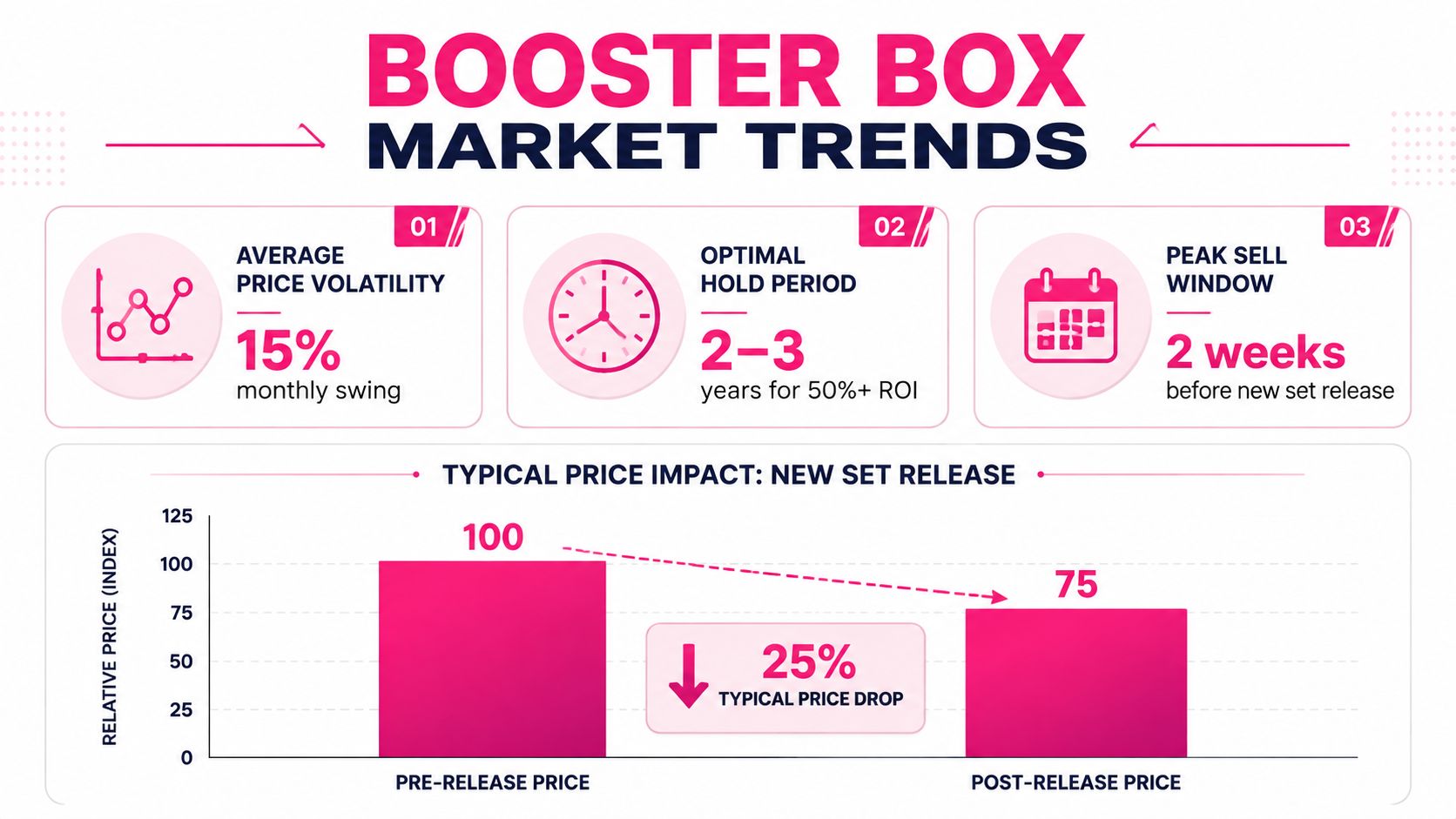
A live market database makes that volatility easy to see. Phantasmal Flames was up 11.79% over 30 days, while Mega Evolution was down 13.79% in the same period. The same source also tracks modern releases with current prices and release dates, which shows how differently new product can behave from older sealed boxes.
Why timing can change the buy
The long view matters too. Market commentary has documented how booster boxes moved from ordinary sealed product into scarce collectibles over time, with historical sales data traceable back to 2004 and older boxes often retracing 20% to 40% before the hobby treated sealed product as an investment vehicle Elite Fourum market discussion. More recent commentary said a basket of boxes that cost about $12,000 in October 2023 later reached about $23,440, and a broader basket rose to about $46,359 over the same general period Elite Fourum market discussion.
Public reports have also placed sealed vintage boxes in six-figure territory, including Japanese Base Set at $125,000 to $137,500, Expedition at $50,000 to $112,500, Skyridge at $90,000 to $212,500, and Neo Destiny at $60,000 Elite Fourum market discussion. Those figures do not mean every box is a strong buy. They show that sealed product now behaves like a collectible market with its own price memory, and that memory affects what a box is worth when you buy it and when you try to move it later.
The buy window that feels urgent is often the one that costs the most.
The practical takeaway is to separate urgency from structure. New releases are noisy, older sets often lack liquidity, and some boxes are easier to resell, which matters more than chasing the first price you see. If you can wait, price discovery usually settles enough to make the decision clearer.
Building a Smarter Booster Box Buying Strategy
A smarter strategy starts with three questions. What does the box really cost, who is selling it, and how easy will it be to move later if you change your mind? If you answer those in order, you avoid most of the usual mistakes.
The first move is to build a budget around landed cost, not list price. That means you set aside money for shipping, tax, and the possibility that a return or dispute could cost you time and money. Once that number is fixed, you can compare boxes across marketplaces without fooling yourself with a fake bargain.
The second move is to create a watchlist of sets you want, then track price and seller quality together. A box with good liquidity, cleaner provenance, and a stable marketplace history can be worth more than a flash discount from an account you don’t trust. The best buy is usually the one another collector will also want later.
What a repeatable process looks like
-
Set a ceiling price: Decide what you’ll pay after shipping and tax.
-
Shortlist trusted sellers: Favor clearer photos, better history, and stronger return terms.
-
Document the box: Save listing pages, photos, and order confirmations.
-
Track resale demand: Ask whether the same box would be easy to explain to another buyer.
-
Skip suspicious bargains: If the discount comes with vagueness, it’s probably not a bargain.
For collectors and vendors who want market access and pricing tools in the same place, Double Holo combines a live marketplace with sealed-product trading and market intelligence. It’s useful when you care about pricing discipline, not just finding the first box that shows up in search.
If you’re buying sealed product this week, treat every listing like a full investment decision. Check the seller, total the ownership cost, verify the wrap, and only then decide whether the box deserves your money.