

A standard modern Pokémon booster box typically lands around $121.99 to $161.64, depending on the set and era. That number isn’t usually printed on the box itself, it’s derived from pack pricing, which is why two listings for the same sealed product can look so different.
You’ve probably seen that gap in the wild. One seller posts a box at a retail-ish figure, another lists the same box well above it, and both prices can look “right” until you understand what booster box MSRP means.
Table of Contents
What Booster Box MSRP Actually Means
You can be standing in a store aisle, or scrolling a marketplace listing at midnight, and see two prices for what looks like the same box. One is the manufacturer’s suggested retail price, the other is the actual market price, and they’re often not the same thing. That’s where the confusion starts.
MSRP means the publisher’s suggested retail price. It’s a reference number, not a law, and not a promise that every seller will honor it. Retailers can sell below it, above it, or ignore it completely if demand, supply, or shipping costs push them there.
Why the term exists at all
Suggested pricing gives distributors and stores a common starting point. It helps a retailer know what “normal” looked like at launch, and it gives buyers a familiar anchor when a box starts moving around in price. In hobbies like Pokémon, that anchor matters because sealed product can shift fast once a set leaves shelves.
The other reason MSRP matters is simple: it gives everyone the same baseline language. If a box launches at one number and later trades for another, the spread tells you something about demand and scarcity. Without that baseline, every price would feel disconnected from the product’s release context.
Practical rule: MSRP is the publisher’s stated number. It is not the same as the price on the shelf, and it’s definitely not the same as what the market will decide later.
The vocabulary collectors actually use
Collectors usually compare three different figures. Street price is what a store or marketplace seller asks today. Market price is what buyers are broadly paying today. Aftermarket value is what sealed product can reach later when supply tightens and collector demand stays alive.
That’s why booster box MSRP is useful but incomplete. It tells you where a box started, not where it ended up. Once you know that, the rest of the pricing conversation gets much easier to follow.
How MSRP Is Set in Practice
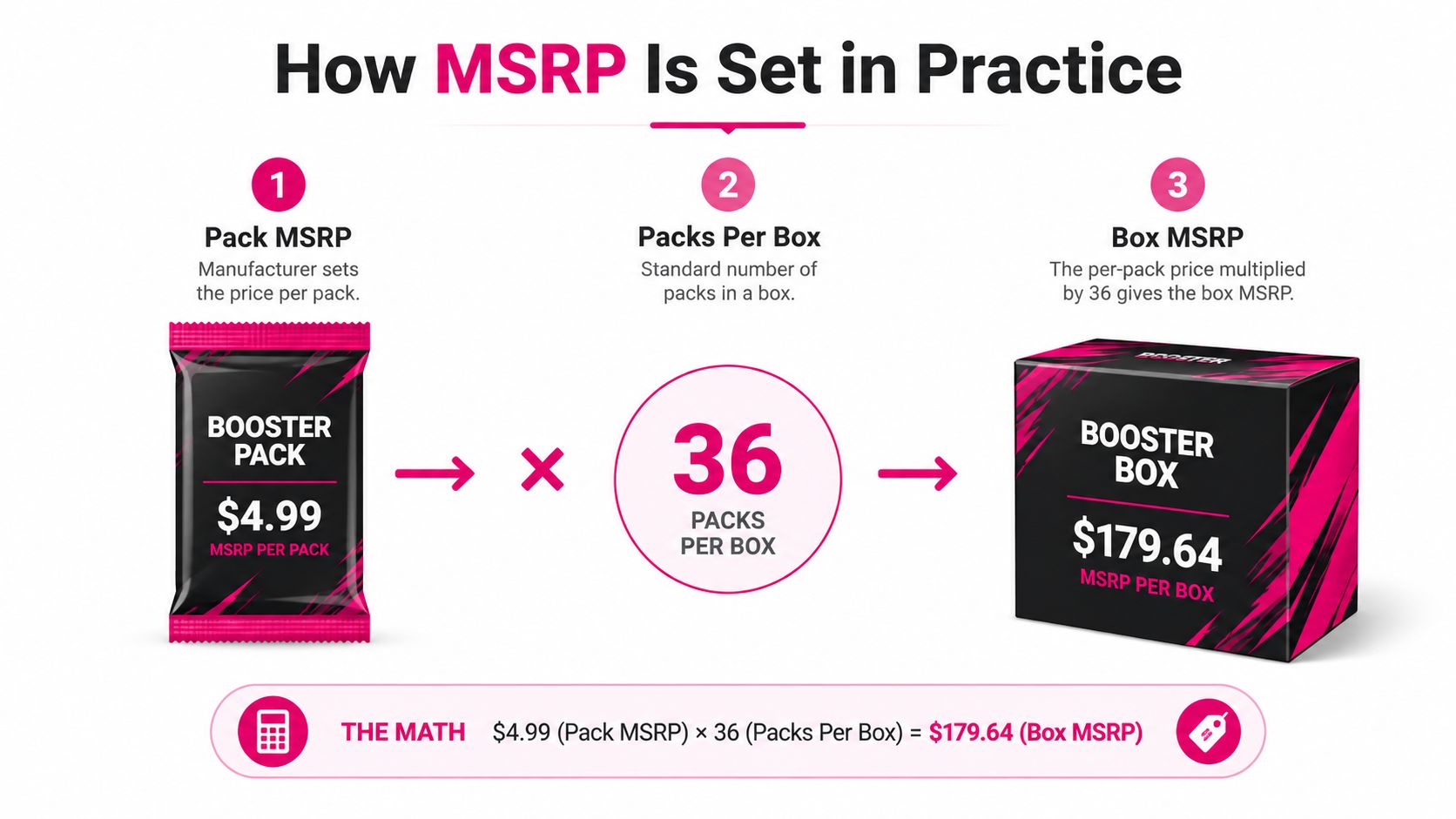
The cleanest way to understand box pricing is to start with the pack and work backward. Pokémon often doesn’t present a standalone box MSRP in the way people expect, so the box number gets reconstructed from the per-pack target. That’s why so many discussions about booster box MSRP end up being math discussions.
The Scarlet and Violet era math
A standard modern Pokémon booster box has 36 packs. If the pack target is $4.49 each, the box target becomes 36 × $4.49 = $161.64. That’s why $161.64 circulates as a box-level target for Scarlet and Violet-era product, even when the box itself doesn’t print a clear standalone MSRP.
That math matters because it shows where the number comes from. The box isn’t priced first, then split into packs. The pack target exists, then the box total follows from it. Once you understand that, the logic stops feeling arbitrary.
Why a pack price change changes the box too
The 2023 Pokémon MSRP discussion tied the box figure to a pack increase from $3.99 to $4.49. That shift matters because a small per-pack change gets multiplied by 36. On a sealed product, that’s how a modest-looking adjustment becomes a much larger box-level move.
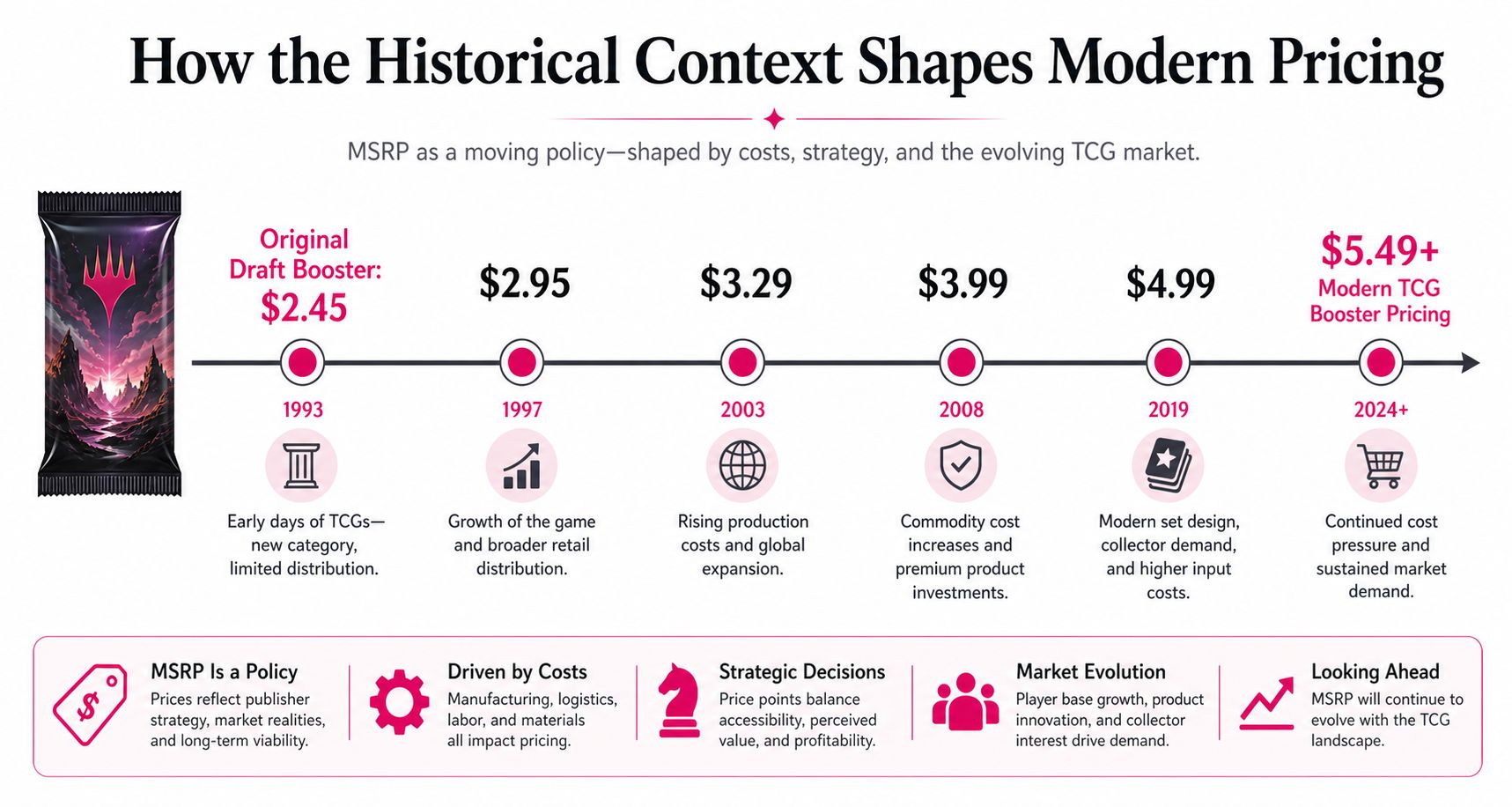
Historical TCG pricing makes the point even more clearly. In Magic: The Gathering, standard draft boosters started at $2.45, then moved to $2.95 in September 1995, $3.29 in October 1999, $3.69 in January 2004, and $3.99 in September 2006, before MSRP was removed entirely in 2019 after another price increase. That timeline shows that MSRP is a policy choice publishers can revise or drop, not a permanent rule.
A box MSRP only looks fixed when you ignore the math behind it. Once the pack price changes, the box target changes with it.
If you want to check the logic from pack to box, the pack-level baseline is the first number to verify, not the last. A useful starting point is this breakdown of Pokémon pack cost, because the box figure only makes sense after you know the pack figure.
MSRP as a Reference Point, Not a Market Price
A box can launch at one number and still trade below or above it almost immediately. That’s the part many collectors miss when they treat booster box MSRP like a final verdict instead of a baseline.
A real modern example
Take Paldea Evolved. It launched in June 2023 at $121.99 MSRP, while research says a pre-release Amazon low was $107.99 and launch pricing averaged near $120 across major retailers such as Walmart and Target. By July 2023, the set had reached roughly $140 to $150, which was a 15% to 23% increase over MSRP in about a month. By December 2024, the same box had moved to roughly $180 to $190.
That sequence shows the real job of MSRP. It marks the starting point for premiums and discounts. It doesn’t cap the market, and it doesn’t guarantee what a buyer will pay later.
Why the gap opens
Supply tightness is one reason. Collector demand is another. Chase-card appeal matters too, because boxes with a stronger pull can hold attention long after launch. Once those forces line up, the market stops caring about the original sticker and starts pricing around availability.
A launch reference is still useful because it tells you whether a listing is cheap, normal, or stretched. A seller asking above launch might still be fair if the sealed market has already moved. A seller asking below launch might be a deal, or it might reflect weak demand in that exact moment.
If you want a clean way to think about it, use MSRP as the origin point on the chart, not the destination. The market decides the destination.
Typical Booster Box MSRP Ranges by Era
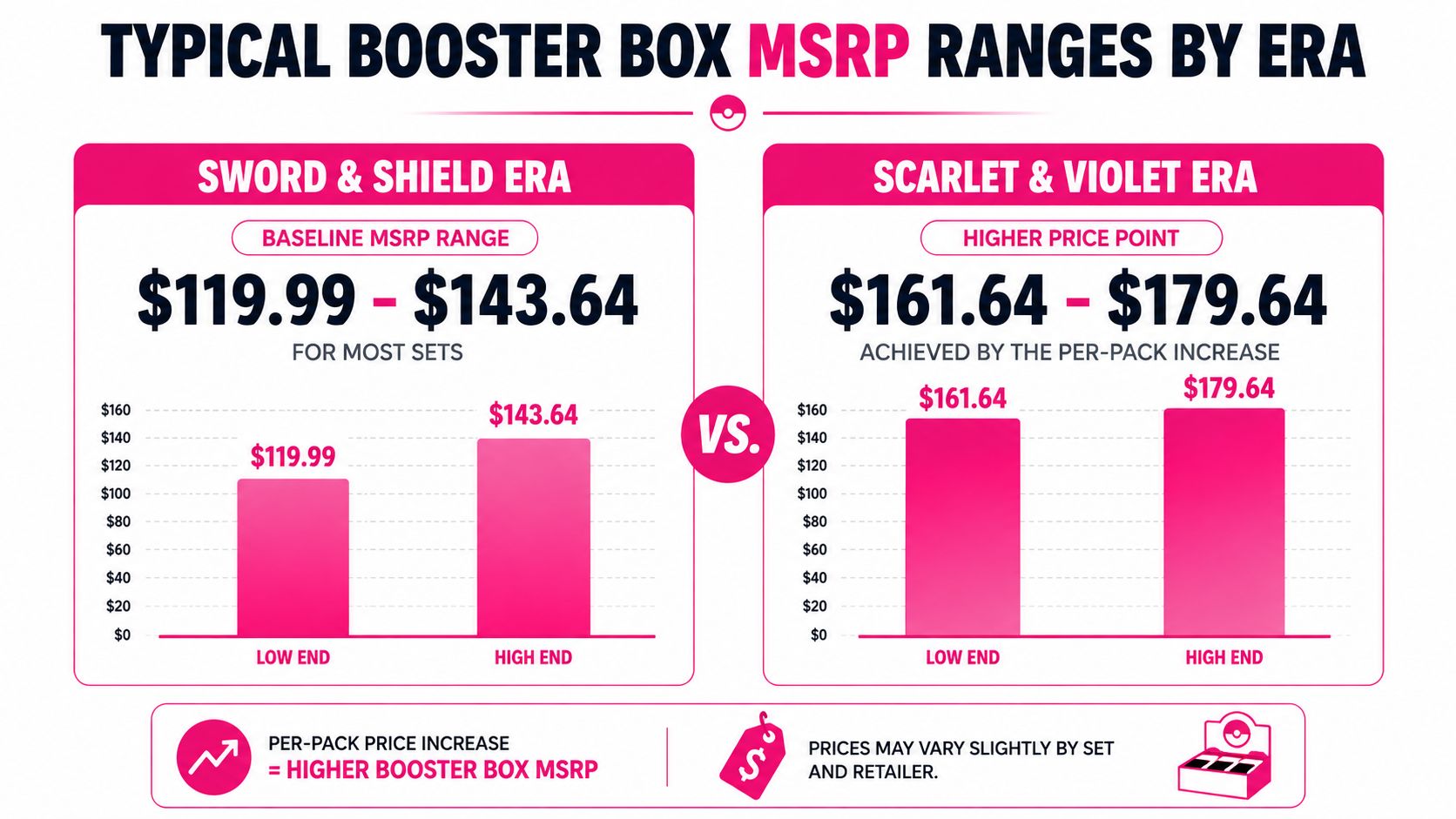
The easiest way to read a sealed listing is to know what “normal” looked like in the era it came from. A modern Pokémon box doesn’t sit in a vacuum, and neither does a vintage one. Prices move with pack structure, release policy, and collector behavior.
A practical range by release era
| Era | How to think about the box price |
|---|---|
| Sword & Shield | Common modern baseline, with current box pricing for most sets around $129.99 to $143.64 depending on the set |
| Scarlet & Violet | Higher pack-based target, often reconstructed at $161.64 from 36 packs × $4.49 (pack math reference) |
| Sun & Moon and early XY | Earlier modern-era boxes sat lower, with sub-$100 figures defining the broader pricing environment in many collectors’ memories, even when launch conditions varied |
| Japanese and multilingual boxes | Separate structure, usually tied to yen-based pricing plus import premiums, so U.S. comparisons can be misleading |
That table gives you a calibrated instinct for whether a listing is normal or off. A box priced like a Scarlet and Violet release shouldn’t be judged against a Sword and Shield memory, and a Japanese box shouldn’t be treated like an English one.
A quick example of why era matters
For a deeper look at sealed value beyond launch MSRP, you can compare your read with this Pokémon booster box value guide. The point isn’t to memorize every historical figure. It’s to spot when a listing sits far outside the usual band for its era.
When MSRP Actually Matters
MSRP is most useful when you’re making a decision, not when you’re admiring a price tag. It helps in three places, and outside those places it’s easy to overrate it.
The three moments where it carries real weight
-
Retail buying: If a marketplace seller is asking above MSRP, the suggested price tells you whether the premium looks modest or stretched.
-
Sealed versus singles: If you’re deciding whether to crack a box, MSRP anchors the comparison between what you paid and what the singles might return.
-
Long-term tracking: If you follow sealed product over years, MSRP is the one baseline that stays consistent across launch windows and retail channels.
The last point matters because it keeps your comparison honest. A box that sold for one price at launch and another price later isn’t “overpriced” just because the second number is higher. You need the historical baseline first, then the current market context.
EV framing beats sticker thinking
Expected value changes the question entirely. A box that returns roughly 40% to 70% of MSRP in opened singles on average can still make sense if the sealed box itself has appreciated. That’s why a $150 box returning around $75 in singles isn’t automatically a disaster, especially if the sealed market has moved to $200 or higher.
Practical rule: Compare the box to both its sealed market price and its singles outcome. MSRP alone can’t tell you whether cracking or holding makes more sense.
That’s the mistake collectors make most often. They treat MSRP as value, when it’s really just one coordinate in the decision. Once you add current sealed price and EV, the picture gets much clearer.
How the Historical Context Shapes Modern Pricing
MSRP has never been a fixed law of nature in trading cards. It’s a policy choice, and publishers adjust it when costs, distribution, and buyer behavior change. Magic: The Gathering gives the cleanest long-run example because the changes were public and gradual.
The long arc of suggested pricing
The draft booster history moved from $2.45 to $2.95 in 1995, then $3.29 in 1999, $3.69 in 2004, and $3.99 in 2006. In 2019, MSRP was removed entirely after a price increase. Those shifts show a steady pattern, not a one-time exception. Publishers raise suggested prices when the market can absorb it, and they stop publishing MSRPs when that framework no longer serves them. (historical pricing discussion)
What that means for Pokémon collectors
Pokémon doesn’t exist outside that larger hobby pattern. When modern booster boxes are discussed in terms of launch MSRP versus current market value, collectors are really comparing a policy anchor to a live market. That’s why a current number can feel stable for a while, then look outdated later.
If you keep that history in mind, you stop expecting MSRP to stay frozen. You start reading it as a snapshot of launch policy. That makes you less likely to panic at a premium and less likely to assume a discount is automatically a bargain.
The smartest sealed-product buyers don’t worship MSRP and don’t ignore it either. They treat it as a moving reference point shaped by real publishing decisions, then compare it to today’s shelf price and today’s EV.
Putting MSRP to Work in Your Buying Decisions
A good buying process doesn’t start with “Is the box expensive?” It starts with “What number am I comparing it to?” That’s where booster box MSRP earns its keep.
A simple mental checklist
-
Confirm the pack count and pack MSRP. A modern English box is typically a 36-pack product, and the pack figure tells you whether the box target is likely to be around $121.99, $143.64, or $161.64 depending on the era.
-
Derive the box MSRP. If the set uses per-pack pricing, do the multiplication yourself so you know where the box number came from.
-
Compare it to current sealed market price. The current market tells you whether the box is trading at a premium, at a discount, or near launch logic.
-
Run an EV check. If the singles don’t justify cracking, sealed might make more sense, and if the sealed market is already above launch, the decision changes again.
For current sealed and singles context, Double Holo’s marketplace and analytics tools are built for that kind of decision work. If you’re cross-checking a box, Buy Pokémon Booster Box is the kind of practical buying reference that pairs well with live market data and pack math.
The bottom line for collectors
MSRP is the starting line, not the finish line. It tells you what the publisher thought the product should cost at launch, then the market takes over. Once you know how to reconstruct the number, you can spot overpriced listings faster and make cleaner calls on sealed versus singles.
Double Holo gives collectors and sellers a live marketplace plus market intelligence tools that help turn launch pricing into a real buying decision. If you want to compare sealed product against current market ranges, check the live data, then visit Double Holo and use the numbers before you make your next box purchase.