

You find a vintage Pokémon box listing at midnight, the photos look clean, the seller sounds confident, and the price is high enough that one mistake would sting. That’s the critical decision point for most buyers of a pokemon vintage booster box, not whether the set is nostalgic, but whether the seal is authentic, the price makes sense, and you’ll be able to sell it later without taking a painful haircut.
Table of Contents
Why Vintage Booster Boxes Demand Serious Due Diligence
A collector can stare at a glossy listing for a pokemon vintage booster box and still have no idea what’s being sold. The box may look spotless, the seller may say “untouched,” and the photos may be taken under perfect light, but none of that proves the seal is original or that the set matches the asking price.
The first problem is authenticity
Vintage sealed product is where small mistakes become expensive. A single compromised seal can wipe out the premium, because buyers aren’t paying only for cardboard and packs, they’re paying for the right to own a factory-sealed artifact from the early hobby era.
Practical rule: if a listing does not give you enough evidence to feel slightly paranoid, it probably doesn’t give you enough evidence to buy.
The second problem is valuation. Vintage boxes don’t trade like a generic collectible where every copy behaves the same. Different sets, print runs, release eras, and condition levels all push prices in different directions, and the gap between “expensive” and “overpriced” gets wide fast.
The third problem is exit planning. Plenty of guides talk about history or nostalgia, but far fewer explain how a seller gets out of a position when they need cash, who the buyer pool is, and how much friction appears at the point of resale. That gap matters because a five-figure sealed box isn’t a casual flip, it’s a commitment of capital.
A good buy starts with three questions. Is the box authentic, is the price anchored to real market behavior, and can you exit on acceptable terms if you need to? If the answer to any of those is fuzzy, the listing deserves more scrutiny before you even think about bidding.
What Qualifies as a Vintage Pokemon Booster Box
A sealed box counts as vintage when it sits inside the early print era, roughly 1996 to 2002, which covers the Base Set period and the first expansion waves. English sealed booster boxes first show up in 1999 with Base Set First Edition, while the earliest Japanese Pokémon cards trace back to 1996 vinticards.nl. That split matters because English and Japanese sealed product do not carry the same supply history, buyer pool, or resale behavior.
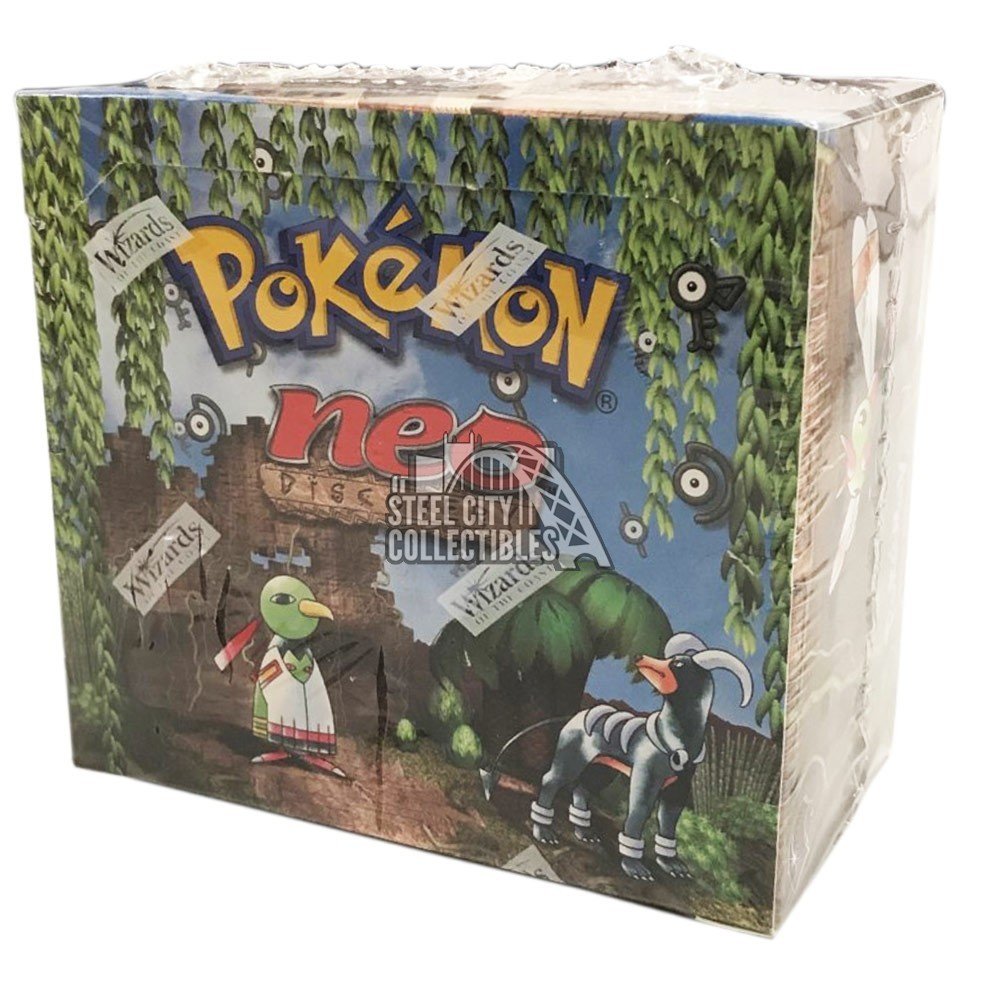
Neo Discovery Booster Box
The vintage window and why it matters
The 1996 to 2002 window is more than a label collectors repeat. It captures the original launch era and the years when Pokémon moved from a niche release to broad mass circulation. Early Pokémon TCG history research notes that from October 20, 1996 to the end of March 1997, 87 million cards were shipped in Japan. That kind of volume explains why untouched sealed boxes are scarce now, especially when buyers want examples that still look original and have not been handled badly.
For a buyer, the boundary is practical. Sealed product from this era is usually treated less like ordinary consumer stock and more like a surviving piece of hobby history. The box reflects the original print run, the regional release pattern, and the distribution conditions of the time. That is why serious buyers talk about it differently from modern sealed product, and why condition, originality, and provenance all matter before a deal is signed.
Set eras and sealed-product context
A standard English booster display box contains 36 packs. That structure gives buyers a fixed frame for evaluation, because the box is a complete sealed unit rather than a loose pile of packs with uncertain handling history.
Sealed product from this era is often discussed with terms like First Edition, Unlimited, and Shadowless, but those labels do not carry the same weight in every buying situation. For a sealed box, the wrap, the box style, and the print-era indicators matter more than card-level grading language, since the contents are still unopened. A box can be valuable for what it is and for what it may contain, but those are not the same question.
For a closer comparison with Japanese sealed product, the Japanese booster box comparison guide is useful because it shows how regional sealed history differs without blending the English and Japanese markets.
Understanding Sealed Box Architecture and Collation
A vintage Pokémon booster box isn’t just a display piece, it’s a sealed container with a very specific structure. Standard English display boxes contain 36 packs, and classic packs hold 10 to 11 cards depending on era. That makes the box mechanically predictable in a way loose sealed product isn’t.
Why the box structure matters
The architecture of the box helps collectors check whether a listing makes sense before they ever touch the seal. If the size, pack count, or general handling cues look wrong, the risk jumps. A factory-sealed box preserves the original pack distribution, which is why buyers care about it as a complete unit instead of valuing it as a loose aggregate of singles.
Practical rule: a sealed box is valuable because the collation is untouched. Once you treat it like an opened bundle of packs, you’ve already missed the point of the premium.
That predictability also matters for inventory modeling. A seller who understands the box’s sealed architecture can think clearly about condition, storage, and verification. A buyer who doesn’t will often overpay for presentation and underweight structural clues.
How sealed collation affects value
The value proposition comes from randomness plus preservation. Buyers aren’t just purchasing cardboard, they’re purchasing a sealed chance at untouched original distribution. That chance is why authenticity questions hit so hard. If the seal was compromised, the entire value logic shifts.
A box with the right architecture can still be wrong in practice, which is why structure is necessary but not sufficient. You want to confirm the outer box aligns with the era, the wrap looks right, and the box hasn’t been manipulated to hide internal access. The vintage box value guide is useful here because valuation and structure have to be read together, not separately.
The most useful habit is to treat box anatomy like an audit trail. If the shell, pack count, and era indicators all agree, you’ve removed one major source of risk. If one of them is off, keep asking questions.
How to Authenticate a Vintage Booster Box Before Buying
Authentication starts with the seal, but it doesn’t end there. Buyers who only zoom in on shrink wrap often miss the broader picture, which includes box condition, seller history, and whether the story around the item fits the physical evidence. That’s why sealed vintage product deserves a different standard from modern product.
Seal and box-condition checks
Start with the wrap. Original factory wrap and aftermarket reseals don’t usually present the same way, especially around seams, corners, and tension points. Look for wrap that sits naturally on the box rather than wrap that appears stretched, overly tight, or uneven at the folds.
Then check the cardboard itself. Vintage boxes should show age in a believable way, with wear patterns that match storage and handling rather than artificial distressing. Sharp corners, consistent printing, and clean edges can be good signs, but they need to be read alongside the seal, not in isolation.
Use a focused checklist:
-
Seal Integrity: look for shrink patterns that feel uniform and factory-applied.
-
Box Art Precision: inspect print sharpness, font consistency, and any odd fading.
-
Dimensions and Weight: compare the feel of the box against a known authentic reference if possible.
-
Flap and Seam Condition: examine whether the folds look opened, pressed, or reworked.
-
Barcode and Printing: make sure the back panel details look coherent with the era.
The most common mistake is trusting one clean photo. Ask for multiple angles, especially the corners, bottom, and top seam. If the seller resists, that resistance is itself data.
Provenance and expert review
A box with good provenance is easier to trust than a box with a vague story. Original receipts, chain-of-custody details, and prior ownership history matter more in vintage than in modern sealed product because the upside on a compromised box is so much lower. That’s where many listings fall apart.
The market has clearly recognized that risk. Independent guides on vintage Pokémon packs stress authenticity checks because sealed WotC-era product commands serious premiums, yet they still don’t answer the buyer’s hardest question, how to separate original from resealed or repackaged stock. That’s the gap a buyer has to close personally.
For a second opinion, use an expert who understands sealed WotC-era packaging rather than assuming any third-party service can solve the issue alone. A service can support your decision, but it doesn’t replace judgment. If the item will cost five figures, the burden of proof should stay high.
A practical buying workflow is simple. Verify the seal, verify the box shell, verify the paperwork, then compare the listing to the seller’s behavior. If those four things don’t line up, walk.
For a broader purchase framework, the buying guide for booster boxes gives a useful complement to the authentication process.
Market Valuation and Record-Breaking Sales Benchmarks
The cleanest way to set expectations is to start with real transactions, not forum guesses. Heritage Auctions reported that a sealed Pokémon First Edition Base Set booster box sold for $408,000 on January 15, 2021, and described it as a world-record result at the time Heritage Auctions. That result shows how far a verified box can go when the pedigree is clean, the collector pool is deep, and the auction house can put the right eyes on it.
What the sales data shows
Earlier market reporting noted that a 1999 Base Set 1st Edition booster box sold for $60,200 on eBay in November 2018 after more than 64 bids. That comparison matters because it shows how fast the top end moved in a short span, not as theory but as a documented market result.
Other vintage boxes reached five-figure territory too:
| Set and Edition | Sale Price | Date | Platform |
|---|---|---|---|
| Pokémon First Edition Base Set booster box | $408,000 | January 15, 2021 | Heritage Auctions |
| 1999 Base Set 1st Edition booster box | $60,200 | November 2018 | eBay |
| 2003 Skyridge booster box | $15,995 | Not specified in verified data | Not specified in verified data |
| 2004 Team Rocket Returns booster box | $14,100 | Not specified in verified data | Not specified in verified data |
| 2002 Legendary Collection booster box | $9,050 | Not specified in verified data | Not specified in verified data |
Those records are useful anchors, but they do not mean every vintage box moves the same way. They define the ceiling, not the floor.
Why some vintage boxes command more
The main drivers are easy to name and hard to manufacture. Print-run scarcity, condition scarcity, and historical significance all matter. The first edition Base Set run stands out because the launch was limited and sold out quickly before the unlimited run followed, which helped create the modern premium around true sealed survivors.
Practical rule: use the headline sales as anchors, not targets. A record box does not justify every asking price in the category.
Regional demand matters too. These sales are relevant across the U.S., Europe, and Asia because they help frame sealed-product valuation, but local depth still differs by market and language. A seller should not assume one auction result proves a fast exit at that same number.
For a tighter read on how asking prices stack up against market norms, the booster box value reference is a useful companion to the raw sales record.
Liquidity Realities and Exit Strategy Planning
Vintage booster boxes attract investors partly because the numbers look strong on paper, but liquidity is the part most buyers underestimate. A box can be valuable and still be hard to sell quickly. That tension is why the right question is not only “what is it worth?” but also “how long will it take to convert into cash?”
What resale speed really looks like
The public conversation around vintage sealed product is shifting from simple appreciation narratives toward price discovery and supply thinning. Recent market discussion asks what happens when vintage supply dries up, which is a better question than hunting for the next undervalued set because it focuses on actual demand depth Reddit discussion. That shift tells you something important, buyers are thinking about scarcity, but also about who will still be there to buy later.
A trophy asset can sit for a long time and still be a rational hold. A liquid asset usually has many active buyers, clear comps, and a narrow spread between what people ask and what people pay. Vintage sealed boxes often sit closer to the trophy side than buyers expect.
The hardest sale is rarely the first one listed. It’s the one where you need cash fast and can’t wait for a perfect auction audience or an ideal collector with the exact set preference you need. That’s where discounts appear.
Planning for an exit before you buy
A good exit plan starts before the purchase. Decide whether you’d rather sell through auction, a marketplace, a dealer, or a private collector network, because each route has a different balance of speed, certainty, and friction. If you don’t know which route you’d use, you don’t yet know what the box is worth to you.
Use these decision points:
-
Time Horizon: buy only if you can hold through slow resale windows.
-
Market Depth: check whether the set has a real buyer base or only headline attention.
-
Documentation: keep the provenance file intact so the next buyer doesn’t have to start from zero.
-
Price Flexibility: decide in advance how much discount you’d accept for speed.
-
Channel Fit: match the item to the sale venue, since not every buyer pool values every box the same way.
The right mindset is disciplined, not emotional. If the box is a passion purchase, own that. If it’s an investment, underwrite the exit before you underwrite the buy.
Your Vintage Booster Box Decision Framework
A serious pokemon vintage booster box purchase comes down to three checks. First, the item has to pass the authentication test, with a seal, box shell, and provenance story that all make sense together. Second, the asking price has to fit real market behavior, not a hopeful reading of the category’s best sale.
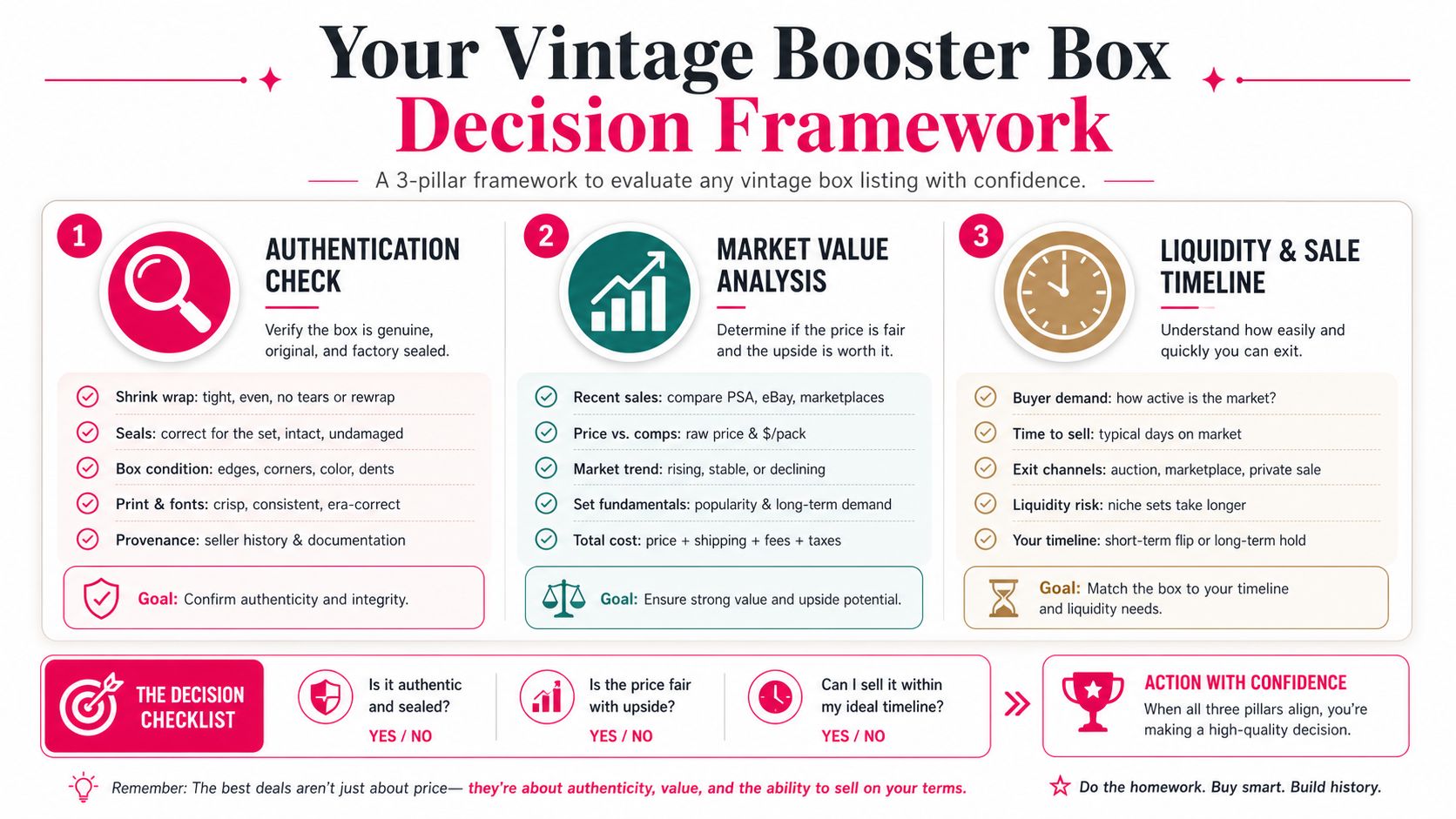
The buying checklist that actually matters
-
Confirm the era: make sure the box sits in the accepted vintage window and matches the set’s release context.
-
Inspect the structure: verify the 36-pack sealed architecture and look for anything that disrupts the factory feel.
-
Pressure-test the seal: ask for seam shots, corner shots, and angles that make manipulation harder to hide.
-
Verify provenance: keep receipts, seller messages, and ownership history together.
-
Anchor the price: compare the listing against verified sales, not forum optimism.
-
Plan the exit: decide how long you can hold and how you’d sell if you had to move fast.
Practical rule: if you wouldn’t be comfortable explaining the box to another collector, you’re probably not done due diligence yet.
A disciplined buyer separates hobby joy from speculative impulse. Both can be valid, but they shouldn’t be confused with each other. If the box still feels right after the authentication review, the sales comparison, and the exit check, then it’s a real candidate.
Double Holo gives collectors a place to compare sealed product with live market context, track price behavior, and manage buying or selling decisions more deliberately. If you’re sizing up a vintage box and want a more structured way to approach the market, visit Double Holo and use the tools that help serious collectors move with more confidence.